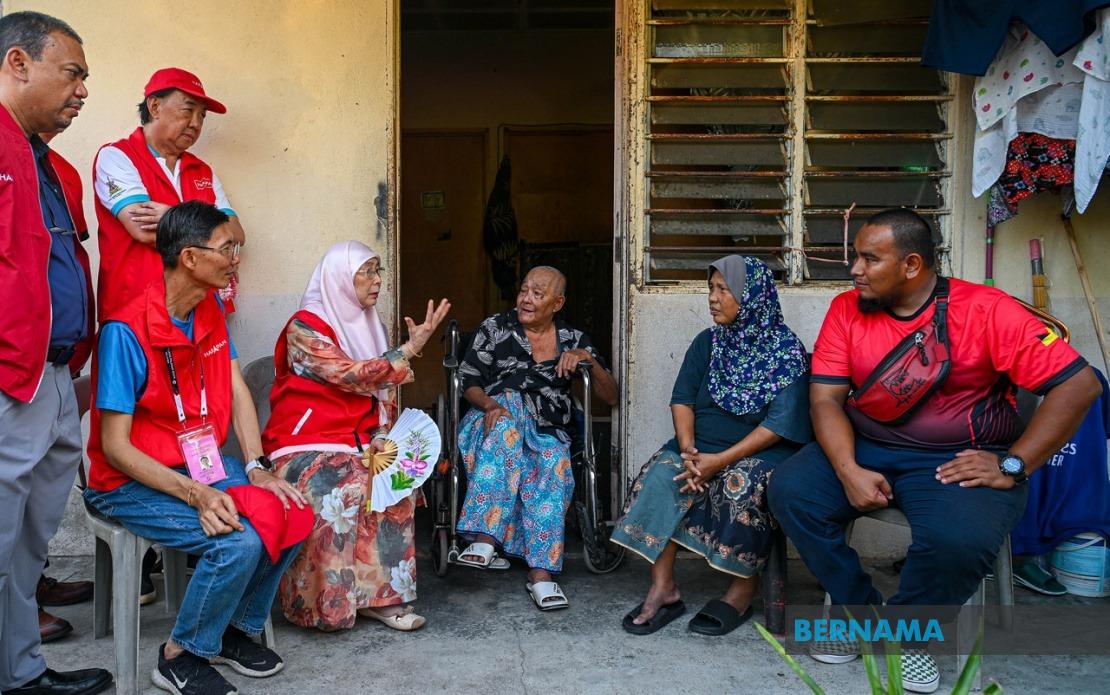
Pakatan Harapan's efforts to connect with constituents took on a personal dimension when party leader Wan Azizah made an unscheduled visit to the modest home of an elderly couple in the Chuah state constituency, underscoring the grassroots dimension of the party's campaign strategy ahead of the August 1 polling day in Negeri Sembilan. Accompanying her was Datuk Yew Boon Lye, PH's candidate in the straight fight against Perikatan Nasional's Pau Jeou Ching, who has maintained a visible presence in the community through such door-to-door outreach initiatives.
The two spent roughly twenty minutes at the residence of Zaiton Hasan, 60, and her husband Paimin Sapari, 71, engaging directly with the residents about their living conditions and the obstacles they navigate daily. The visit revealed the household's struggles with chronic health ailments: Zaiton contends with high blood pressure whilst Paimin manages diabetes, conditions that often correlate with medical expenses that strain household budgets in rural and semi-rural constituencies across Malaysia. For many voters in similar circumstances throughout Negeri Sembilan, healthcare costs compete with basic necessities, making the visibility of political leaders in such contexts symbolically important even as policy solutions remain complex.
The emotional resonance of the encounter was evident in Zaiton's subsequent remarks to BERNAMA. "This is the first time a major leader has come to my house and I feel like it's a dream," she said, reflecting a broader sentiment among rural Malaysians who often feel disconnected from national political figures. Her gratitude extended to both Wan Azizah and Yew, whom she characterised as displaying genuine warmth and attentiveness. The comment illustrates how high-profile visits, regardless of their policy outcomes, can carry psychological weight for constituents accustomed to minimal political engagement at the leadership level.
Beyond the symbolic gesture, the visit yielded tangible material assistance. The Port Dickson People's Spirit Welfare Association presented Paimin with a wheelchair, a practical intervention that addresses his mobility constraints and potentially improves his daily quality of life. Such welfare contributions, whilst modest in financial terms, represent a bridge between political campaign activity and community service delivery, demonstrating how electoral engagement can intersect with social support mechanisms. For households managing multiple health conditions on limited resources, such donations alleviate pressure that might otherwise fall entirely on family members.
The timing of the visit reflects the intensifying campaign schedule as Negeri Sembilan approaches its electoral moment. The 16th state election has drawn clear battle lines, particularly in constituencies like Chuah where straight fights between PH and PN candidates will likely determine the broader state outcome. Yew's presence alongside Wan Azizah signals the party's determination to consolidate its support base, particularly among lower-income voters who have traditionally formed part of PH's coalition. The personal attention to elderly voters facing hardship sends a message that the coalition prioritises vulnerable demographics, a positioning that matters in a state where economic disparities remain pronounced.
Negeri Sembilan's electoral calendar has already commenced its formal phase. The Election Commission designated July 28 for early voting, allowing certain categories of voters—including those with mobility challenges, election officials, and security personnel—to cast ballots before the main polling day. This staggered approach occasionally generates strategic considerations for political campaigns, as early voting patterns can provide preliminary indicators of electoral momentum. By August 1, all registered voters will have had the opportunity to participate, determining whether PH can maintain its foothold in the state or whether PN will make territorial gains.
The encounter between Wan Azizah and the elderly couple exemplifies a campaign dynamic increasingly visible across Malaysian politics: the tension between large-scale political messaging and intimate community engagement. National leaders face pressure to maintain high visibility whilst state and local candidates must cultivate ground-level support through personal connections and responsiveness to constituent needs. For Yew, the endorsement from a prominent PH figure carries institutional weight, potentially influencing undecided voters whilst reinforcing party discipline among grassroots supporters. Simultaneously, the visit demonstrates PH's awareness that electoral victory in Negeri Sembilan depends not solely on policy pronouncements but on demonstrated commitment to individuals facing everyday challenges.
The broader context of Negeri Sembilan politics cannot be separated from these local interactions. The state has experienced significant political volatility over recent years, with shifting coalitions and leadership transitions creating uncertainty about governance direction. Constituencies like Chuah may ultimately determine whether the state veers toward PH continuity or PN transition. Voters evaluating their choices often weigh direct impressions of candidates and leaders alongside party platforms, making the human dimension of campaigning consequential for outcomes. Zaiton and Paimin represent demographic segments—elderly, health-burdened, economically vulnerable—whose electoral preferences could prove decisive in tight contests.
For regional observers monitoring Malaysian politics, such grassroots engagement illustrates how contemporary electoral campaigns integrate symbolic politics with material welfare provision. Political parties increasingly recognise that community trust builds through visible leadership attention combined with concrete assistance. Whilst a single wheelchair or one pastoral visit cannot resolve structural poverty or healthcare access challenges, these interventions signal alignment with constituent interests and create platforms for ongoing political dialogue. In Negeri Sembilan's competitive environment, such moments accumulate to shape voter perceptions and ultimately determine electoral fortunes.

