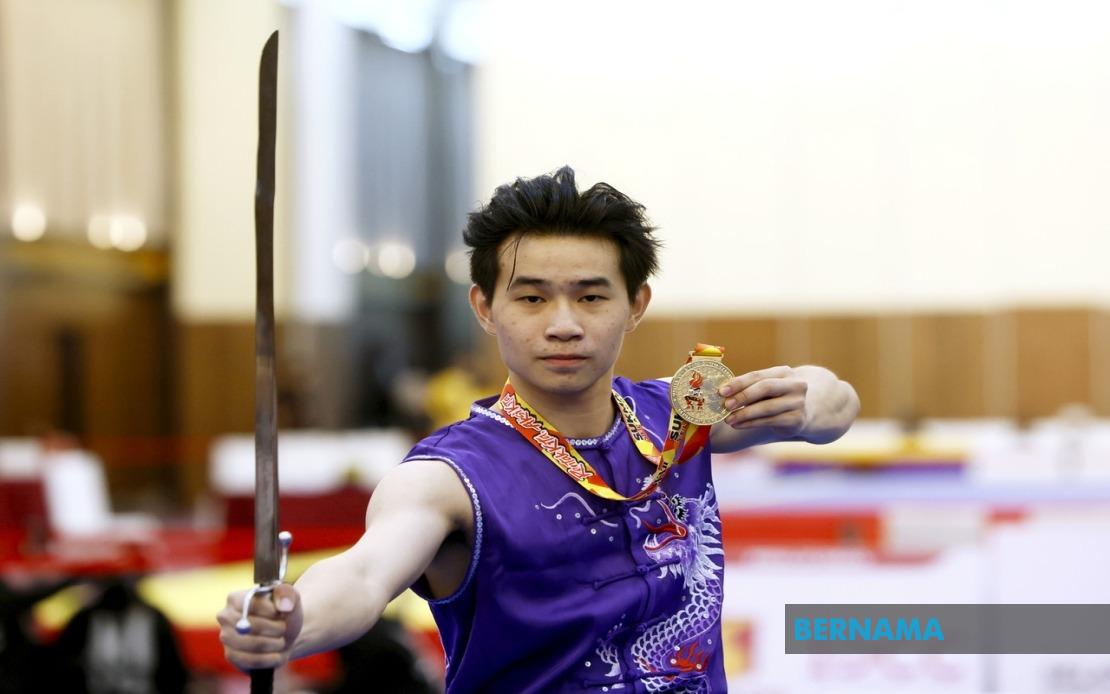
Wee Din Jun's journey to the podium at the 2026 Malaysia Games has been anything but straightforward, yet the Penang wushu competitor managed to transform adversity into triumph on Wednesday at Shah Alam's Ideal Convention Centre. The 21-year-old Bayan Lepas native earned gold in the men's nandao nangun competition with a commanding score of 9.600 points, punctuating what has proven to be an emotionally charged progression through his three appearances at Southeast Asia's premier multi-sport event.
The achievement carries particular weight given the physical challenges Din Jun has navigated in recent weeks. A hip injury sustained approximately one month before the Games' commencement threatened to derail his participation entirely, yet the athlete's determination to compete in his final SUKMA appearance proved stronger than the setback. His winning margin was decisive—silver medallist John Phang of Sarawak finished with 9.563 points, while Selangor's Tan Yu Zhe claimed bronze with 9.550 points, demonstrating the calibre of opposition Din Jun overcame.
For Malaysian wushu enthusiasts and regional sports observers, this victory represents far more than a single gold medal. Din Jun's trajectory across his three SUKMA campaigns illustrates the often turbulent path elite young athletes navigate in pursuit of excellence. His debut at SUKMA 2022 in Kuala Lumpur yielded a bronze medal—a respectable start that promised greater achievements to come. However, that optimism dissipated dramatically at the 2024 edition held in Sarawak, where technical lapses across three events left him returning home empty-handed, a bitter pill for an athlete of his evident talent.
The psychological toll of that previous disappointment cannot be understated. Emerging young competitors in Southeast Asian sports frequently struggle with the mental dimensions of elite competition, where the margin between success and failure often hinges on composure and focus under pressure. Din Jun's struggle at SUKMA 2024 appeared to represent such a critical juncture—a moment where momentum shifted decidedly against him, threatening to define his Games legacy before he had reached his athletic prime.
What unfolds in the aftermath of such setbacks frequently determines an athlete's long-term trajectory. Din Jun's approach to his final Games appearance, by his own account, reflected a deliberate psychological recalibration. His coaching staff advocated for emotional equilibrium and performance-focused mindfulness rather than outcome obsession—a distinction that sports psychology research consistently identifies as pivotal for competitors struggling to break through performance plateaus. By concentrating exclusively on execution quality rather than medal outcomes, Din Jun created the mental framework necessary to deliver his best performance when it mattered most.
The redemptive narrative takes on additional significance within Malaysia's sporting context. Wushu remains a discipline where Southeast Asian athletes, particularly those from Malaysia and Singapore, have demonstrated genuine competitive prowess at regional and international levels. Din Jun's gold medal contributes to building sustained excellence in the sport domestically, establishing a template for younger practitioners aspiring toward SUKMA podiums and beyond. His victory also underscores the depth of wushu talent emerging from Penang, a state with a robust martial arts tradition.
Din Jun's decision to dedicate his achievement to a former coach who has since relocated to China adds another layer of emotional resonance to the narrative. Coaching relationships frequently prove transformational for developing athletes, and the inability to share previous competitive achievements with influential mentors creates lasting regret. This gold medal effectively bridges that gap, offering retrospective vindication of the coaching guidance and support that shaped his technical development, even as those figures have moved beyond Malaysia's borders.
Looking ahead, Din Jun's competitive calendar immediately extends beyond this nandao nangun triumph. The nanquan event scheduled for the following day presents an opportunity to construct an even more accomplished final SUKMA appearance, potentially doubling his medal haul and cementing a more prominent legacy than his two prior Games experiences would have suggested. Multiple medals across wushu disciplines would substantially elevate his standing within Malaysian sporting circles and demonstrate the breadth of technical capability that distinguishes truly elite practitioners.
Beyond the immediate competition framework, Din Jun's comeback trajectory carries instructive implications for Malaysian sports development more broadly. Athletes confronting injury, poor performances, or extended struggles frequently require clear pathways toward redemption rather than permanent relegation from high-level competition. The structure of the Games system, which provides multiple opportunities for athletes to compete and improve across successive editions, theoretically enables precisely this kind of recovery narrative. Din Jun's success validates that system's utility, particularly for younger competitors navigating the volatile early stages of elite athletic careers.
The broader Southeast Asian sporting context amplifies the relevance of Din Jun's achievement. Regional competitions serve as crucial proving grounds where athletes from smaller nations establish competitive credentials and gain valuable experience against internationally calibrated opposition. Wushu events at SUKMA draw strong entries from across the region, making victories in such contexts meaningful indicators of technical proficiency and mental resilience rather than hollow domestic achievements.

