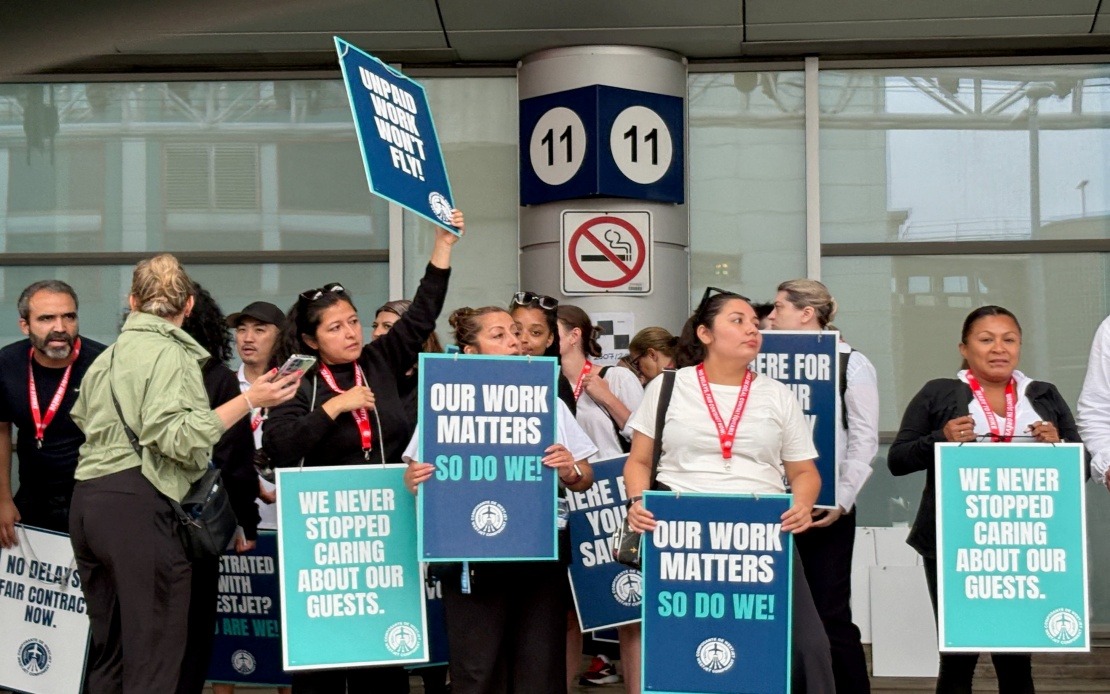
The industrial action at WestJet, Canada's second-largest carrier, commenced on Sunday when more than 4,000 flight attendants walked off the job, triggering the suspension of roughly 600 flights each day and upending travel arrangements for an estimated quarter-million passengers. The timing of the dispute could hardly be worse for the airline and its customers, with Monday marking a civic holiday that typically ranks among the busiest travel periods in Canada's annual calendar. Industry analysts project the disruption will extract a substantial financial toll on WestJet, with costs measured in millions of dollars as the company grapples with operational paralysis and cascading cancellations.
At the heart of the labour dispute lies a fundamentally structural disagreement regarding compensation frameworks. Flight attendants are demanding payment for preparatory and concluding work performed on the ground before departure and following arrival, duties that critics argue have long been overlooked in standard employment agreements. This issue has gained prominence in North American aviation only recently, with Delta Air Lines pioneering the practice in 2022 by introducing dedicated compensation for ground-based labour. Air Canada subsequently adopted similar provisions this past February under a newly negotiated contract, establishing a precedent that has emboldened unionised crews at other carriers to pursue comparable arrangements.
The striking workers represent members of the Canadian Union of Public Employees, whose leadership has characterised the impasse as a result of management intransigence. Union representative Alia Hussain issued a pointed statement, declaring that the union would not have resorted to industrial action had WestJet demonstrated genuine responsiveness to workforce concerns throughout the extended bargaining period. The negotiation process has stretched across nearly eleven months without yielding breakthrough agreements, suggesting entrenched positions on both sides that resist easy compromise. The prolonged nature of talks hints at deeper philosophical differences about how airlines should value and remunerate workforce contributions beyond the conventional in-flight service model.
Current compensation structures at WestJet reflect the traditional aviation industry approach, with flight attendants earning hourly rates spanning from $28.88 to $53.61 per credit hour depending on seniority and experience levels. These figures stand in contrast to the newly established Air Canada framework, which provides flight attendants with compensation equivalent to as much as seventy percent of their standard hourly wage for the preparatory hour immediately preceding aircraft departure. Such disparity creates competitive pressure within Canada's airline sector, as talented personnel gravitate toward employers offering superior remuneration packages and more comprehensive recognition of their labour contributions.
Federal Jobs Minister Patty Hajdu expressed official disappointment through social media channels, noting that the failure of both parties to reach settlement following protracted negotiation efforts represented a missed opportunity for avoiding disruption. Her public intervention underscores the government's stake in resolving labour conflicts affecting critical transportation infrastructure and consumer mobility during peak travel seasons. The minister's statement signals potential federal interest in facilitating resolution, though Canadian labour law typically restricts government involvement to specific circumstances or formal mediation mechanisms.
WestJet's leadership has acknowledged the gravity of the situation while defending its negotiating position. Chief Executive Alexis von Hoensbroech conveyed regret regarding the strike's commencement, emphasising the cascading impacts on passenger travel plans, employee morale, and the network of communities and commercial partners dependent on the airline's operations. The company committed to providing refunds to affected travellers, attempting to mitigate reputational damage and customer frustration during an extended service interruption. Nevertheless, such remedial measures cannot fully compensate for missed connections, disrupted vacations, or cancelled business engagements.
The WestJet situation reflects broader sectoral trends across North American aviation, where flight attendants have increasingly mobilised to demand modernised compensation models acknowledging the full scope of their professional responsibilities. The precedent established by Delta and Air Canada has fundamentally altered expectations throughout the industry, compelling carriers to reassess historical compensation frameworks that confined paid work to in-flight service hours. Regional airlines and carriers lacking substantial union representation face mounting pressure to voluntarily improve compensation to retain experienced personnel and maintain competitive positioning.
For Malaysian and Southeast Asian readers, the Canadian strike offers instructive lessons regarding labour relations in aviation during the region's own post-pandemic recovery. As airlines across Asia resume expansion and hiring accelerates, questions of fair compensation and recognition of diverse job functions become increasingly salient. Many Southeast Asian carriers have yet to implement systematic compensation for ground-based flight attendant work, potentially creating labour friction as international experience raises workforce expectations. The Canadian experience demonstrates that delay in addressing such compensation gaps typically results in more costly labour disputes rather than preventing them.
The geographic and temporal coincidence of the strike with a major holiday weekend amplifies both the strike's effectiveness as a bargaining tool and the public impact, potentially accelerating settlement prospects through mutual recognition that prolonged disruption serves neither party's interests. Airlines operating within heavily unionised jurisdictions like Canada face structural constraints that distinguish their labour relations environment from many Southeast Asian carriers where union representation remains less comprehensive. Nevertheless, the underlying principles regarding fair compensation for expanded job definitions transcend regional boundaries and may presage similar demands across Asia-Pacific aviation as globalisation exposes workers to international standards.
The resolution of this dispute will significantly influence labour relations trajectories across Canadian aviation and potentially establish benchmarks for international carriers operating in multiple jurisdictions. If WestJet ultimately accedes to ground work compensation demands, the precedent may accelerate similar concessions at other carriers facing unionised workforces. Conversely, a protracted strike that exerts mounting financial pressure on the company could demonstrate management's capacity to withstand labour pressure, potentially deterring similar actions elsewhere. Most likely, a negotiated settlement will emerge that partially accommodates flight attendant demands while preserving airline operational flexibility, reflecting the typical outcome of labour disputes where both parties possess meaningful bargaining leverage.

