For more than two decades, New York City has been conducting an ambitious experiment in youth empowerment and urban design: letting schoolchildren lead the transformation of their own playgrounds. The results have been extraordinary. Since 2002, the Community Schoolyards programme—a collaboration between the Trust for Public Land, the city's education department, and environmental officials—has overseen the construction of 225 student-designed recreational spaces across the city. The investment has exceeded US$200 million (RM815.6 million), funded through a combination of government allocations and private philanthropy. What emerges from this initiative is not merely a collection of better play facilities, but a profound shift in how cities can engage young people in solving the problems of their own neighbourhoods.
The process itself represents an inversion of how urban design typically functions. Rather than professional architects imposing visions from above, students serve as junior landscape designers, driving every major decision. The methodology is deliberately structured to balance imagination with practical constraints. Young people begin by creating wish lists unfettered by budgetary reality—swimming pools, chocolate fountains, merry-go-rounds, koi ponds—before engaging in the disciplined work of prioritisation and compromise. They measure spaces, map existing conditions, and create detailed designs. Critically, the process incorporates input from teachers, parents, and neighbours, with the wider community voting on final plans. This approach does more than produce better playgrounds; it teaches young people that meaningful civic participation requires both dreaming boldly and negotiating realistically with competing interests.
The playgrounds themselves reflect a sophisticated understanding of the social dynamics that shape how children actually use public space. At one Bronx facility, girls advocated passionately for their own basketball court because boys had monopolised the existing courts. The design solution was both simple and profound: one half-court was painted distinctly pink, while the remaining three half-courts and full court remained blue. The colour differentiation created psychological space as much as physical space. Girls reported feeling more confident and self-assured on the pink court, protected from judgement, though notably boys are welcomed and can play if they ask permission first. One 11-year-old participant, Charlotte Lawrence, articulated the deeper impact: "It makes me comfortable and it makes me happy. And it makes me, honestly, believe in myself because I'm not alone on this court." The design acknowledges that equity in public space sometimes requires visual demarcation and social norms that protect historically marginalised users.
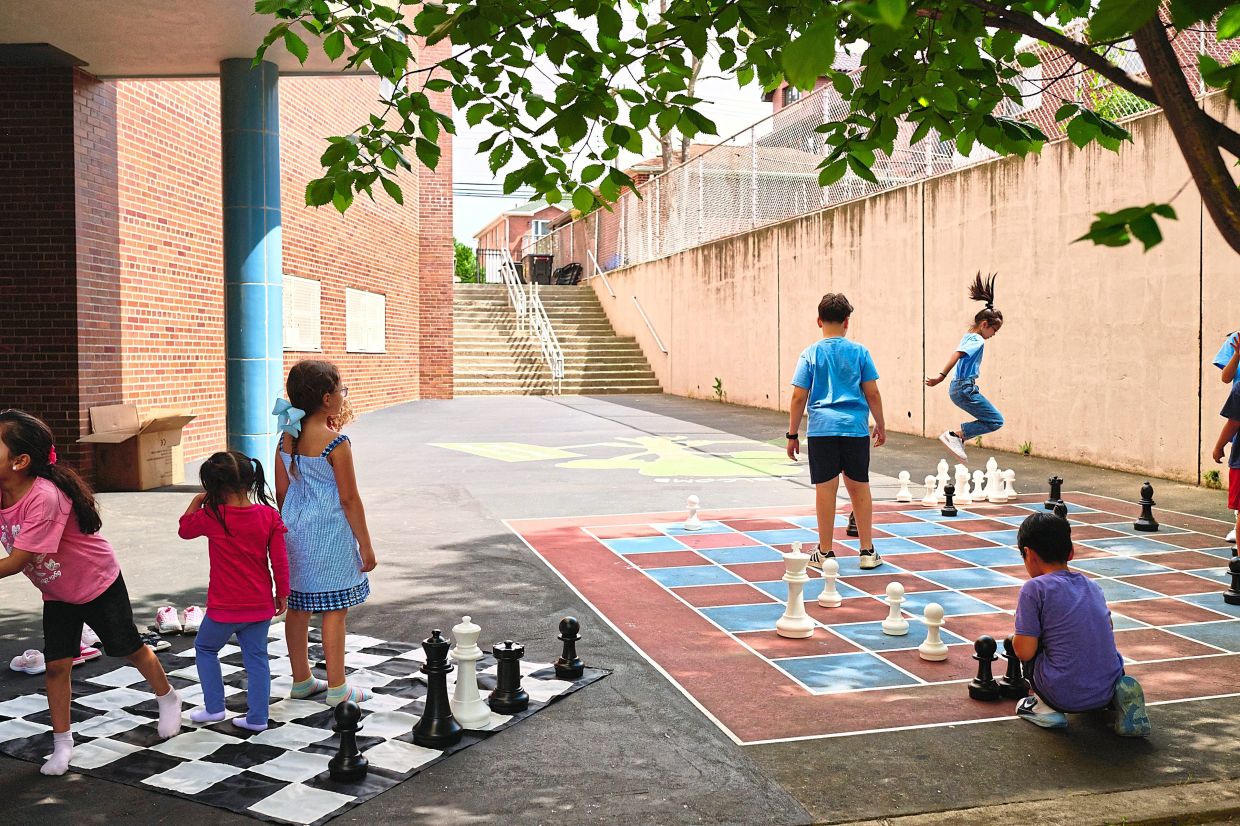
Creativity flourishes when young people have genuine authority over design decisions. Students at North Hills School in Queens, inspired by the Harry Potter series with its wizards playing life-size chess, incorporated two giant painted chessboards into their playground. One student, Ayden Chabane, explained the appeal: "It adds more life to the game because it's bigger and you can see the characteristics of each piece better." The only practical challenge has been the durability and occasional loss of physical pieces, a problem that pales against the imaginative engagement the feature generates.
Some designs respond to observed social needs with remarkable sensitivity. At a Harlem playground, girls had been sitting on the ground to have their hair braided, an informal gathering practice that reflected both cultural tradition and the lack of appropriate seating. Students designed tiered benches with three pairs of steel-slatted seats where one seat in each pair sits slightly lower, specifically configured for hair-braiding work. What emerged unexpectedly was multi-functional use: the benches became platforms for parkour, impromptu stages for dancing, and props for imaginative play, with children pretending the higher and lower seats represented cars and drivers. The design's flexibility demonstrates how responsive architecture can accommodate both anticipated and unanticipated uses when it is grounded in understanding actual behaviour.
Thematic coherence contributes significantly to how playgrounds function as community gathering places. A Brooklyn facility features a "floor is lava" obstacle course set within a broader rock stars and gems aesthetic. A painted volcano sits at the basketball court's centre with lava depicted flowing around playground equipment, chess tables, and benches. The visual consistency transforms a standard play space into an immersive environment where the game becomes an icebreaker for social connection. Amia Peoples, 11, articulated this: "I like that it's something a lot of people can play. I connected with a lot of people on this playground." The design recognises that children need aesthetic environments that encourage both active play and social bonding.
Some designs demonstrate environmental stewardship and connection to local history. Emanuel Kaplan School students created mushroom-shaped stools with bright red tops and white spots that reference their Queens neighbourhood's woodland heritage. These functional art pieces serve dual purposes as resting places and play equipment. Young children like six-year-old Jack Henshaw described hopping between them sequentially: "We use them for hopping on. We can go one by one by one by one and sometimes we skip one or two." The design embeds local environmental history into everyday play activity.
Nature integration represents another consistent thread across these spaces. While students at Pacific School in Brooklyn initially wished for a petting zoo with goats, donkeys, and llamas, they ultimately designed a pollinator garden featuring butterflies, bees, and native plants. The compromise between fantasy and feasibility has yielded unexpected benefits. A fourth-grade group called Team Tomato has assumed stewardship responsibilities, managing the garden throughout the year. The entire school participates: classes propagate seedlings indoors during winter months, parents donate plants, and students like Kamali Foreman, nine, experience direct sensory engagement with nature. Her observation—"It makes my nostrils say, 'This is nature.' I'm breathing in nature"—captures something essential about how green space can transform children's relationship with the natural world.
For Malaysian and Southeast Asian contexts, this model offers provocative lessons about democratic participation and youth agency. Many cities across the region face similar challenges: cramped, underutilised schoolyards that offer little recreational appeal, and limited mechanisms for young people to influence decisions affecting their daily lives. The New York programme demonstrates that involving students as genuine decision-makers—not merely consulted, but genuinely empowered—produces designs that are simultaneously more practical and more imaginative than expert-led approaches alone. The financial investment, while substantial, must be evaluated against multiple returns: improved recreational infrastructure, demonstrated youth civic engagement, and the intangible but profound impact of children learning that their ideas matter and can be implemented at scale.
The whimsical elements—dragons, unicorns, aliens—might suggest frivolity, but these designs reveal mature understanding of how environment shapes behaviour and belonging. Each playground becomes a community hub that functions year-round, serving not just students but neighbours and families. When 225 such spaces have been created over two decades, the cumulative effect extends well beyond individual schoolyards. The programme establishes a template for reimagining how cities can engage their youngest residents not as passive consumers of designed spaces but as architects of their own environments. In doing so, it offers a model of democratic participation grounded in concrete, visible, celebratory outcomes that children can literally play in and on every day.

