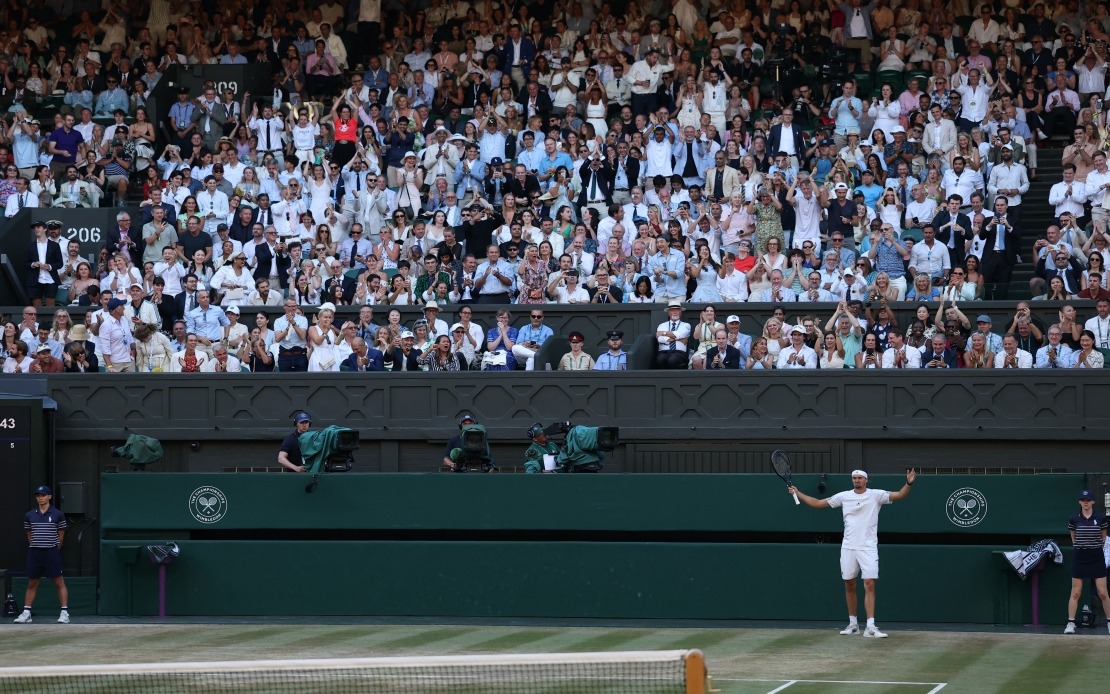
Jannik Sinner's commanding four-set victory over Alexander Zverev in the men's singles final provided a memorable conclusion to an exciting two weeks of tennis at Wimbledon, showcasing the emerging dominance of the Italian talent on grass courts. The match served as a fitting capstone to a championship marked by compelling narratives, emotional comebacks, and unexpected heroes who captured the imagination of spectators across the globe.
Marketa Noskova's path to the women's singles final was anything but straightforward, as the Czech player nearly surrendered a seemingly decisive position before rallying to claim her breakthrough grand slam title at age 21. The decisive moment came in the second set when Noskova squandered five championship points after leading 5-2, a collapse that threatened to define her tournament in devastating fashion. Her recovery and ultimate triumph drew inevitable comparisons to another Czech champion whose Wimbledon heartbreak became the stuff of legend.
The historical parallels were striking and poignant. Jana Novotna's 1993 final collapse against Steffi Graf—captured in an unforgettable image of the Czech player weeping on the Duchess of Kent's shoulder—remains one of the most emotionally resonant moments in Wimbledon's storied history. Novotna endured five years before capturing her own grand slam title in 1998, making her achievement all the sweeter in hindsight. Noskova's fate proved mercifully different; taking a bathroom break during her turbulent match, she walked past the trophies adorning the corridor and made a quiet but resolute vow: "I'm taking the big one!" Her determination proved prophetic, transforming a near-disaster into a triumphant narrative.
British wild card Jacob Fery emerged as the tournament's most improbable and beloved protagonist, his run to the semi-finals capturing the hearts of home supporters hungry for domestic success at SW19. The 23-year-old resident of Wimbledon, ranked 114 in the world and playing on a wild card invitation, delivered performances that seemed to defy the odds stacked heavily against him. His quarterfinal victory over the higher-ranked Zizou Bergs proved to be the turning point where his remarkable campaign truly accelerated towards the sport's consciousness.
Fery's battleground—Court 18 on what became one of the tournament's most scorching days—saw him face a particularly grueling test of both physical and mental fortitude. Trailing by four games in both the fourth and fifth sets while enduring three separate nosebleeds, any reasonable expectation would have suggested his improbable run had reached its natural conclusion. Instead, the young Briton summoned reserves of composure and determination that belied his relatively modest ranking, leveling the match by winning a tension-filled tiebreak. As Bergs, positioned 77 places higher in the world rankings, visibly lost his composure under the mounting pressure, Fery maintained his equilibrium through the ten-point decider that would ultimately secure his passage forward.
Fery's achievement held particular significance within the broader context of British tennis at the national championship. His semi-final appearance made him only the fifth British male player during the twenty-first century to progress beyond the opening week at the All England Club, an accomplishment that underscored both the rarity of such success and the symbolic importance of his breakthrough. For a tennis-mad nation that had witnessed a largely disappointing domestic showing throughout the championships, Fery's presence as the last British competitor standing became a source of genuine national pride and invested hope.
Novak Djokovic's quarterfinal encounter represented another chapter in his seemingly inexhaustible catalogue of age-defying athletic feats, yet this particular victory came at a cost that would prove decisive to his tournament hopes. The Serbian champion's 5-hour 15-minute triumph set an unwelcome record as the longest quarterfinal in Wimbledon's history, concluding with just eight minutes remaining before the 11pm curfew that evening. The physical and emotional toll of such an extended battle became evident in subsequent rounds, as his reserves of energy appeared substantially depleted despite his ultimate success.
Djokovic's labored path to victory encompassed multiple obstacles that tested his resolve beyond the conventional demands of competitive tennis. A calf injury required courtside treatment following the opening set, introducing the specter of a potential withdrawal and forcing questions about his ability to maintain his performance across subsequent rounds. Furthermore, a heated exchange with tournament referee Denise Parnell regarding the closure of the roof before the third set added psychological friction to an already demanding contest. The 24-time grand slam champion ultimately prevailed against third seed Felix Auger-Aliassime, but observers noted that his reserves of stamina and competitive fire appeared substantially diminished heading into his semi-final encounter against the ascending Sinner.
The women's semi-final between Coco Gauff and Karolina Muchova distilled to a single dramatic tiebreak, a pulsating 18-minute passage of play that contained multiple momentum shifts and concluded with both competitors having possessed match points. At 8-8 within that tiebreak, Muchova received a time violation and then struck a ball long, presenting Gauff with her first opportunity to close out the contest. The American inexplicably surrendered this chance by netting what appeared to be a straightforward drop-shot winner, a mental lapse that kept Muchova's hopes alive. Muchova subsequently generated her own match point opportunity, but dramatic misfortune intervened as she slipped during her preparation for what should have been a finishing volley, allowing Gauff's cross-court forehand to slip past her. The Czech ninth seed converted her second opportunity, maneuvering the American around the court before Gauff's tired forehand surrendered to the net, a fitting conclusion to a match defined by narrow margins and fluctuating fortune.
Serena Williams's wild card return to competitive tennis at age 44 and nearly four years after her "evolution away" from professional sport provided the championship's most transcendent narrative, generating palpable excitement throughout the first week's proceedings. Her arrival on Centre Court produced a standing ovation that reflected not merely sporting appreciation but the emotional investment fans maintained in her career and legacy. Against Daria Gavrilova, 24 years her junior, Williams demonstrated glimpses of her formidable capabilities, even securing an early break in the decisive set that suggested a potential storybook conclusion following her 2019 semi-final appearance.
Williams's promising trajectory ultimately collided with the harsh realities of age and injury as her physical reserves diminished during the final stages of her match against Gavrilova, whose own composure under the pressure of competing against a tennis icon provided compelling evidence of her own mental strength. A knee injury sustained late in the opening set fundamentally compromised Williams's mobility and competitive capacity, ultimately necessitating her withdrawal from a planned doubles reunion with her sister Venus that would have provided an additional sentimental dimension to her return. The injury transformed what had promised to be a triumphant comeback narrative into a poignant reminder that even the greatest athletes remain subject to the physical constraints that age and accumulated competition impose.

