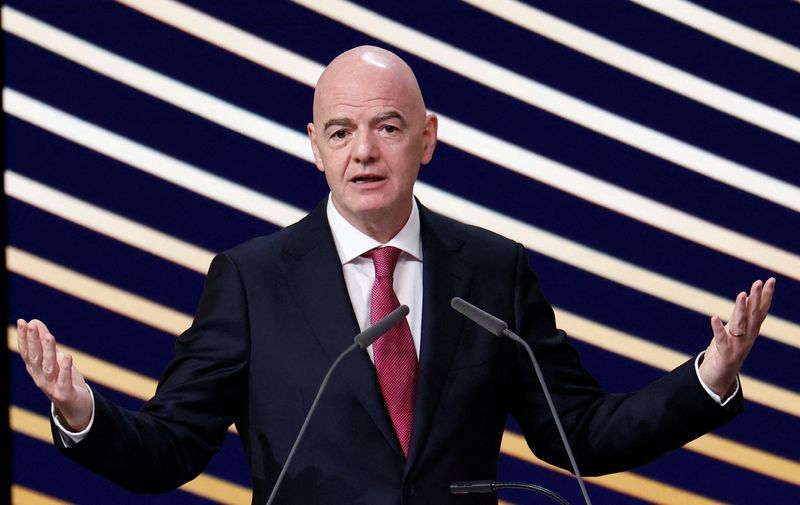
The governance crisis engulfing FIFA has found an unexpected catalyst: two female administrators who have become the public face of institutional resistance to President Gianni Infantino. Laura McAllister of Wales and Lise Klaveness of Norway, both serving on UEFA's executive committee, have stepped into the spotlight as Infantino's ambitious plan to restructure FIFA's financial architecture through a private equity partnership collapsed under mounting opposition from regional governing bodies.
The dispute centres on FIFA Football Enterprises, a privately-backed venture that Infantino championed as essential for modernising the sport's infrastructure and generating revenue. However, the proposal encountered fierce resistance from UEFA and other continental federations, with Wales becoming the first national association to withdraw support for the FIFA president's re-election bid. The backlash spread rapidly through FIFA's internal ranks, forcing Infantino to convene an emergency meeting in Morocco to address the growing mutiny within the organisation.
McAllister, who also serves as UEFA vice-president, has become a particularly vocal critic, advocating measures including a potential UEFA boycott of FIFA events unless governance issues are resolved. Her intervention signals that this dispute extends beyond financial disagreements; it reflects deeper anxieties about how football's global governing body operates and who controls its future direction. For McAllister, the crisis represents a fundamental departure from the sport's foundational values—a concern that resonates with football's growing emphasis on integrity, transparency, and equitable administration.
The emergence of women as protagonists in this institutional struggle has naturally invited reflection on whether football might be ready for female leadership at its highest levels. Former FIFA President Sepp Blatter explicitly endorsed this possibility this week, declaring that the sport's governing body should elect a woman to its presidency. McAllister, however, offered a more measured perspective, acknowledging that while female leadership would be welcome, the path remains complicated and genuine meritocratic assessment cannot be assumed within FIFA's political ecosystem. She emphasised that any woman assuming the presidency would need to navigate FIFA's complex international political landscape, where regional and national interests frequently override questions of competence or vision.
The participation of McAllister and Klaveness in this crisis carries particular significance given the historically male-dominated nature of football administration. Both women developed their careers initially as international players before advancing into governance roles—McAllister as a political scientist and Klaveness as a lawyer—bringing intellectual frameworks and external professional perspectives to their positions. This background appears to have shaped their approach to the current dispute, framing the issue not merely as a technical or financial disagreement but as a principled stand regarding football's fundamental character and values.
McAllister has articulated a distinctive argument: that women administrators often bring a different orientation to football governance, less preoccupied with commercial expansion and more focused on the sport's universal accessibility and social purpose. She contends that football belongs to everyone from grassroots to elite level, should encompass girls as comprehensively as boys, and must reach the world's poorest regions with equal commitment as wealthy nations. From this perspective, the resistance to FIFA Football Enterprises represents not merely operational disagreement but defence of football's democratic character against capture by private capital and political interference.
Yet the statistics reveal how far football's governance structures lag behind aspiration. Of FIFA's 211 member associations, only ten are led by female presidents, with Klaveness among this small cohort. This disparity reflects both historical patterns of exclusion and persistent structural obstacles that impede women's advancement into senior positions. Any realistic challenge to FIFA's presidency would require extraordinary coalition-building across continents, unlikely to coalesce around gender alone without substantive policy platforms and institutional backing from major football nations.
McAllister has counselled against forcing rapid change through revolutionary means, preferring instead a gradualist approach that builds momentum through consistent advocacy and institutional persistence. This pragmatic stance acknowledges that transforming entrenched male-dominated structures requires patient accumulation of influence and normative shift alongside direct action. The strategy resembles broader approaches to women's advancement in governance globally: demonstrating competence and commitment within existing hierarchies while simultaneously challenging the legitimacy of those hierarchies themselves.
Comparison with other global sports bodies illuminates FIFA's particular deficiency. The International Olympic Committee now operates under female leadership and has pioneered gender equity initiatives for more than a decade, establishing equal competition between men and women at the Olympics. Football, by contrast, has lagged considerably, with World Cup participation still profoundly unequal and women's competition receiving substantially less institutional resources, broadcast attention, and commercial investment. This disparity persists despite the demonstrable global appeal and commercial viability of women's football, suggesting governance resistance rather than market realities explain the gap.
The current crisis may inadvertently create opportunity for accelerating institutional reform around female leadership and broader governance transparency. The collapse of Infantino's private equity initiative and the evident fracturing of consensus around his continued presidency have exposed FIFA as vulnerable to organised opposition. Whether this vulnerability translates into meaningful structural reform—including pathways toward female leadership and genuine democratic accountability—remains uncertain. The outcome will likely depend on whether coalitions sustaining current resistance can maintain unity around governance principles rather than dissolving once the immediate crisis subsides.
For Malaysian and Southeast Asian football communities, the governance struggle at FIFA carries tangible implications. Regional associations and national federations depend on FIFA's institutional stability, competitive structures, and revenue distribution mechanisms. Women's football development in the region, already constrained by limited investment and governance attention, could benefit substantially from FIFA operating under reformed structures that prioritise equitable access and transparent administration. The prominence of female leaders like McAllister and Klaveness in driving institutional accountability thus extends beyond symbolic representation to affect concrete resource allocation and competitive opportunity across Asian football.

