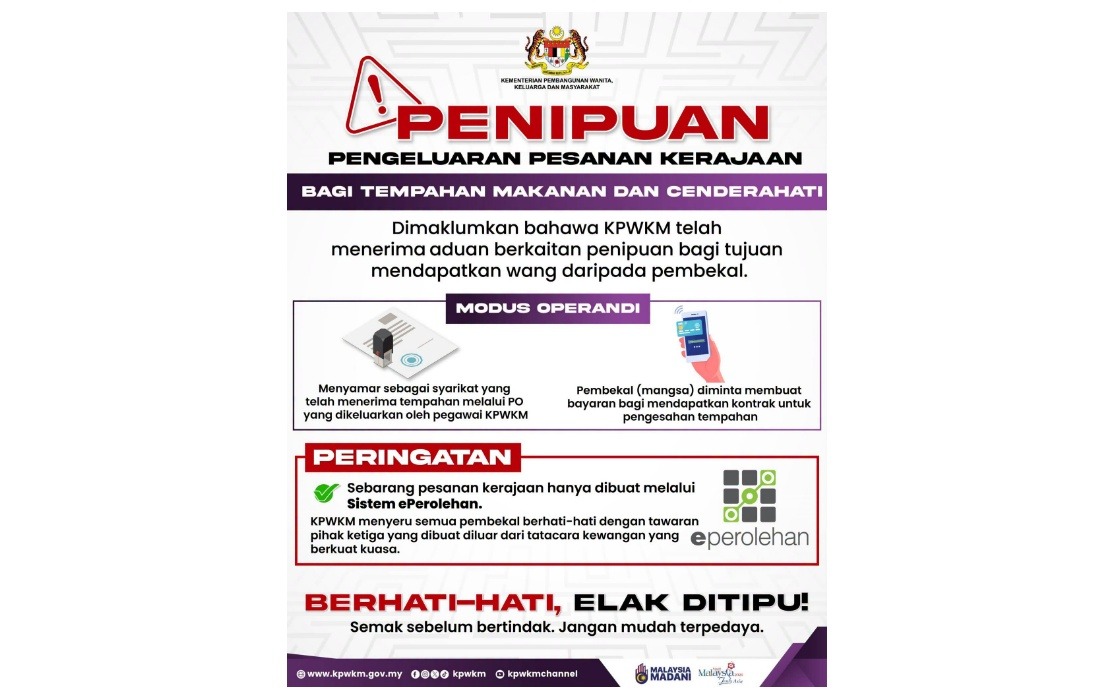
Malaysia's Women, Family and Community Development Ministry (KPWKM) has issued a stern alert to the business community regarding an escalating fraud scheme targeting government suppliers. The ministry emphasised that all legitimate procurement activities are conducted exclusively through the official ePerolehan platform, and that it never requests advance payments from contractors or suppliers to secure or validate government contracts.
The warning underscores a critical vulnerability in Malaysia's procurement ecosystem, where scammers are exploiting the government's reputation and the names of ministry personnel to extort money from unsuspecting business operators. According to KPWKM's statement, the fraudsters have been targeting food and beverage suppliers as well as souvenir providers, falsely claiming to represent the ministry and promising lucrative contracts for fictitious government programmes and events.
The scale of the problem has already resulted in substantial financial losses across multiple transactions, with victims reporting sums in the thousands of ringgit. The modus operandi involves sophisticated impersonation, where scammers identify themselves as representatives of legitimate companies or ministry officials and then request upfront payments ostensibly to confirm orders or secure contractual arrangements. This approach exploits the natural trust that suppliers place in official government communications and the genuine urgency that surrounds government procurement deadlines.
KPWKM has made unambiguously clear that the ministry adheres strictly to established financial procedures and governance standards. No legitimate government procurement in Malaysia involves requests for cash payments made to individual officers, informal intermediaries, or third-party entities outside the formal procurement framework. This principle applies universally across all government ministries and agencies, and any departure from this standard should be treated with immediate suspicion.
The ministry has specifically directed all suppliers and potential contractors to implement robust verification protocols before engaging in any transactions purporting to originate from KPWKM. The ePerolehan system, Malaysia's centralised government electronic procurement portal, serves as the single authoritative source for all legitimate government purchasing activities. Suppliers can cross-reference any claimed government order against this system to confirm its authenticity. Any purchase order that cannot be verified through ePerolehan should be rejected outright, regardless of how persuasive or official the accompanying communication may appear.
The advisory also addresses the psychological tactics employed by sophisticated fraud operations. Scammers frequently create a sense of urgency and exclusivity, suggesting that opportunities exist outside normal channels or that special arrangements can be made for favoured suppliers. They may reference real government events or programmes to enhance credibility and exploit the natural desire of business owners to expand their commercial opportunities. However, the fundamental principle remains immutable: genuine Malaysian government business never operates through informal payment channels or personalised financial arrangements.
For small and medium-sized enterprises, which often form the backbone of Malaysia's supplier ecosystem, this warning carries particular significance. SMEs frequently operate with limited administrative infrastructure and may lack dedicated compliance departments to verify government communications. This makes them especially vulnerable to sophisticated scams that impersonate government agencies. The ministry's guidance therefore serves as an essential protective mechanism for this crucial segment of the Malaysian business community.
KPWKM has also appealed directly to Malaysian business operators and the general public to maintain heightened vigilance and report any suspicious communications claiming to represent the ministry. The authorities responsible for combating fraud and financial crimes should be notified immediately of any payment requests made in KPWKM's name, particularly those that deviate from the ePerolehan system or involve requests for cash transfers to personal accounts.
The broader implications of this procurement fraud problem extend beyond the immediate financial losses incurred by individual suppliers. Such scams undermine public confidence in government procurement systems and create unnecessary suspicion around legitimate government communications. They also impose additional administrative burdens on government agencies, which must invest resources in issuing warnings and investigating complaints rather than focusing on core service delivery.
As Malaysia continues to strengthen its digital governance infrastructure and expand e-commerce capabilities, cybersecurity experts and procurement specialists emphasise that public education represents a critical component of fraud prevention strategy. Business operators must develop sufficient digital literacy to distinguish between authentic government communications and fraudulent imitations. This requires ongoing engagement between government agencies and the business community to share information about emerging threats and best practices.
For suppliers operating across Malaysia and the broader Southeast Asian region, understanding the specific procurement protocols of each government jurisdiction remains essential. While Malaysia's ePerolehan system provides a centralised verification mechanism, suppliers working with multiple governments must familiarise themselves with each nation's distinct procurement frameworks and authentication procedures. The fundamental principle of never paying advance fees to secure government contracts transcends all jurisdictions and represents a universal safeguard against organised fraud networks.
The ministry's proactive stance in issuing this warning demonstrates growing recognition among Malaysian government agencies of the importance of transparent communication with stakeholders regarding security threats. By providing specific details about the fraud tactics being employed, KPWKM enables suppliers to implement targeted defensive measures and contributes to a broader culture of procurement integrity that benefits the entire Malaysian business ecosystem.

