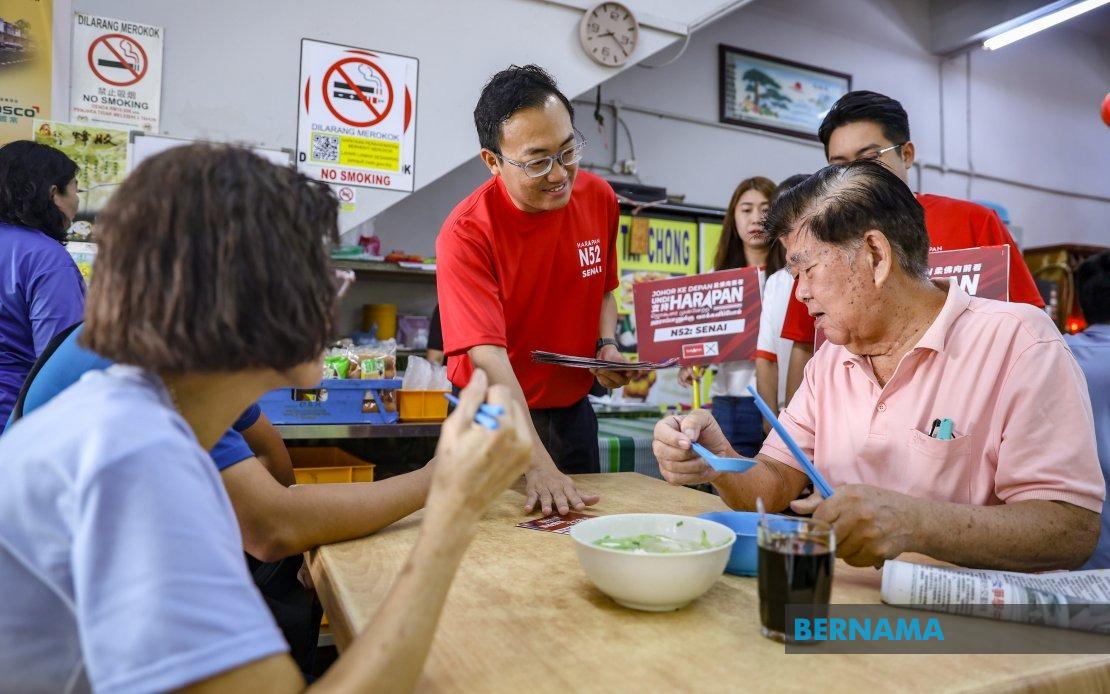
Wong Bor Yang, the incumbent assemblyman for Senai, is making his case for re-election centred squarely on the accomplishments of his previous term. Speaking in Kulai ahead of Johor's 16th state election on July 11, Wong expressed confidence that Pakatan Harapan will successfully retain this constituency by appealing to voters on the basis of tangible results rather than campaign rhetoric. His campaign strategy represents a deliberate pivot away from partisan political messaging towards a narrative emphasising problem-solving and pragmatic governance.
The foundation of Wong's electoral pitch rests on his assertion that he has delivered meaningful change in areas that directly affect residents' daily lives. He highlighted his relentless push for solutions to the longstanding flash flood crisis that has plagued multiple neighbourhoods within Senai. During his previous stint in office, Wong worked persistently to secure government funding for drainage infrastructure improvements, eventually channelling RM1 million from the state government into upgrading the drainage system in Taman Aman and its connection to Sungai Skudai. Beyond state-level support, he leveraged a partnership with Kulai MP Teo Nie Ching to unlock an additional RM3 million for drainage projects in Peladang Kulai Besar and Saleng, successfully removing both areas from the district's roster of flash flood hotspots.
Wong's political trajectory distinguishes him from many candidates in the current election cycle. Since 2014, his career has spanned multiple phases of Malaysia's evolving political landscape. He began as a special officer in the Kulai Member of Parliament's office, subsequently transitioned to a local councillor position in 2018, and was eventually elected to serve as the Senai state assemblyman. This varied experience, Wong argued, has equipped him with a realistic understanding of how government machinery operates and where leverage points exist for extracting results from bureaucratic systems. A journalism graduate from Shih Hsin University in Taiwan, Wong contended that his background gives him particular insight into communicating effectively with both constituents and officials.
Beyond infrastructure, Wong has invested political capital into cultural and recreational initiatives that reflect Senai's heritage. He spearheaded the transformation of a defunct cinema into a community operations centre and oversaw the renovation of a two-decade-old badminton facility into Tiny Lake, a family recreational space developed under the Sejati MADANI programme. These projects, while appearing modest in scope, demonstrate Wong's willingness to allocate attention and resources to quality-of-life improvements that resonate with local residents. The initiatives also underscore his argument that effective constituency work involves understanding community priorities beyond the headline-grabbing infrastructure projects.
Healthcare emerges as Wong's declared priority for a potential second term. He has been vocal in advocating for substantial upgrades to Kulai Hospital, citing its current capacity of 93 beds as inadequate for a district whose population is projected to reach 500,000 by 2030. This argument reflects growing pressure on health infrastructure across Malaysia's urban and semi-urban centres, where rapid population growth has outpaced facility development. Wong has also committed to resolving a protracted land acquisition issue that has stalled the construction of a new Health Clinic in Taman Mewah, a project he attributed to bureaucratic delays at the state level. By positioning healthcare as a key concern, Wong is aligning his campaign with a broader voter preoccupation across Malaysia about accessibility and quality of medical services.
The political context surrounding Wong's bid for re-election reveals the complexity of the Senai contest. With 66,635 registered voters, the constituency is being contested in a three-way race involving Wong from Pakatan Harapan, Tai Chee Chee representing Barisan Nasional, and Tew Chien How from Bersama. This multi-candidate scenario introduces unpredictability into the race dynamics, as vote splitting could significantly influence the outcome. Wong's campaign strategy of emphasising his existing track record appears calibrated to appeal to voters who value continuity and demonstrated competence over fresh faces or alternative party platforms.
Wong's assessment of the Senai electorate reflects a broader confidence in voter sophistication. He characterised the Bangsa Johor voting population as politically mature and dynamic, suggesting that constituents will ultimately evaluate candidates primarily on performance metrics and documented achievements rather than hollow campaign promises. This framing implicitly criticises alternative candidates who lack comparable administrative experience or substantive local track records. Whether this characterisation accurately describes voter priorities in Senai will become evident on polling day, but it reveals Wong's confidence that his years of constituency service constitute a durable electoral asset.
The timing of the Johor state election holds significance for the broader political trajectory of Malaysia's southern state. Elections scheduled for July 11, with early voting commencing July 7, occur within a period of relative political stability in Johor, where Pakatan Harapan has maintained its position in state government. Wong's campaign therefore benefits from the association with an incumbent state administration, though this advantage must be balanced against any voter dissatisfaction with state-level performance. His emphasis on local delivery rather than state-wide policy questions suggests a strategic decision to emphasise areas where he can claim direct credit rather than share responsibility for broader governance challenges.
Wong's extensive experience navigating different positions within Malaysia's political system offers insight into how evolving political coalitions have reshaped opportunities for constituent service. His progression from opposition bench member to government councillor to state assemblyman reflects the broader volatility and realignment of Malaysian politics over the past decade. This trajectory could be presented as evidence of adaptability, though it might equally invite questions about consistency of principles. Wong appears to be banking on the former interpretation, positioning his varied experience as a source of practical wisdom rather than opportunistic political manoeuvring.
The healthcare and infrastructure projects Wong has championed align with electoral priorities evident across Malaysia's urban and semi-urban constituencies. Voters in such areas increasingly prioritise tangible service delivery improvements over ideological rhetoric, a trend that Wong's campaign explicitly acknowledges. By centering his re-election bid on flood mitigation outcomes, cultural heritage initiatives, and healthcare advocacy, Wong is responding to demonstrated voter concerns while simultaneously building a record that he can point to as evidence of effectiveness. Whether these accomplishments prove sufficiently compelling to overcome the challenge posed by new candidates in a three-way contest remains an open question, but they clearly form the foundation of his electoral strategy heading into the July 11 polling date.

