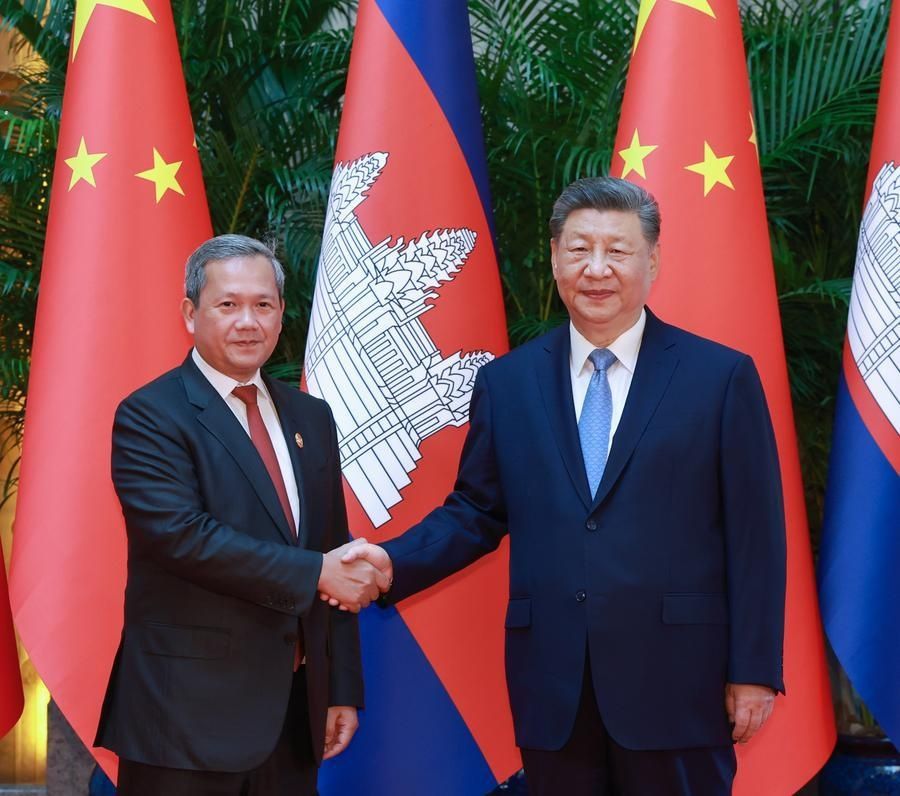
Chinese President Xi Jinping held talks with Cambodian Prime Minister Hun Manet in Shanghai on Friday, emphasizing the enduring bonds between Beijing and Phnom Penh whilst outlining an ambitious agenda to elevate their relationship into the next decade. The meeting, which took place during Hun Manet's attendance at the 2026 World Artificial Intelligence Conference, underscores how economic forums have become crucial venues for high-level bilateral diplomacy in the region. Xi's framing of the relationship as an "ironclad friendship" rooted in historical ties reflects Beijing's broader strategy of cementing long-term partnerships with Southeast Asian nations through appeals to shared heritage and common interests.
At the heart of their discussion lay the expansion of the "Diamond Hexagon" cooperation framework, a multilayered initiative designed to integrate the two economies across multiple sectors. This conceptual architecture demonstrates how Beijing approaches regional integration—by creating formal structures that encompass trade, investment, infrastructure, and security dimensions simultaneously. For Cambodia, which remains heavily reliant on Chinese capital and technical expertise, such frameworks provide both opportunities and dependencies that shape the country's development trajectory. The framework's evolution signals Beijing's intention to deepen Cambodia's integration into its economic ecosystem, a pattern increasingly evident across Southeast Asia.
The two leaders identified the Industrial Development Corridor and the Fish and Rice Corridor as priority areas requiring accelerated development. These initiatives represent more than simple trade arrangements; they embody a vision of cross-border economic zones where Chinese investment, Cambodian labour and resources, and logistical networks converge to create integrated value chains. The Industrial Development Corridor specifically targets manufacturing and processing sectors where Cambodia's lower costs and geographic proximity to China offer competitive advantages. The Fish and Rice Corridor, meanwhile, reflects Cambodia's agricultural heritage and its potential as a food supplier to China's rapidly urbanizing population—a partnership that ties Cambodia's economic future directly to meeting Beijing's strategic needs.
Beyond traditional sectors, both leaders committed to modernizing Cambodia's economy through investments in artificial intelligence and the digital economy. This pivot towards emerging technologies positions Cambodia within China's broader push to establish technological leadership across Asia. For Malaysian observers, this development carries significance, as it indicates how regional competitors are positioning themselves within China's innovation ecosystem. Cambodia's embrace of AI and digital infrastructure, backed by Chinese expertise and capital, could reshape competitive dynamics in Southeast Asia's technology sector over the coming decade.
The bilateral agenda included a frank discussion of cross-border security challenges, with Xi emphasizing the need to combat counterfeiting, smuggling, online gambling, and telecom fraud. These are not incidental crimes but systematic problems that undermine both countries' governance structures and generate billions in illicit flows. Telecom fraud, in particular, has emerged as a transnational scourge affecting multiple Southeast Asian nations and China itself. Hun Manet's commitment to intensified cooperation on these fronts reflects Phnom Penh's recognition that Chinese investment requires stable institutional frameworks and rule of law—even if Cambodia's track record on such matters remains contested internationally.
A notable dimension of the talks involved Xi's mediation role in Cambodia-Thailand border tensions. By positioning China as a constructive peacemaker whilst supporting dialogue, Xi reinforces Beijing's influence over regional disputes and demonstrates its value as a stabilizing power. For Cambodia, Chinese diplomatic backing provides reassurance and leverage in negotiations with Thailand. The approach also illustrates how major powers use their economic leverage and political relationships to shape regional security architecture. Cambodia's willingness to rely on Chinese mediation reflects both historical alignment and pragmatic recognition of Beijing's growing influence over Southeast Asian geopolitics.
Hun Manet's response emphasized Cambodia's unwavering commitment to the one-China policy and pledged deeper political trust and expanded bilateral trade. This reaffirmation matters because it signals continuity despite generational change in Cambodian leadership; Hun Manet, who assumed the premiership in 2023, is consolidating his authority partly through demonstrating his dedication to Cambodia's most important external relationship. For investors and observers tracking Cambodia's trajectory, such statements provide reassurance about the stability of its China-centric foreign policy, even as regional dynamics evolve.
The emphasis on major infrastructure projects reflects the scale of Chinese investment flowing into Cambodia. From ports and highways to hydroelectric facilities and special economic zones, these projects physically reshape Cambodia's landscape whilst integrating it into Chinese-led regional supply chains. The renewal of commitment to such projects during high-level meetings ensures continued political momentum and priority access to credit lines and technical expertise. For Cambodia, such projects represent the primary vehicle for economic development and job creation; for China, they represent both investment opportunities and strategic assets that enhance Beijing's regional connectivity and influence.
The tacit agreement to deepen cooperation on emerging sectors like the digital economy whilst maintaining focus on agriculture underscores a sophisticated division of labour. Cambodia provides resources, labour, and geographic positioning; China supplies capital, technology, and market access. This complementarity, whilst economically rational, also creates asymmetries that merit scrutiny. Cambodia's economic model increasingly depends on Chinese investors and markets, a concentration that reduces policy flexibility and increases vulnerability to shifts in Beijing's priorities or global economic conditions.
For Southeast Asia more broadly, this bilateral renewal illustrates a fundamental reality of contemporary regional politics: China's growing capacity to structure partnerships that serve its strategic interests whilst offering sufficient benefits to partner nations to sustain political commitment. Cambodia's alignment with Beijing is neither coercive nor unique; it reflects rational calculation by Phnom Penh's leadership that engagement with China serves Cambodia's development interests better than alternative strategies. The challenge for other Southeast Asian nations, including Malaysia, lies in calibrating their own China relationships to maximize economic benefits whilst preserving strategic autonomy—a balance that has proven increasingly difficult to maintain.

