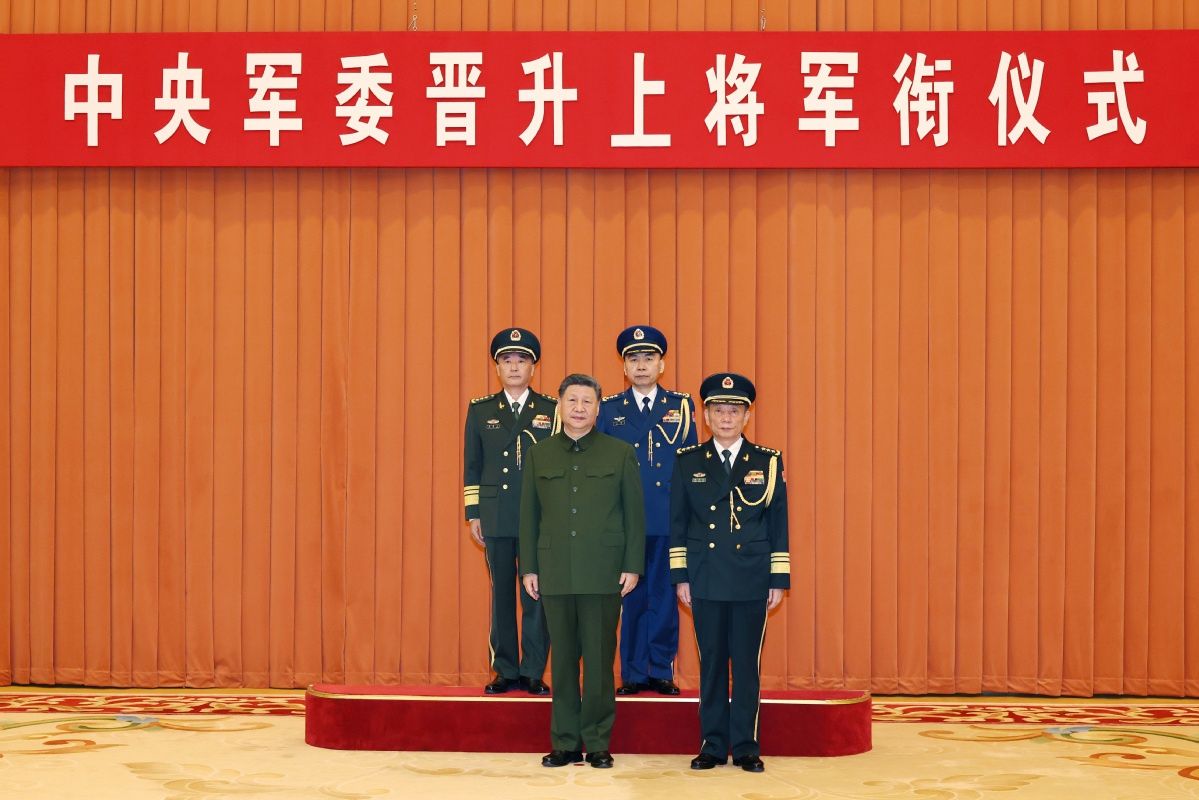
Chinese President Xi Jinping has appointed a new leadership team overseeing military discipline and anti-corruption efforts, marking another significant reshuffle within the People's Liberation Army as the nation's top leader continues an unprecedented cleanup campaign across the armed forces. Zhang Shuguang has assumed the role of secretary for the Central Military Commission's discipline inspection commission, a position that puts him at the forefront of rooting out financial misconduct and corruption among China's defence establishment. The appointment was announced through state-run Xinhua News Agency following a formal ceremony in Beijing on Friday, July 3, with President Xi present to oversee the transition. Alongside this move, Wang Gang has been elevated to commander of the People's Liberation Army Air Force, succeeding the departed Chang Dingqiu. Both Zhang Shuguang and Wang Gang have been promoted to the rank of general, China's highest active-service military rank.
The leadership changes reflect broader institutional repositioning within China's defence hierarchy. Zhang Shengmin, who previously held the military's top anti-graft position, has been reassigned to serve as vice chairman of the Central Military Commission, a lateral move that maintains his seniority while removing him from frontline corruption investigations. This transition suggests the Communist Party is rotating personnel between oversight and command functions, potentially preventing any single official from accumulating excessive power over military discipline matters. The departure of Chang Dingqiu from the Air Force command position, meanwhile, leaves questions about his future trajectory within the defence establishment, as Beijing has not yet clarified his next posting.
These personnel changes exist within the context of an extraordinarily aggressive military purge that began in mid-2023, shortly after President Xi secured his historic third consecutive term as party leader. The scope of the campaign has been staggering by modern Chinese standards. Over the past year, Xi's administration has removed two vice chairs of the Central Military Commission, three separate CMC members, a former defence minister, and at least a dozen commanding generals who headed major military regions and operational commands. This represents the most extensive removal of senior military personnel in roughly half a century, reflecting Xi's determination to consolidate control over the armed forces and eliminate what he perceives as entrenched power bases that might resist his authority.
The most dramatic episode in this purge came earlier in 2024 when authorities launched a formal investigation into Zhang Youxia, Xi's onetime ally and one of the highest-ranking generals in the military hierarchy. Zhang Youxia's downfall was particularly striking because he had long been viewed as part of Xi's inner circle, suggesting that no official, regardless of prior relationship or position, is beyond scrutiny in this campaign. The investigation signalled that Xi is willing to sacrifice even trusted associates if they are suspected of corruption or disloyalty, sending a powerful message throughout the officer corps about the consequences of financial misconduct or resistance to central authority. This willingness to pursue allies underscores the intensity with which the Communist Party intends to reshape military governance.
For Malaysian and Southeast Asian observers, these developments carry important implications for regional security dynamics. A military purge of this magnitude can create uncertainty about chain-of-command reliability, decision-making processes, and the continuity of defence policies. The removal of so many senior commanders simultaneously raises questions about institutional stability within the PLA and whether the military's capacity to execute complex operations might be temporarily affected. Additionally, the centralisation of power within Xi's hands through these personnel changes reinforces his authority over defence and security matters, potentially influencing how China approaches territorial disputes, military modernisation programmes, and strategic initiatives across the region.
The anti-corruption campaign also reveals deep structural problems within the defence establishment that Beijing evidently feels require systemic intervention. Widespread financial misconduct among senior officers suggests procurement corruption, embezzlement of military funds, and possibly kickback schemes related to defence contracts. By aggressively prosecuting these cases and replacing implicated officials, Xi is signalling commitment to military efficiency and eliminating corruption that could undermine readiness and operational effectiveness. However, the scale of the purge also suggests the problems were considerably more extensive than previously acknowledged, raising questions about how such corruption persisted without earlier detection or intervention.
The role of the Central Military Commission's discipline inspection commission has become increasingly central to Xi's governance strategy. By appointing trusted personnel to oversee this body, Xi ensures that investigations proceed according to his priorities and that outcomes align with his broader consolidation efforts. The discipline commission now serves not merely as an anti-corruption body but as a tool for reshaping the military's officer corps according to Xi's preferences. This politicisation of the anti-graft function means that purged officials may be targeted not solely for corruption but also for perceived disloyalty, insufficient ideological alignment, or resistance to Xi's policies. The distinction between genuine corruption investigation and political purge becomes increasingly blurred.
Last week's move to strip six military lawmakers of their seats in China's National People's Congress represented another dimension of this broader personnel reshuffling. Military representation in the legislature carries symbolic and practical significance, providing the defence establishment direct input into national policymaking. By removing these parliamentarians, presumably those connected to ousted officials, Xi further consolidates party control over both military institutions and the formal structures of state power. The cumulative effect of these moves is a military organisation that is increasingly personalised around Xi's leadership and stripped of autonomous power centres that might challenge his authority.
The implications of this sustained purge extend beyond Chinese internal politics to shape how the region perceives Chinese military stability and leadership coherence. Regional governments and militaries have long maintained careful working relationships with Chinese counterparts; significant personnel changes at the top command levels can disrupt established channels of communication and require recalibration of bilateral defence arrangements. Taiwan, Japan, and Southeast Asian nations with maritime disputes involving China will be closely monitoring whether these leadership transitions affect Beijing's strategic posture or willingness to negotiate outstanding territorial disputes. The military's reduced focus on corruption investigations might theoretically free resources for operational readiness, or the internal turbulence could create distraction from external security matters.

