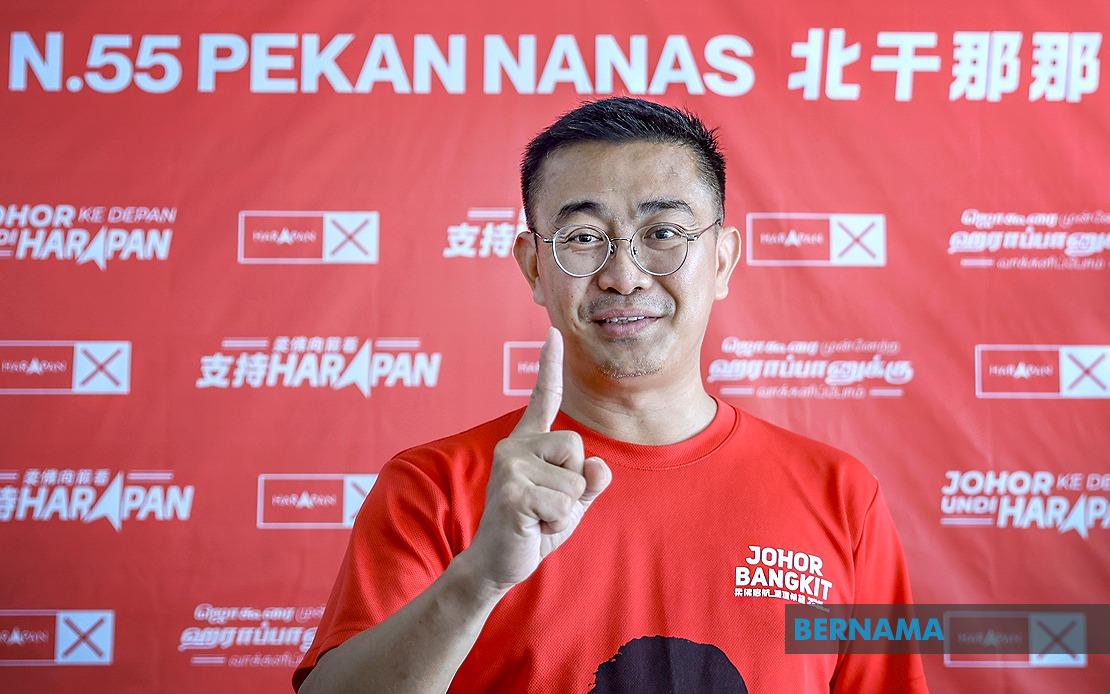
Pekan Nanas faces a straight fight between a familiar face and an incumbent as Pakatan Harapan candidate Yeo Tung Siong makes his pitch to return to the Johor state assembly. The former two-term assemblyman for the constituency is approaching the upcoming state election with confidence rooted in his previous service from 2013 to 2022, arguing that his established relationship with constituents and demonstrated commitment to the area provide him with a solid foundation for recapture.
Yeo's campaign strategy emphasises direct engagement with the electorate, a tactical approach that has seen him cover substantial ground during the current campaign cycle. He estimates having connected with approximately 60 per cent of voters through a diversified outreach programme spanning walkabouts, community forums, neighbourhood gatherings, household visits, and drop-ins at local markets and food establishments. The feedback he reports receiving throughout these interactions has been predominantly positive, suggesting a receptive audience to his candidacy.
The former teacher and vice-principal frames his appeal primarily around accessibility and responsiveness to constituent concerns. Rather than emphasising formal protocols or maintaining distance from the community, Yeo positions himself as readily available and personally engaged with solving local problems. This approach reflects an understanding that Malaysian voters increasingly value representatives who are present and willing to engage directly with community needs.
During his tenure as elected representative, Yeo points to concrete infrastructure projects implemented in the constituency. A RM500,000 allocation secured for rectifying the Pulai River's flow represents a direct response to chronic flooding issues that have long plagued the area. Additionally, he collaborated with the private sector on drainage improvement work around Kampung Melayu Raya, demonstrating the kind of collaboration between government and business that increasingly defines effective local governance in Johor.
The constituency's residents have articulated two major concerns during the campaign period: traffic congestion and employment prospects. These issues are not unique to Pekan Nanas but reflect broader challenges facing Johor's suburban and peri-urban communities as the state experiences ongoing economic development and population growth. Yeo's response focuses on infrastructure solutions designed to address connectivity gaps.
Should voters return him to office, Yeo has prioritised two shortcut projects aimed at reducing travel times between Pontian and Johor Bahru. The proposed route connecting Ulu Pulai to Pekan Nanas and the alternate junction linking Pulai to Sri Bunian represent practical responses to congestion issues that affect both daily commuters and economic activity. These projects also underscore how state-level assembly representatives can influence connectivity and infrastructure development that extends beyond immediate constituency boundaries.
On employment generation, Yeo proposes reviving a career carnival initiative previously organised during his earlier term. By facilitating connections between local job-seekers and major employers operating in and around Pekan Nanas, the programme creates a tangible mechanism for matching labour supply with demand in the constituency. This represents a measured approach to addressing unemployment through practical facilitation rather than unfunded promises.
Yeo emphasises his intention to strengthen access to government welfare and social security support systems for vulnerable residents. By committing to enhanced engagement with agencies including the Social Welfare Department and the Social Security Organisation, he signals awareness that constituency representation extends into advocacy and navigation of bureaucratic systems that often overwhelm disadvantaged populations.
The Pekan Nanas contest represents a direct comparison between established representation and incumbent stewardship. Incumbent Tan Eng Meng of Barisan Nasional brings his own record to scrutiny as voters assess competing claims about who best serves their interests. The one-on-one battle reflects the simplified political landscape Johor presents in this electoral cycle, where straight fights between major coalitions have become more common.
For Malaysian and Southeast Asian observers, the Pekan Nanas campaign illustrates evolving patterns in state-level politics. Candidates increasingly emphasise personal accessibility, targeted infrastructure solutions, and engagement with bread-and-butter economic concerns rather than higher-order ideological positioning. Yeo's campaign resonates with this trend, suggesting that voters in this constituency weigh tangible service delivery and demonstrated constituency awareness against other electoral considerations.

