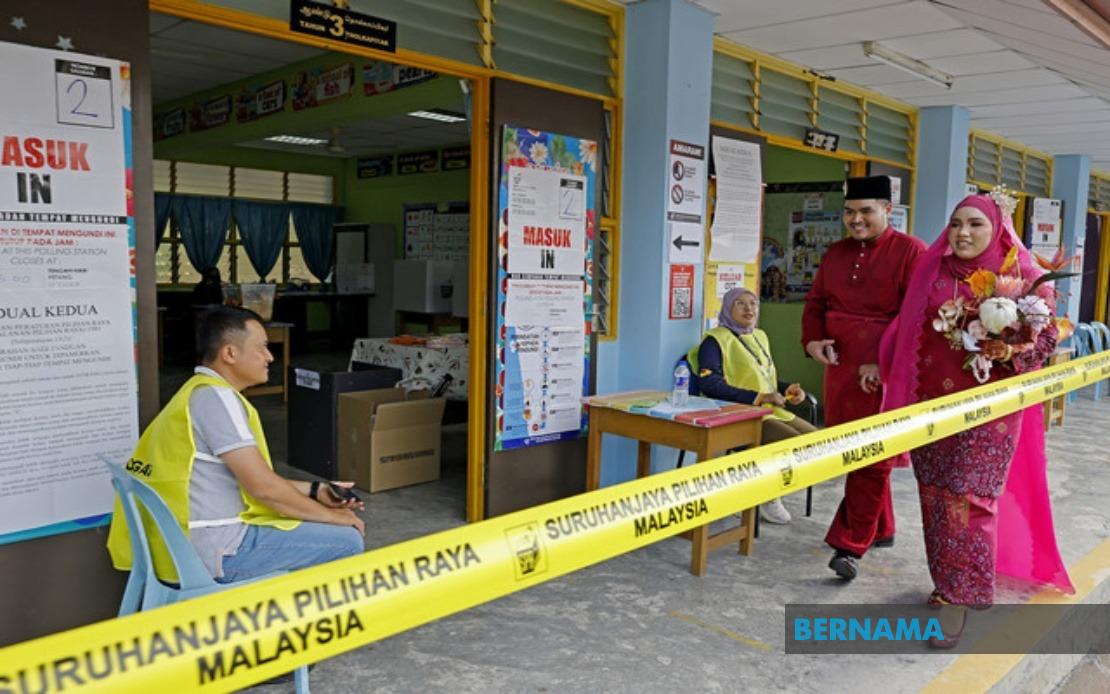
At a polling station in the Labu constituency of Negeri Sembilan, one of the day's most distinctive moments came not from political speeches or campaign activities, but from a young woman's determination to fulfil her civic duty without compromising her personal milestone. Noor Farzana Masnoor, a 26-year-old marketing officer, arrived at Sekolah Jenis Kebangsaan Tamil (SJKT) Ladang Kubang in her striking red traditional bridal attire, casting her ballot alongside her newly-married husband, Luqman Adam Sudirman, 27, during the Negeri Sembilan state election.
The decision to vote in full wedding regalia reflected a conscious choice to integrate two significant events in her life rather than delay one for the other. For Noor Farzana, the moment carried deeper meaning beyond the ceremonial aspects. She and her husband viewed their presence at the polling centre as a statement about the values that would define their marriage and their roles as citizens in Malaysia's democratic system. Rather than treating the election as a routine obligation to be dispatched before the wedding festivities began, they framed voting as an integral part of their day's significance.
The couple's approach resonates with broader conversations about youth engagement in Malaysia's political processes. As members of Generation Z, Noor Farzana and Luqman represent a demographic that political analysts have increasingly scrutinized for their voting patterns and levels of civic participation. Their deliberate choice to prioritize voting despite the demanding schedule of a wedding day challenges stereotypes about young Malaysians being disengaged from electoral processes. The optics of a bride in traditional finery at a polling station naturally attracted attention, but their underlying message was substantive rather than merely photogenic.
In her comments to the media, Noor Farzana articulated a perspective that distinguishes her generation's understanding of democratic participation. She emphasized that voting opportunities do not arrive frequently in a citizen's life, making each election a significant responsibility rather than a routine administrative task. This framing suggests an appreciation for the comparative rarity of elections and a recognition that the representatives chosen during these periods shape policy and governance across multiple years. Her statement reflects a maturity in recognizing that individual electoral choices aggregate into collective decisions affecting entire communities.
The couple's emphasis on choosing representatives who will genuinely serve constituents rather than merely occupying office points to concerns about accountability and effectiveness in local governance. In Labu, voters were selecting candidates who would represent their interests in state-level deliberations, and Noor Farzana's articulation of this responsibility indicates awareness that electoral choices carry tangible consequences for public services, infrastructure development, and policy implementation at the state level. This awareness distinguishes their voting as something more than a perfunctory box-ticking exercise.
The Labu constituency, where they cast their ballots, forms part of the broader political landscape of Negeri Sembilan, a state that has seen evolving political dynamics in recent Malaysian elections. The state has historically been politically competitive, with shifts in voter preferences reflecting changing economic conditions, development priorities, and political leadership styles. Young voters like Noor Farzana and Luqman constitute an increasingly important demographic bloc whose participation levels and voting preferences can influence electoral outcomes, particularly in constituencies with substantial youth populations.
Their decision to maintain their wedding attire while voting also carries symbolic weight in the context of Malaysian society. Traditional Malay bridal wear represents cultural continuity and personal identity, and integrating this into the act of voting suggests a worldview where cultural practices and civic responsibilities are not mutually exclusive but rather complementary aspects of a complete identity. This integration challenges any false dichotomy between tradition and modern democratic participation.
The memory-making aspect that Noor Farzana highlighted—her desire for the day to be remembered as a demonstration of young people valuing both rights and responsibilities—indicates an aspirational dimension to their actions. By publicly coupling their wedding with their voting, they were consciously creating a narrative about what it means to be a young Malaysian citizen. They positioned themselves as models for their generational cohort, suggesting that democratic participation enhances rather than detracts from life's significant personal moments.
For observers monitoring youth electoral engagement in Malaysia, such instances provide measurable evidence of younger Malaysians taking their democratic roles seriously. Turnout among voters aged 18-40 has been a consistent concern for election analysts, with various studies suggesting lower participation rates among this demographic compared to older age groups. Noor Farzana and Luqman's visible, deliberate participation in the Negeri Sembilan election represents a counternarrative to generalizations about youth disengagement, though individual examples cannot substitute for comprehensive participation data.
The couple's story also reflects the practical realities of modern life in Malaysia, where significant personal events and civic obligations often overlap. Rather than treating these potential conflicts as obstacles, Noor Farzana resolved them by integrating both into a single narrative. This pragmatism, combined with their articulated commitment to responsible citizenship, presents a model of engaged civic participation that transcends demographic stereotypes. Their choice to vote together as a newly married couple also reinforces the idea that political participation can be a shared value within families and intimate partnerships.
Moving forward, the integration of voting into their wedding day may serve as a reference point in their personal history, a moment where they collectively affirmed shared values about governance and citizenship. For younger Malaysians observing their example, the message is clear: civic engagement and personal life milestones need not be sacrificed for one another, and the choice to prioritize voting reflects maturity rather than obligation. The visibility of their participation in the Labu constituency polling centre contributes to broader discussions about how Malaysian democracy engages with its youngest eligible voters and how generational attitudes toward electoral participation continue to evolve.

