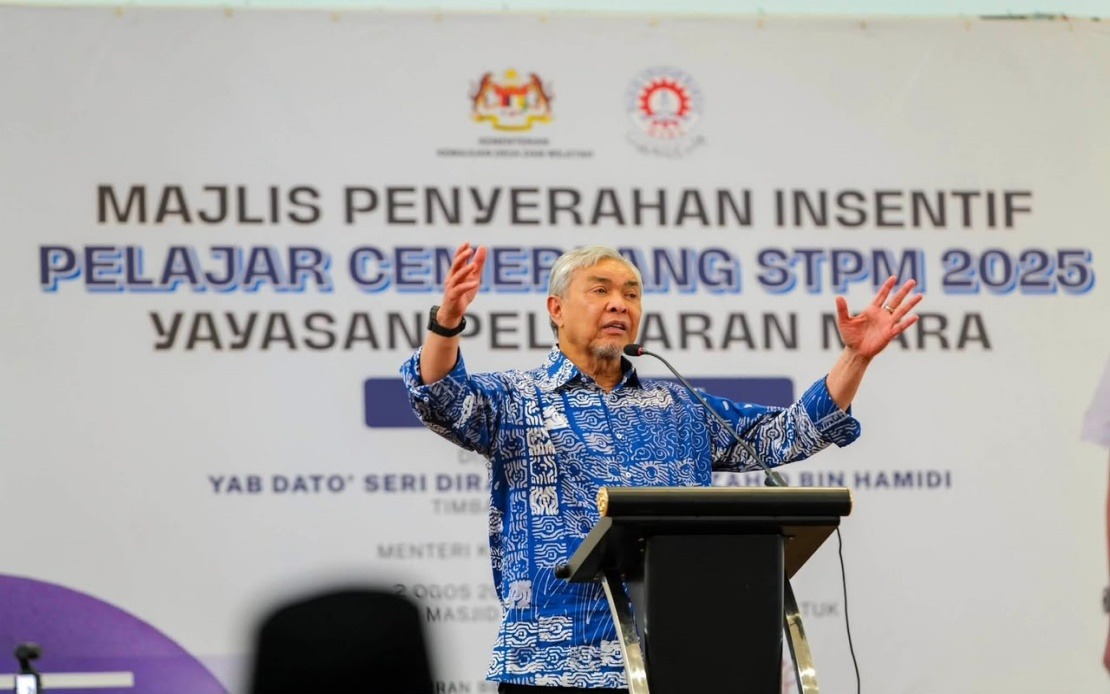
Yayasan Pelajaran MARA (YPM) has presented the 2025 STPM Excellence Incentive to 38 students from two secondary schools in the Perak district of Bagan Datuk, recognising their exceptional examination performance at a time when Malaysia continues to emphasise academic merit and educational advancement across the nation. The recipients come from Sekolah Menengah Kebangsaan Khir Johari and Sekolah Menengah Kebangsaan Tun Abdul Razak, both institutions playing a crucial role in developing the district's young talent pipeline.
Deputy Prime Minister Datuk Seri Dr Ahmad Zahid Hamidi, who represents Bagan Datuk as its Member of Parliament, announced the recognition in a statement, underlining the significance of these achievements within the broader context of educational development in the constituency. His emphasis on the award reflects a growing political and institutional focus on celebrating and incentivising academic excellence among secondary school leavers who excel in Malaysia's matriculation pathway, particularly as they prepare for tertiary education.
Beyond the STPM excellence awards, the achievement of the Bagan Datuk cohort extends into international educational opportunities. Three students from the district have secured admission to Al-Azhar University, one of the Islamic world's most prestigious institutions, to pursue specialised studies in Islamic Syariah and Usuluddin. This dimension of the announcement carries particular weight in Malaysia's educational landscape, where opportunities for Malaysian students to access globally recognised Islamic tertiary institutions remain competitive and sought-after. The placement reflects both individual excellence and the quality of guidance available within the district's secondary education system.
The recognition programme also encompassed broader support mechanisms beyond academic incentives. A total of 23 students received the YPM Education Compassionate Fund, suggesting that the foundation's approach extends beyond rewarding top performers to addressing the socioeconomic barriers that can impede educational progress. This dual-track approach—celebrating excellence while providing financial assistance to students facing economic constraints—reflects Malaysia's evolving understanding that academic potential exists across all socioeconomic strata, but opportunity and support systems must be deliberately constructed to unlock it.
Ahmad Zahid's commentary accompanying the announcement positions these results as evidence of latent capacity within Bagan Datuk's student population. His assertion that the district's children possess "tremendous potential when given the right opportunities, guidance and support" frames educational achievement not merely as an individual accomplishment but as a product of systemic investment. This framing carries implications for policy considerations around resource allocation, school infrastructure, and teacher quality in districts seeking to replicate similar success patterns.
The deputy prime minister's statement reflects a philosophical conviction about education's transformative capacity, articulating that investment in learning represents the most effective instrument for altering life trajectories and establishing foundations for community development. This perspective, while not novel in Malaysian political discourse, gains practical significance when accompanied by concrete mechanisms like the YPM awards and compassionate funds that translate rhetoric into material support for students and families.
Parental involvement emerges as a central theme in Ahmad Zahid's messaging, with an explicit appeal for families to maintain their role as catalysts for educational aspiration and persistence. In the Malaysian context, where family structures and parental expectations significantly influence educational outcomes, this emphasis acknowledges the essential interplay between formal institutional provision and domestic encouragement. The recognition of parental responsibility sits alongside institutional accountability, suggesting that educational success requires alignment across multiple spheres of influence.
The aspirational element of the announcement points toward retention and brain-gain considerations within the district. Ahmad Zahid expressed hope that students progressing to higher education locally and internationally would subsequently return to contribute to Bagan Datuk's development. This articulation of a circular flow—whereby investment in education generates human capital that eventually cycles back to benefit the origin community—reflects concerns about brain drain that affect many Malaysian districts, particularly those outside major metropolitan centres. The implicit call for diaspora engagement and return migration suggests awareness that tertiary education's benefits risk concentrating in urban centres unless deliberate efforts create incentives and opportunities for degree-holders to remain or return.
The STPM examination itself, as the pathway through which these achievements were demonstrated, occupies a specific position within Malaysia's educational architecture. As the primary route through which students transition from secondary schooling to university entry, STPM performance functions as a critical filtering mechanism and signifier of academic capability. The recognition of excellence at this juncture represents an investment in identifying and encouraging students at a pivotal transition point, potentially influencing their subsequent educational trajectories and career outcomes.
Yayasan Pelajaran MARA's role in implementing these incentive schemes reflects the broader institutional apparatus through which Malaysia channels support toward educational advancement. As a foundation established to facilitate educational access and promote learning, YPM's awards programmes represent targeted interventions designed to recognise merit while simultaneously removing financial barriers that might otherwise constrain talented students from disadvantaged backgrounds. The integration of academic excellence recognition with needs-based compassionate funding demonstrates a comprehensive approach to educational support.
For Malaysian readers and stakeholders monitoring educational trends, the Bagan Datuk results offer an instructive case study in how concentrated institutional effort, political attention, and family engagement can generate measurable improvements in secondary school outcomes. The diversity of achievements—spanning domestic excellence recognition, international university placements, and financial support for economically vulnerable students—illustrates the multifaceted nature of educational support necessary to maximise the potential within any given cohort. As Malaysia continues recalibrating its education policy framework, examples such as Bagan Datuk's 2025 results provide empirical evidence of what becomes possible when systemic support aligns with individual ambition and institutional capacity.
The announcement ultimately serves as both a celebration of individual student accomplishment and an implicit policy statement about priorities and mechanisms for nurturing Malaysia's educational talent. Whether these recognition frameworks will expand to encompass other districts and cohorts, and whether they will translate into sustained career pathways and economic opportunities for recipients, remain questions that will shape the long-term developmental impact of such initiatives. For now, the 38 Bagan Datuk students and the broader cohort receiving YPM support represent tangible evidence of Malaysia's capacity to identify, nurture, and reward educational excellence at the secondary level.

