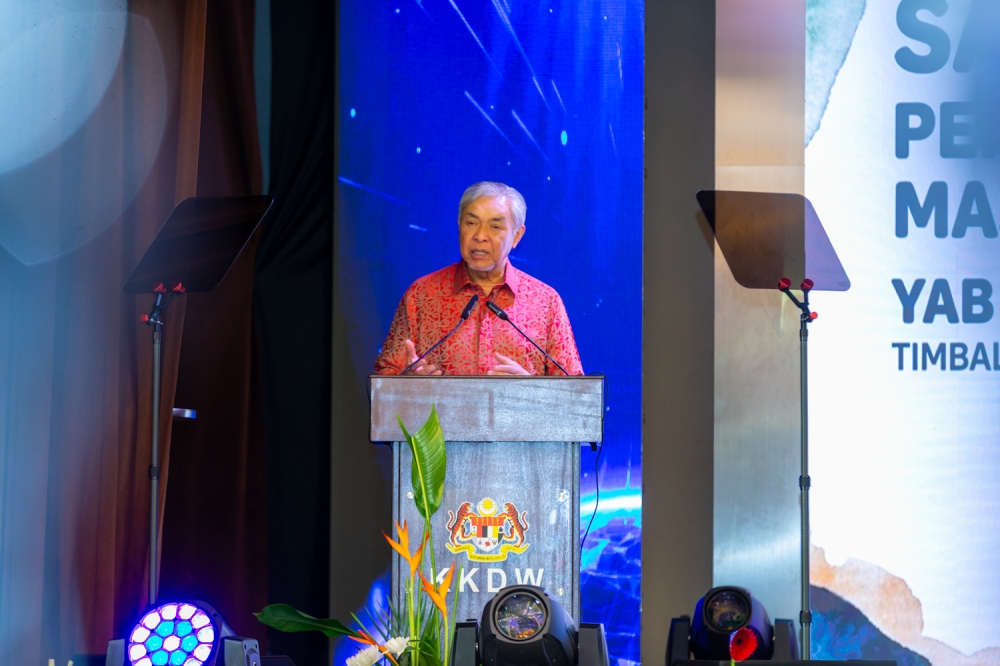
Deputy Prime Minister Datuk Seri Ahmad Zahid Hamidi moved swiftly to quash speculation surrounding alleged high-level political discussions involving major Malaysian coalitions, emphasising that reports of such a gathering bore no credence. His statement from Putrajaya on July 21 came amid social media circulation of claims that senior figures from Barisan Nasional, Perikatan Nasional, Gabungan Parti Sarawak, and Gabungan Rakyat Sabah had convened for secret negotiations, fuelling renewed conjecture about potential shifts in Malaysia's political landscape.
The DPM's categorical denial underscores the persistent volatility that characterises Malaysian politics, where unverified reports of backroom dealings routinely circulate, testing the stability of governing coalitions. In an environment where parliamentary mathematics can shift dramatically with the defection or realignment of a handful of lawmakers, any suggestion of opposition consolidation triggers urgent clarifications from the government camp. Zahid's response reflects the delicate balance that administrations must maintain when addressing such claims—neither engaging extensively with rumour, nor appearing dismissive of legitimate public concern regarding political trajectory.
Zahid's reaffirmation of his allegiance to the unity government formation carries particular weight given his prominent position within Barisan Nasional, which anchors the broader coalition structure. Historically, deputy prime ministers have wielded significant influence in steering party direction during moments of coalition uncertainty, and Zahid's explicit statement thus serves a reassurance function to allies within the government structure. The messaging appears calibrated to prevent any ambiguity that might embolden backbenchers or fringe elements to explore alternative arrangements.
The proliferation of such rumours reflects deeper anxieties within Malaysia's political establishment. The unity government, formally established to stabilise national governance following the 2022 general election, remains dependent on careful coalition management. Any fracturing of the broad agreement that currently underpins parliamentary support for the administration could precipitate fresh instability, complicating efforts to implement longer-term legislative and policy initiatives. For observers tracking Malaysian political dynamics, these periodic eruptions of speculation serve as barometric readings of underlying coalition health.
Perikatan Nasional, which leads the opposition and represents a substantial parliamentary bloc, has generally pursued a critical but measured stance toward the unity administration. Similarly, GPS and GRS—which represent crucial seats from East Malaysia—occupy somewhat ambiguous positions, having chosen to work with rather than directly oppose the government on key votes. Any genuine coordinated movement among these entities would fundamentally alter the parliamentary calculus and potentially threaten government survival. This reality explains why even unsubstantiated claims receive urgent official response.
The timing of such reports often coincides with moments of perceived government vulnerability or broader dissatisfaction within coalition ranks. Malaysian political observers note patterns wherein speculation tends to intensify during periods of legislative gridlock, economic challenge, or intra-coalition tensions. The current cycle of denial and reaffirmation may thus signal not merely reactive damage control, but reflection of genuine underlying discussions about alternative arrangements occurring at various political levels.
Zahid's position as deputy prime minister positions him as a key custodian of Barisan Nasional's interests within the coalition framework. His emphatic restatement of support for the unity government carries institutional weight beyond personal political positioning. By explicitly rejecting the claims, he effectively signals to other government coalition partners that the BN bloc—the largest component of the administration—remains committed to the current arrangement, at least for the immediate term.
Malaysia's coalition politics have long been characterised by fluid arrangements and shifting allegiances, with parties frequently repositioning themselves to secure ministerial positions, influence over policy direction, or enhanced resource allocation. The unity government, despite its stabilising intent, operates within this context of structural instability. Any coalition member contemplating alternative arrangements must carefully assess parliamentary implications and the probability of securing superior terms through realignment. Zahid's intervention attempts to reinforce that the status quo remains the most advantageous configuration for participating parties.
From a Malaysian perspective, such political cycles underscore the ongoing challenge of achieving durable governance frameworks. The unity government was established as a deliberate attempt to transcend the polarisation that characterised previous electoral cycles. Yet the continued circulation of alternative coalition scenarios suggests that this project remains incomplete and that fundamental political consensus around current arrangements has not yet solidified. For Southeast Asian observers, Malaysia's ongoing coalition management offers instructive lessons regarding the difficulty of constructing stable parliamentary majorities across deeply fragmented political systems.
Zahid's statement ultimately serves multiple audiences: government coalition partners seeking reassurance, opposition parties gauging administration resilience, the investment community monitoring political risk, and the broader electorate seeking clarity on governance stability. By categorically rejecting the reports while reaffirming commitment to current arrangements, he attempts to project confidence while acknowledging the legitimate public interest in understanding political trajectories. Whether such interventions prove sufficient to anchor the unity government over the medium term will depend significantly on whether underlying coalition tensions can be managed and whether economic and governance performance sufficiently justifies continued participation by all parties.

