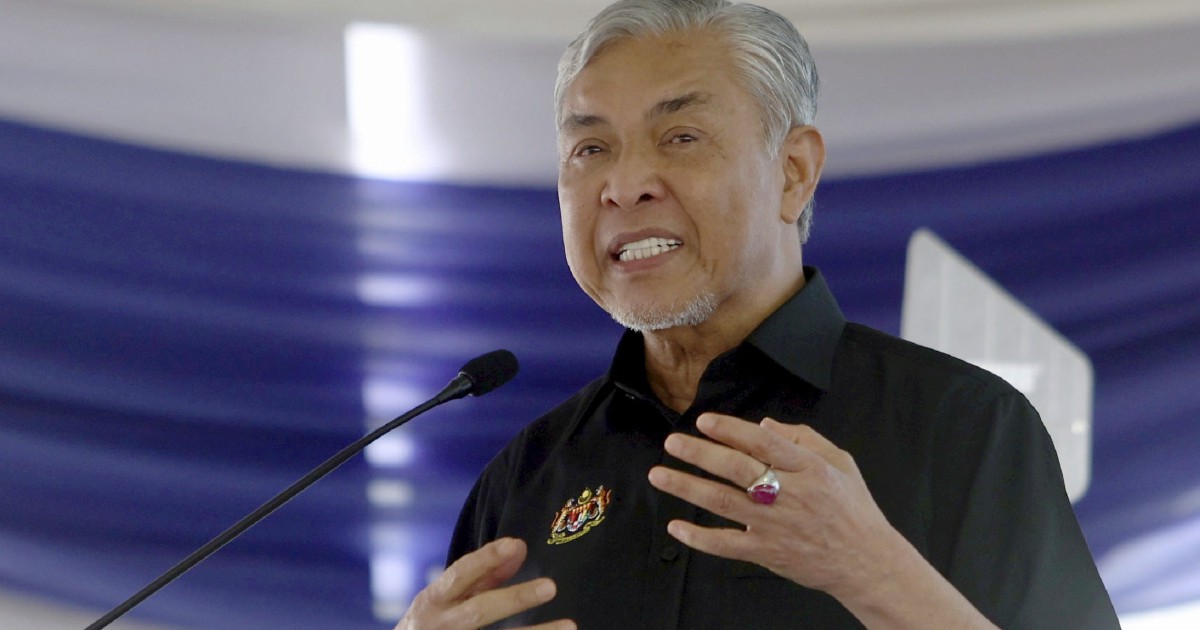
Deputy Prime Minister Datuk Seri Dr Ahmad Zahid Hamidi moved to quell persistent rumours about a snap election yesterday, telling reporters in Tampin that no substantive conversations have taken place within government circles regarding an early dissolution of parliament. His unequivocal statement appears designed to settle mounting speculation that has circulated across political circles and media outlets in recent weeks, particularly as Malaysia's governing coalition faces periodic questions about its cohesion and electoral viability.
The denial carries particular significance given Malaysia's political history of unexpected electoral calls. The timing of Zahid's remarks also reflects broader efforts by the ruling administration to project an image of stability and clear governance direction to the public and international investors alike. By explicitly stating the absence of formal discussions, the Deputy Prime Minister sought to curtail further conjecture that could destabilise market sentiment or trigger unnecessary political manoeuvring among coalition partners.
Political observers note that such categorical statements from senior government figures typically signal a deliberate intent to maintain the status quo rather than court electoral surprises. In Malaysia's context, where coalition governments have grown increasingly reliant on careful management of multiple parties with divergent interests, the predictability of a full five-year term can be advantageous for implementing medium-term policies and budget allocations. Zahid's declaration suggests the administration intends to pursue this conventional timeline.
The backdrop to these remarks involves the United Malays National Organisation's (UMNO) ongoing navigation of its position within the larger Barisan Nasional (BN) coalition and its broader relationships with other political entities. An early election would carry substantial risks, particularly if internal party dynamics or coalition mathematics remained unfavourable. The Deputy Prime Minister's reassurance thus extends beyond mere political theatre—it reflects calculated assessment that current electoral conditions do not warrant an accelerated vote.
Wider regional developments also factor into Malaysian electoral calculations. The global economic uncertainty, inflationary pressures affecting household incomes, and ongoing transitions in regional political dynamics create an environment where governments often prefer stability over gambling on electoral outcomes. By confirming the government's intention to continue its present course, Zahid signals that policymakers are prioritising longer-term governance over short-term political advantage.
The statement also carries implications for Malaysia's smaller coalition partners and independent politicians whose support sustains the current parliamentary majority. Assurances about maintaining the existing electoral calendar reduce pressure on these actors to seek alternative political alignments before a potential snap poll. This dynamic has become increasingly critical in Malaysian governance, where the parliament's delicate equilibrium means that abrupt shifts in political affiliation can fundamentally alter power structures.
For ordinary Malaysians, such pronouncements affect consumer confidence and business planning. Businesses typically benefit from clearer visibility regarding the electoral calendar, allowing them to allocate resources more strategically and coordinate expansion plans around political stability. The certainty provided by Zahid's remarks extends these benefits across the economy and may help stabilise the Malaysian ringgit against currencies affected by regional political uncertainty.
Opposition parties will likely cite Zahid's statement as either a sign of electoral vulnerability or as confirmation that the government recognises its comfortable parliamentary position. The framing of such statements within opposition narratives often depends on broader political messaging strategies and the timeline's proximity to the actual constitutional deadline for the next general election, currently set for June 2028.
Historically, Malaysian Deputy Prime Ministers have occasionally made similar declarations that were subsequently overtaken by political events, though such reversals carry substantial reputational costs. Zahid's explicit denialism here suggests confidence in the coalition's stability or at least a determination to present such stability to the public regardless of underlying tensions. The credibility of such statements ultimately depends on whether intervening months validate the administration's apparent self-assurance regarding coalition cohesion.
The political economy of this announcement extends to Malaysia's position within ASEAN and its bilateral relationships. Foreign governments and investors often take comfort in electoral predictability, viewing snap elections as introducing unnecessary uncertainty into bilateral arrangements and market access. By confirming the standard electoral timeline, Malaysia implicitly signals its commitment to predictable governance and continuous policy implementation.
As Malaysian politics continues evolving with changing generational preferences and emerging political movements, the ruling coalition's ability to maintain internal discipline while projecting unity remains paramount. Zahid's statement represents one component of this broader narrative—a calculated effort to persuade parliament, the electorate, coalition members, and international observers that the current government possesses both the legitimacy and the capacity to serve its intended full term without recourse to premature electoral tests.

