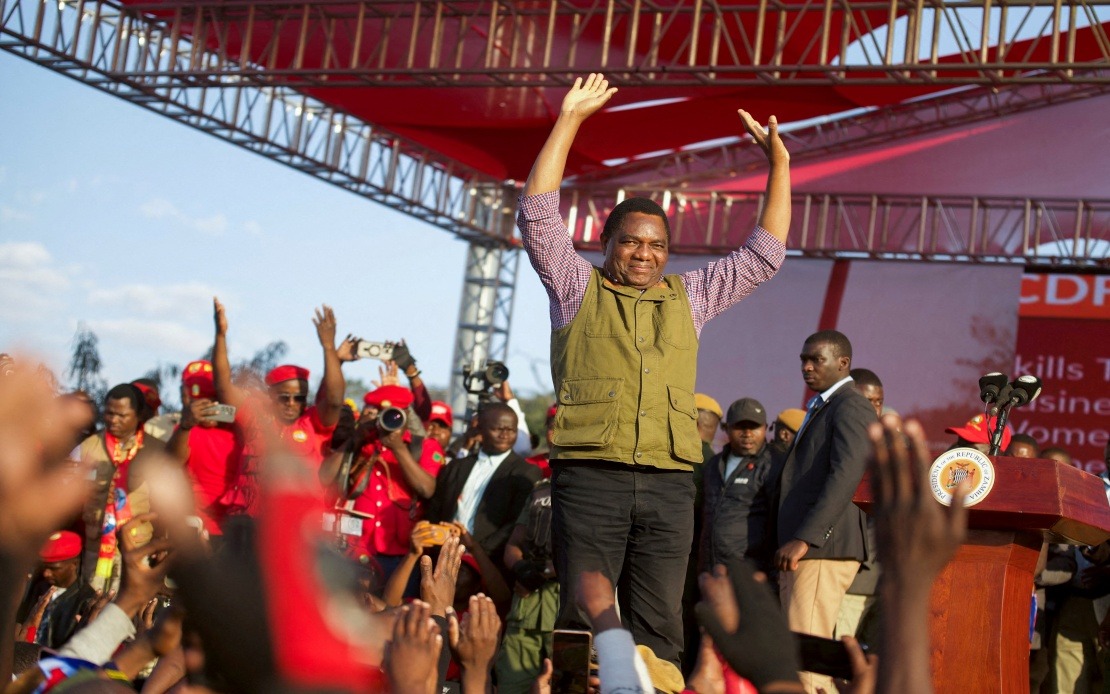
Zambian President Hakainde Hichilema has clinched a second term in office following his commanding performance in last Thursday's presidential election, according to results announced by the Electoral Commission of Zambia early Tuesday morning. The 64-year-old incumbent received more than 2.9 million votes, substantially exceeding the constitutional requirement of 50 per cent plus one vote needed to claim victory. This decisive outcome underscores Hichilema's consolidation of political support just over a year into his initial tenure, positioning him for another five-year mandate.
Hichilema's principal challenger, Brian Mundubile of the National Restoration Party for Unity and Progress (NRPUP), garnered 1.8 million votes, trailing considerably behind the incumbent. The margin of victory was so substantial that Electoral Commission of Zambia chairperson Mwanagala Zaloumis determined the remaining uncounted ballots from selected polling stations across five of Zambia's 226 constituencies would be immaterial to the final outcome. This assessment allowed officials to declare Hichilema president-elect without awaiting complete tabulation, a procedurally sound decision given the mathematical impossibility of the remaining votes reversing the result.
The announcement triggered spontaneous celebrations throughout Lusaka's streets well before the official declaration and continued well into the morning hours as citizens from diverse backgrounds converged to express their enthusiasm. Despite the early hour and cool temperatures characteristic of Zambia's winter season, crowds remained buoyant and energised, reflecting broad public engagement with the electoral process. This visible display of civic participation and acceptance of results demonstrated the democratic character of the election and the public's willingness to participate actively in shaping their nation's political direction.
Reacting to his re-election through social media, Hichilema struck a humble and inclusive tone, acknowledging the electorate's decision and reaffirming his commitment to serving the nation. His statement emphasised gratitude for the trust placed in his hands and framed his second term as an opportunity to continue serving as the country's principal administrator. This messaging approach sought to unite the broader population behind his administration and signal continuity in governance priorities. The tone adopted by the president-elect suggested recognition that maintaining political cohesion would be essential for addressing Zambia's substantial economic and social challenges in the coming years.
Collins Maoma, the national chairperson of Hichilema's United Party for National Development (UPND), addressed media representatives following the official declaration, urging the victorious president to maintain the standards of leadership that had resonated with voters. His public remarks functioned both to celebrate the ruling party's success and to establish expectations for the incoming administration, highlighting the party's emphasis on consistent governance quality. Maoma's statement reflected the UPND's confidence in their mandate while suggesting that the party leadership anticipated the president would build upon accomplishments and policy directions established during his first term.
The election result represents a significant political development for Southern Africa, where presidential re-election bids often face unpredictable outcomes due to shifting economic circumstances and voter sentiment. Zambia has experienced considerable macroeconomic pressures in recent years, including challenges related to debt management and currency stability. Hichilema's successful re-election despite these headwinds suggests either that voters credited his administration with implementing stabilising measures or that they perceived his approach as preferable to opposition alternatives. The verdict provides important context for understanding regional political dynamics and the factors influencing electoral outcomes across the continent.
For Malaysia and other Southeast Asian nations maintaining diplomatic and trade relationships with Southern African countries, Zambia's stable political transition carries broader implications. Predictable governance transitions facilitate more consistent bilateral engagement and economic partnerships. The peaceful and orderly nature of Zambia's election process, coupled with the acceptance of results by opposition candidates and the electorate more broadly, demonstrates institutional resilience in electoral administration and respect for democratic norms. These factors typically create conditions conducive to sustained foreign investment and diplomatic cooperation, matters of interest to nations seeking reliable trading partners and political allies across the African continent.
Hichilema's first term has encompassed efforts to address Zambia's pressing fiscal challenges, including negotiations with international creditors and implementation of economic reform measures. His re-election provides legitimacy and political capital for continuing these initiatives into his second mandate. The UPND's confidence in the president's continued leadership, as expressed by party officials, suggests the ruling coalition intends to pursue consistent policy directions across priority sectors including energy, mining, and infrastructure development. These portfolios directly intersect with international commerce and investment patterns relevant to Malaysian companies and investors with African exposure.
The electoral commission's methodical approach to result verification, despite declaring Hichilema the president-elect before complete tabulation, reflected both confidence in the preliminary tallies and respect for constitutional timelines governing presidential transitions. This balance between administrative efficiency and thoroughness illustrates the institutional maturity expected in contemporary African electoral systems. Zambia's approach compares favourably with international best practices for rapid result declaration while maintaining data integrity, an increasingly important consideration as African nations enhance their electoral infrastructure and democratic institutions.
Looking ahead, Hichilema's second term will likely focus on consolidating economic stabilisation gains and addressing the inflation and unemployment challenges that have characterised recent Zambian experience. His administration's success in implementing these priorities over the coming five years will determine whether his re-election marks a turning point toward sustained recovery or represents merely a temporary reprieve from persistent structural difficulties. The international community, including Malaysia and other trading nations, will monitor Zambian governance closely to assess the trajectory of institutional development and political stability in this strategically positioned Central African nation.

