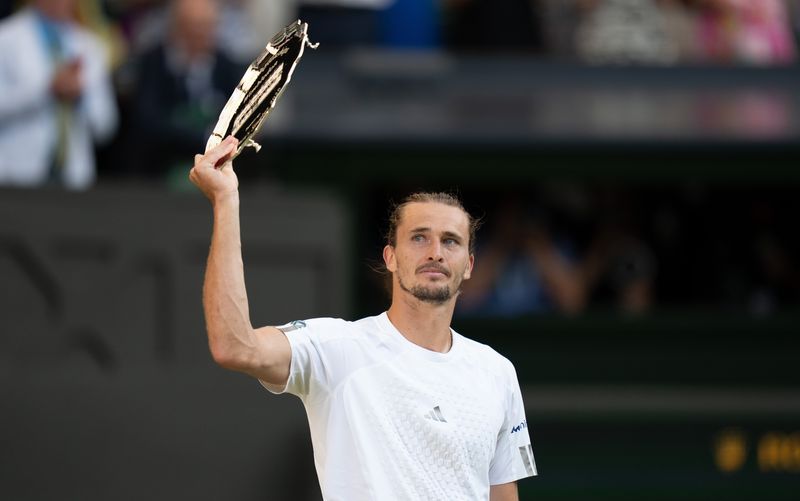
Alexander Zverev's steady ascent up the world rankings will reach a new peak on Monday when he officially claims the ATP number two position, yet the German recognises that the gap between himself and the sport's current elite remains formidable. Despite his runner-up finish at Wimbledon following a four-set final loss to Jannik Sinner on Sunday, Zverev is increasingly convinced that a fundamental shift in his tactical approach—one emphasising aggressive baseline play and attacking opportunities—represents his best pathway to eventually challenging the dominance of Sinner and Carlos Alcaraz at tennis's marquee events.
The 29-year-old's display on Centre Court against world number one Sinner proved far more competitive than the overwhelming majority of their previous encounters. In a contest that stretched across four sets with a tiebreak decided in the opening frame, Zverev snapped a frustrating streak of 14 consecutive lost sets against the Italian before ultimately succumbing 6-7(7) 7-6(2) 6-3 6-4. While the loss extended his head-to-head record against Sinner to 0-10, the manner of his performance suggested genuine competitive parity for stretches of the match—a marked departure from encounters where the Italian has typically dismantled the German's defences with authoritative efficiency.
A decisive moment emerged during the third set when Zverev held what proved to be his only genuine break point opportunity at 3-3. A fall at that juncture appeared to shift momentum decisively, and had he converted that chance and continued his upward trajectory, he could have realised a historic achievement as the first German man to claim the singles crown at the All England Club since Michael Stich in 1991. Instead, that tumble effectively redirected the match's trajectory, with Sinner consolidating and ultimately imposing his authority across the final two sets.
Zverev's Grand Slam credentials took a significant step forward last month when he captured his first major title at the French Open after 41 previous attempts, though some observers noted the particular circumstances that surrounded that triumph. Jannik Sinner fell unexpectedly in the second round at Roland Garros, whilst Carlos Alcaraz remained sidelined throughout the tournament due to an ongoing wrist injury. Notwithstanding these contextual factors, the psychological breakthrough proved transformative for the German, injecting a newfound confidence that manifested itself through the more aggressive tactical approach he implemented throughout his Wimbledon campaign.
Zverev's game underwent a noticeable transformation across the fortnight on grass, particularly through his willingness to attack with his forehand—a stroke that historically had been criticised for excessive caution and lack of conviction. That methodical, risk-averse approach gave way to a far more aggressive posture, with the German routinely stepping inside the baseline to dictate play and punish any shortage of precision from his opponents. In the final against Sinner, his first serve percentage maintained respectable levels hovering near eighty percent for substantial portions of the match, whilst his forehand proved sufficiently destructive to test the Italian's typically impeccable court positioning and retrieval capabilities.
When discussing his strategic evolution, Zverev articulated a clear philosophical commitment to this attacking methodology that extends beyond the immediate tournament cycle. He acknowledged that the year began with adjustments to this aggressive template, noting that some early-season matches revealed inconsistency in execution as he refined the approach. However, his steadfast commitment to maintaining this attacking blueprint throughout the campaign has progressively yielded improved results, with the German convinced that continued refinement of this technique will yield even greater dividends. His recent success at major championships suggests the strategic recalibration has achieved genuine traction.
Whilst Sinner and Alcaraz collectively command twelve Grand Slam titles between them, establishing themselves as the sport's unquestionable elite, Zverev nonetheless projects genuine optimism regarding his capacity to ultimately establish himself as a consistent major championship contender capable of defeating these rivals on tennis's biggest stages. He characterised his recent performances against both players as evidence of incremental progress, noting that whilst he has yet to defeat either on this calendar year, he has consistently pushed both towards their competitive limits. His Australian Open challenge against Alcaraz and his Wimbledon performance against Sinner demonstrated sufficient quality to suggest he is narrowing the competitive distance, even in matches that ultimately ended in defeat.
The narrative surrounding tennis's third force has preoccupied observers throughout recent seasons, with Zverev perpetually cast in that role yet frequently positioned far below the top two in terms of realistic competitive capacity. His reflection on this dynamic reveals an athlete keenly aware that actual competitive proximity requires more than abstract ranking placement. If he can sustain this aggressive trajectory and translate it into victories against Sinner and Alcaraz in significant tournaments, the distinction between occupying the third spot and genuinely competing for major titles would fundamentally alter his career narrative.
The physical toll of his Wimbledon final extended beyond the psychological disappointment of falling short on Centre Court. Zverev sustained a knee injury during that crucial third-set tumble, rolling his knee in a manner disturbingly reminiscent of a similar injury sustained two years prior. The immediate consequence manifested through degraded serving mechanics, with his capacity to generate maximum velocity from his delivery compromised as he struggled to push through the serve's explosive extension phase. This mechanical limitation coincided with a temporary dip in his overall performance level during the third set, though he subsequently regained his form in the fourth as the adrenaline sustained his competitive engagement.
Despite the ultimate outcome, Zverev's assessment of his Wimbledon performance projected an athlete conscious of having reached a genuine inflection point in his career trajectory. The consistent quality he maintained throughout the final—notwithstanding the physical setback—suggested that his aggressive playing philosophy is yielding substantive dividends. For Malaysian and Southeast Asian tennis followers tracking the sport's evolution, Zverev's pathway represents a compelling alternative narrative to the Sinner-Alcaraz duopoly that has otherwise defined men's tennis throughout 2024.
Looking forward, the question confronting Zverev involves whether he can maintain the aggressive tactical discipline required to consistently challenge the sport's elite whilst simultaneously managing the physical demands of playing such an attacking brand of tennis across extended campaigns. His recent achievements demonstrate that this pathway remains viable, yet sustained success against Sinner and Alcaraz will require not merely stylistic adjustment but also the kind of consistent execution under pressure that has thus far remained elusive. The Wimbledon final, despite its unsuccessful conclusion, provided genuine evidence that such competitive equilibrium may eventually prove achievable.

