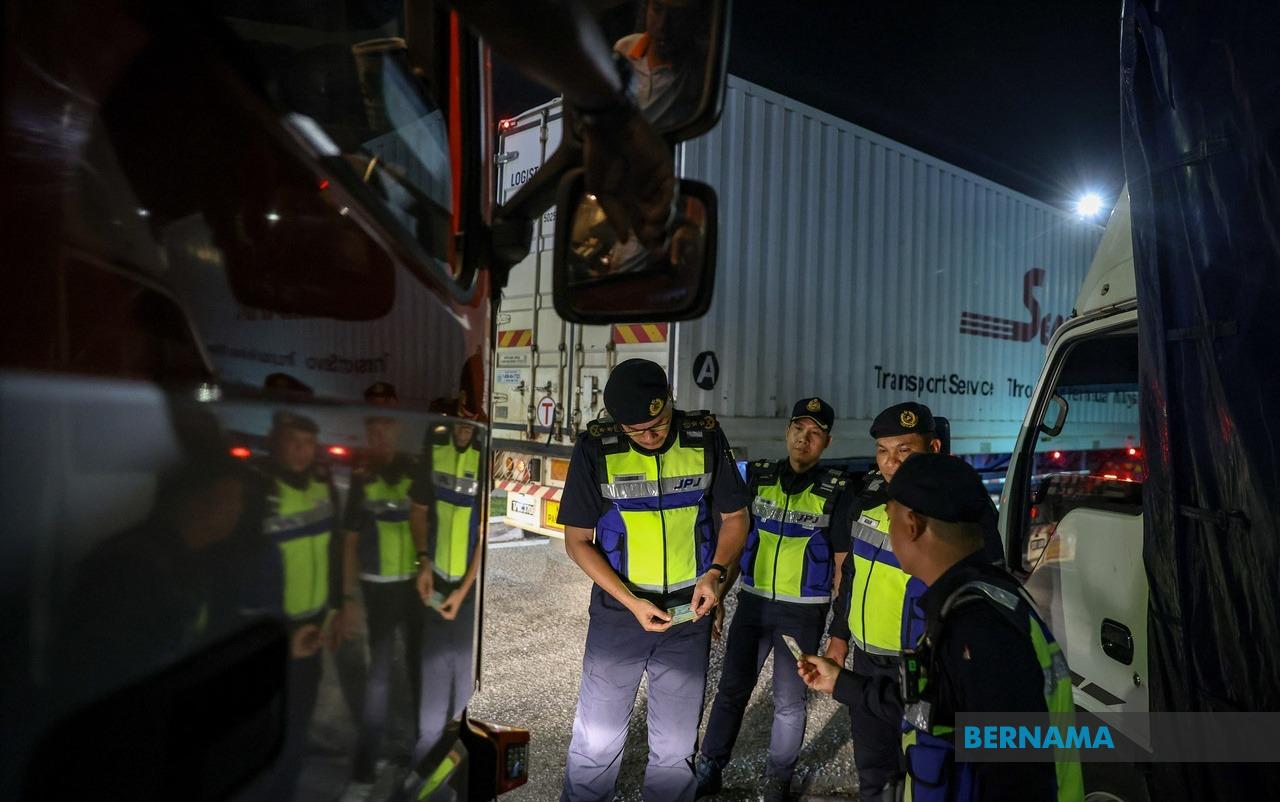
Johor's road transport authorities have concluded a significant anti-drug enforcement campaign that exposed an alarming level of substance abuse among commercial drivers, with 16 individuals testing positive for various drugs during screening operations conducted from July 1 through July 15. The coordinated initiative, led by the Johor Road Transport Department (JPJ) in partnership with the Royal Malaysia Police (PDRM), the National Anti-Drug Agency (NADA), and PLUS Malaysia Berhad, targeted goods vehicles and public service operators at critical checkpoints across the state, revealing both a drug compliance issue and broader road safety concerns within the transportation sector.
According to Johor JPJ director Zulkarnain Yasin, the operation processed 164 drivers through mandatory urine screening tests, with roughly one in ten failing to comply with drug-free standards. Of those testing positive, methamphetamine emerged as the dominant substance of concern, with 10 drivers detected for use of the drug or its crystalline variant commonly known as "ice." The screening also identified three drivers positive for ganja, two for morphine, and one for an unspecified narcotic, indicating a diverse pattern of substance dependency among operators responsible for transporting goods and passengers across major highways and urban routes.
The operational scope extended beyond the central highway corridor, encompassing screening points at three strategically important locations: a major highway rest and service area, the enforcement station adjacent to the JPJ's Johor operations centre, and a prominent bus terminal. This multi-venue approach reflected an understanding that substance abuse among drivers requires oversight at various intersection points where commercial vehicles congregate, congregate, rest, and commence journeys. By stationing screening teams at rest facilities alongside enforcement hubs and passenger terminals, authorities aimed to capture the widest possible cross-section of the commercial transport workforce.
The consequences for those identified as drug users are substantial and designed to remove impaired operators from active service. JPJ has authority under Section 56(4) of the Road Transport Act 1987 to suspend or revoke the vocational driving licences of individuals who test positive for controlled substances, effectively barring them from legally operating commercial vehicles pending rehabilitation and re-certification. This mechanism represents a critical safeguard, as drivers under the influence of narcotics pose demonstrable risks to themselves, passengers, and other road users, particularly given the long-distance nature of many commercial routes and the heavy machinery involved.
Beyond the drug-related findings, the operation unveiled a systemic problem of non-compliance with basic road safety and vehicle regulatory standards across the commercial transport sector. Enforcement teams documented 707 instances of drivers operating without valid driving licences, an alarming figure that suggests widespread gaps in credential verification and possible employment of undocumented or unqualified personnel. A further 626 vehicles carried expired road tax documentation, while 574 lacked current insurance coverage, each violation independently exposing operators to legal liability and creating potential compensation gaps in the event of accidents.
Vehicle-specific infractions pointed to deficiencies in maintenance standards and regulatory adherence among commercial operators. The operation detected 128 instances of vehicles lacking proper Goods Vehicle Licences (GDL), 113 overweight vehicles exceeding load specifications, and 51 vehicles with expired PUSPAKOM (Malaysian Automotive Research and Development Corporation) inspection discs. These violations carry both safety and economic dimensions: overloaded vehicles accelerate wear on road infrastructure, compromise vehicle handling and braking capacity, and increase accident risk, while unlicensed goods vehicles often lack proper insurance and maintenance protocols.
Technical defects formed a substantial component of the violations recorded, with 39 cases of unauthorised vehicle modifications, 30 instances of non-compliant tyres, and 928 additional technical violations across the examined fleet. These figures suggest that cost-cutting pressures within the commercial transport industry may be incentivising operators to defer proper maintenance, modify vehicles in ways that compromise safety systems, and source substandard components to reduce operational expenses. For Malaysian road users, such practices translate to increased hazard levels on major highways, particularly the North-South Expressway and other arterial routes where heavy commercial traffic predominates.
The integrated operational model employed by JPJ, PDRM, NADA, and PLUS Malaysia demonstrates a recognition that commercial vehicle safety requires multi-agency coordination spanning drug enforcement, traffic policing, licensing oversight, and infrastructure management. No single agency possesses the jurisdiction and resources to adequately monitor the commercial transport ecosystem, which encompasses federal expressways, state highways, and municipal routes. NADA's participation underscores the nexus between substance abuse and transportation safety, as impaired driving ranks among the leading preventable causes of commercial vehicle accidents in Malaysia.
For the broader Southeast Asian region, Malaysia's commercial transport sector serves as a critical logistics backbone, with goods vehicles regularly traversing international borders to Thailand, Brunei, and Singapore. Deficiencies in driver screening, vehicle maintenance, and regulatory compliance therefore possess implications beyond national roads, potentially affecting cross-border supply chains and creating reputational risks for Malaysian operators in regional trade networks. The operation's findings suggest that enhanced vetting mechanisms and technology-enabled compliance monitoring could yield significant improvements in safety and operational standards.
The scale of violations uncovered raises questions about the adequacy of routine enforcement mechanisms and the compliance culture within commercial transport companies. The 1,500-plus combined violations detected across a single operation indicate that intermittent roadside checks may be insufficient to ensure consistent adherence to safety standards. Transport operators may perceive the risk of detection during casual patrols as manageable given the statistical likelihood of evading enforcement, creating rational incentives to defer maintenance and employ inadequately qualified personnel. Sustained, visible enforcement operations may be necessary to shift operator behaviour and genuinely improve road safety outcomes across the state.
Looking ahead, the findings from this Johor operation will likely inform policy discussions regarding licensing renewal intervals, vehicle inspection frequencies, and penalties for regulatory violations among commercial operators. The prevalence of drug use among drivers suggests that routine fitness-to-drive assessments should encompass substance screening protocols, transforming such tests from exceptional enforcement measures into standard occupational health requirements. For Malaysian road users and regional trading partners, the operation represents both a cautionary signal regarding current safety gaps and an encouraging indicator that authorities are actively identifying and addressing compliance failures within the commercial transport sector.

