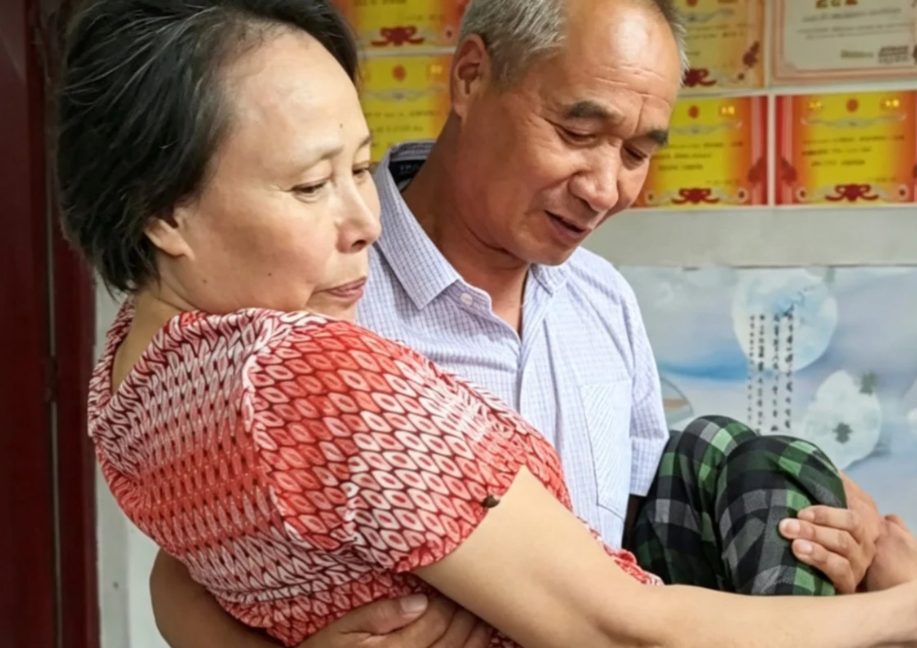
In the quiet city of Pingdingshan, nestled in Henan province in central China, an extraordinary tale of marital commitment has captivated millions online across the country. For a quarter-century, Li Junliang has devoted himself entirely to caring for his wife Jia Fang, who sustained a catastrophic spinal injury that left her paralysed from the chest down. Their story, now widely circulated on Chinese social media, speaks to enduring values of family loyalty and personal sacrifice that resonate throughout East and Southeast Asia, where such narratives often reflect broader cultural expectations around spousal duty and lifelong commitment.
The pivotal moment that transformed their lives came in 2001 when Jia Fang, then aged 36, suffered a devastating fall from a cliff while riding in a pedicab—an accident so severe that it left her unable to move or care for herself in any capacity. Li Junliang, one year her senior, made the immediate decision to become her full-time caregiver, a responsibility that would eventually span more than two decades. At the time of the accident, their two children were still young, just 10 and 13 years old, meaning Li faced the dual burden of maintaining household operations while ensuring his wife's survival and comfort.
The physical demands of such caregiving cannot be understated. In those early years following Jia's accident, Li turned his wife's body every two hours without fail to prevent the development of potentially life-threatening bedsores—a routine that guaranteed he would never experience an uninterrupted night's sleep. As time progressed and their circumstances stabilised somewhat, he adjusted this schedule to every four hours, yet the cumulative effect remains profound. For two decades, Li has sacrificed the fundamental human need for restorative sleep, a reality that has visibly aged him and turned his hair completely grey, as his wife would later observe with both admiration and sorrow.
Beyond preventing physical deterioration, Li has implemented a comprehensive care regimen that extends to emotional and mental wellbeing. He regularly lifts his wife into a wheelchair and wheels her outside to experience sunshine and fresh air—simple human pleasures that someone in her condition might otherwise never know. He performs regular massage therapy on her limbs to combat muscular atrophy, maintaining her physical condition to the greatest extent possible given the constraints of her paralysis. The specificity and consistency of these interventions suggest a man who has studied caregiving extensively and approached his responsibility with deliberate, thoughtful methodology rather than mere duty.
The broader context of their family life reveals the full scope of Li's sacrifices. While maintaining round-the-clock care for his wife, he simultaneously raised two children through their formative years, overseeing their education and development during a period when many families would have struggled under such circumstances. Their home walls display certificates of academic achievement from when the children were students, tangible evidence of the care and attention Li provided despite his overwhelming caregiving obligations. Eventually, both children grew to adulthood and established their own families, yet Li's commitment to his original charge never wavered.
Financial arrangements remain murky in the family's story, with reports containing no clear explanation of how Li has sustained his family over 25 years while providing full-time care to his wife. The absence of documented employment raises questions about whether he receives government assistance, relies on family support, or has managed to balance occasional work with his caregiving duties. This lacuna in the narrative reflects a broader reality across Asia: the economics of long-term caregiving remain largely invisible, and families managing such situations often navigate bureaucratic systems with minimal public support or acknowledgment.
Jia Fang herself has become vocal about her appreciation, expressing to media that her husband works tirelessly while she watches his hair turn grey—a poignant image of sacrifice she feels acutely. She has publicly stated that she considers herself the happiest person in the world because she married the right man, a declaration that frames their relationship not as a burden endured but as a profound partnership. Her gratitude is not abstract; she has thanked him specifically for 25 years of care, acknowledging the magnitude of what she has asked him to provide, even if not deliberately.
Li's own words reveal the philosophical framework underpinning his commitment. When responding to his wife's gratitude, he references his wedding day promise that home is complete only with her presence—a romantic sentiment transformed into literal daily practice. He further pledges to continue caring for her not merely for another 25 years, but potentially for 35 or 45 years more, extending well into what would be both their twilight years. This is not the statement of a man grudgingly fulfilling an obligation, but rather someone who has fundamentally integrated caregiving into his identity and life purpose.
Their community has noticed and appreciated his devotion. An unnamed neighbour interviewed in the report expressed amazement at Li's commitment, noting that many men would struggle to maintain such care over such extended periods, and marvelling that despite the demands, their home remains clean and orderly—suggesting Li manages household management alongside medical caregiving. This observation is not incidental; it speaks to the exhaustion required to maintain both personal care for a dependent adult and basic household operations simultaneously.
The story has generated profound reactions online across mainland China, with observers expressing emotional resonance to the couple's journey. Comments range from spiritual reflection—suggesting that such loyalty will be divinely rewarded—to practical admiration for actions that few would willingly undertake. For Southeast Asian readers, the story engages deeply with cultural narratives about filial piety, spousal loyalty, and the unspoken obligations that bind families together across difficult circumstances. In societies where extended family care and personal sacrifice remain valued, if sometimes romanticised, Li Junliang's quarter-century of service challenges and affirms traditional expectations simultaneously.
The broader implications of this narrative deserve consideration. While Li's devotion merits genuine admiration, his story also illuminates the invisible labour burden that caregiving imposes, predominantly on individuals—disproportionately women in most societies—who forego personal development, career advancement, and life aspirations. That such stories become celebrated on social media suggests societies recognise the extraordinary nature of sustained caregiving, yet simultaneously normalise the expectation that family members will provide such care with minimal external support or societal acknowledgment. The question lingers: should caregiving of this magnitude require such heroic individual sacrifice, or do such stories expose gaps in how Asian societies structure care and support for their most vulnerable members?

