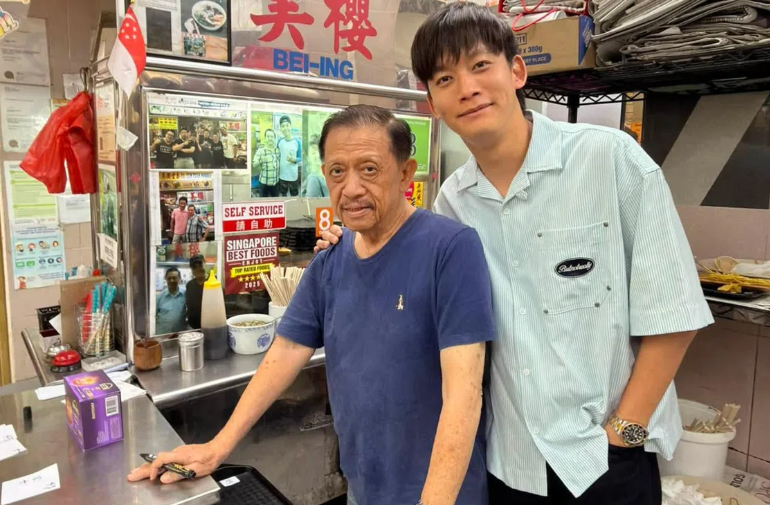
Singaporean actor Noah Yap has firmly rejected allegations that his visit to an injured elderly hawker at Roxy Square was motivated by a desire for media attention and public spotlight. The actor struck back at online detractors who had questioned his intentions, insisting that his concern for the elderly vendor was genuine and rooted in a deeply personal relationship spanning more than two decades.
Critics had taken to social media to suggest that Yap's decision to visit the hawker and subsequently post about the encounter was a calculated move to generate publicity and draw attention to himself before other public figures could do the same. One commenter specifically described Yap as a "smart actor fighting for limelight immediately before others", implying that his gesture was primarily self-serving rather than altruistic. The accusation appears to have struck a nerve, prompting the actor to issue a direct and somewhat caustic response to his detractors online.
In his defence, Yap laid out the foundation of his relationship with Bei-Ing Wanton Noodle and its proprietor, Yeo, explaining that the connection predated his rise to prominence. According to Yap, he has been a regular customer at the stall continuously since his primary school years, making the business relationship span more than 20 years of his life. This long-standing patronage suggests that any concern he expressed would be rooted in genuine affection rather than opportunism, as he would have had countless earlier opportunities to leverage the relationship for publicity had that been his intent.
Yap further emphasised the personal nature of his bond with the elderly hawker by noting that Yeo and his family members had consistently shown interest in his wellbeing during their regular interactions at the stall. The actor characterised this as evidence of a reciprocal relationship built on mutual care and respect, describing Yeo as someone who "practically saw me grow up". This detail paints a picture of an informal familial connection rather than a transactional business relationship, which undermines the narrative that Yap's visit was purely self-promotional.
The incident that prompted Yap's visit occurred at Roxy Square coffee shop on August 15, when a video of a physical altercation between Yeo and a younger man circulated rapidly across social media platforms. According to accounts provided by Yeo and his family members, the elderly hawker had been walking past a table after closing his stall when he noticed a young girl at a neighbouring table. Yeo, apparently charmed by the child's appearance, reached out and gently patted her on the head in what he viewed as a harmless and friendly gesture.
The situation escalated when the girl's father intervened and confronted Yeo, leading to a physical confrontation that was captured on closed-circuit television cameras installed at the establishment. The footage that subsequently surfaced online appeared to show the younger man grabbing Yeo and forcefully shoving him to the ground, an act of violence that generated significant public outrage and sympathy for the elderly hawker. Police authorities have since confirmed that a formal report was lodged and investigations are currently underway to determine the appropriate course of action.
Yap visited Yeo the following day, on August 16, to assess his condition and provide support during what must have been a distressing period for the elderly vendor. Despite the visible injury and the traumatic nature of the incident, the actor found Yeo maintaining a positive outlook and good spirits. However, the elderly hawker initially demonstrated reluctance to seek formal medical treatment, a concern that Yap likely shared with him during their conversation.
In addressing his online critics, Yap included a pointed barb directing them to "get a life", suggesting that those levelling accusations against him were perhaps spending excessive time on social media scrutinising the actions of public figures. He further noted that he does not possess the kind of free time that would allow him to fabricate charitable gestures for publicity purposes, implying that his schedule as a working actor keeps him sufficiently occupied without needing to engineer controversy or goodwill through strategic public relations moves.
Beyond the personal defence, Yap used his social media platform to advance a broader message about the incident itself. He explicitly condemned violence as a response to any situation, emphasising that "violence is never the answer" and should not be employed regardless of the circumstances or perceived provocation. The actor simultaneously called for greater kindness and compassion within society, suggesting that Yeo's initial gesture toward the child—however it might be interpreted—did not warrant the violent response he received.
The case touches on broader questions about public figures' responsibilities when they witness or become aware of incidents affecting ordinary citizens in their communities. Yap's decision to visit and post about the encounter reflects a growing expectation that those with platforms should use them to amplify voices of vulnerable people. Yet his experience also demonstrates the inherent tension such actions create: any attempt by a celebrity to draw attention to an ordinary person's plight runs the risk of being dismissed as self-serving by online observers who may already hold cynical views about public figures' motivations.
For Malaysian and Southeast Asian readers, the incident underscores tensions that exist across the region regarding respect for elderly citizens and the cultural norms around gestures of affection toward children. The explosive reaction to Yeo's pat on the head reflects evolving sensibilities around physical contact with strangers' children, a norm shift that has occurred rapidly in recent years. Yap's defence of his elderly friend, combined with his criticism of the violent response, positions him as defending traditional community values while simultaneously acknowledging contemporary concerns about appropriate behaviour.

