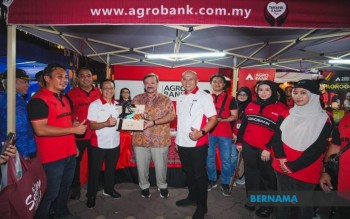
Agrobank is ramping up efforts to bring financial services directly to small-scale traders and micro-entrepreneurs across Malaysia, with engagement sessions at Sabah's Api-Api Night Market and Papar Tamu Farmers' Market generating more than RM8 million in financing applications. The on-the-ground initiative represents a shift in approach by the agricultural development bank, moving away from traditional office-based service delivery towards meeting business owners where they operate, a strategy that has already gained traction in the Klang Valley before expanding eastward to Borneo.
The two Sabah sessions engaged with a combined 248 traders, with the Api-Api Night Market session alone reaching 153 hawkers and entrepreneurs. Papar Tamu Farmers' Market attracted 95 traders, both venues chosen specifically for their prominence as economic anchors within their respective communities. These are not random locations but carefully selected hubs where informal and formal small business activity thrives, places where owners typically operate with limited banking access and face barriers to conventional lending processes.
The financing discussions at these markets centred on addressing immediate business needs, particularly working capital requirements and expansion plans. For many hawkers operating on tight margins, access to quick capital for inventory, equipment, or operational scaling has traditionally meant turning to informal lending sources or relying on retained earnings. Agrobank's direct approach attempts to bridge this gap by explaining formal financing products in settings familiar to traders, reducing the intimidation factor that often keeps micro-entrepreneurs away from banks.
Finance Minister II Datuk Seri Amir Hamzah Azizan's presence at the sessions underscores the political importance assigned to inclusive financial access. This visibility signals government commitment to ensuring that development banking initiatives reach beyond Peninsular Malaysia into East Malaysian states, where geographical dispersion and smaller merchant populations have traditionally made targeted outreach more expensive and challenging. Sabah's expansion demonstrates willingness to invest resources in markets that major commercial banks often overlook.
Agrobank Group president and chief executive officer Datuk Tengku Ahmad Badli Shah Raja Hussin emphasised that each business community confronts distinct challenges requiring tailored solutions. The Sabah presence, he stressed, allows the bank to develop deeper understanding of local trading dynamics and customise support accordingly. This insight reflects growing recognition that off-the-shelf financing products designed for Peninsular contexts may not optimally serve East Malaysian traders facing different supply chains, market structures, and seasonal patterns.
The engagement sessions serve purposes beyond immediate loan disbursement. They function as market research opportunities, allowing Agrobank to gather intelligence about trader concerns, identify common obstacles to business growth, and understand what additional services—beyond pure financing—might strengthen business sustainability. Financial advisory support and non-financial guidance addressing business management practices have become integral components of Agrobank's support ecosystem, recognising that capital alone does not ensure business success.
This initiative connects directly to Prime Minister Datuk Seri Anwar Ibrahim's directive for financial agencies to accelerate outreach and disburse RM5 billion in financing to small traders. The broader policy context reveals government anxiety about whether traditional banking channels adequately serve the micro-entrepreneur segment, particularly crucial during post-pandemic recovery phases when working capital constraints threaten business viability. Agrobank's expanded grassroots presence becomes a policy implementation mechanism, translating high-level directives into tangible field operations.
The RM8 million in applications collected through these sessions represents actual demand articulation—traders self-selecting to engage and express financing needs when barriers to access are lowered. This distinguishes the figure from theoretical estimates of unmet financing demand, offering concrete evidence that accessibility gaps persist in the informal and micro-business sectors. The conversion rate from applications to actual disbursements will ultimately determine whether this outreach translates into meaningful economic impact.
For Malaysian readers, particularly those in smaller towns and rural areas, these sessions illustrate a broader trend of financial institutions recognising the limitations of centralised service delivery models. Night markets and farmers' markets represent informal economic spaces that generate substantial economic activity but often remain peripheral to formal financial planning. Agrobank's presence in these venues legitimises informal business structures and signals that the banking system increasingly acknowledges its responsibility to support this segment rather than reserving services for formally registered, larger enterprises.
The expansion to Sabah also carries strategic implications for East Malaysian economic development. Small trading and hawking activities disproportionately constitute economic activity in less densely populated regions. Improved access to capital for these micro-entrepreneurs can strengthen local purchasing power, support agricultural value chains, and reduce economic dependency on a handful of large corporations or government employment. The sessions thus represent not merely banking outreach but potential catalysts for more distributed, locally-rooted economic growth patterns.
Looking forward, the success of these engagement sessions will likely influence how Agrobank and other development financial institutions allocate resources. If conversion rates from applications to approvals remain healthy and disbursed loans demonstrate reasonable repayment performance, this model may expand further into Sarawak and rural Peninsular locations. The approach proves that accessibility and relationship-building matter as much as product design when serving marginalised borrower segments who may lack business registration documents or conventional collateral but operate viable enterprises deserving financial support.

