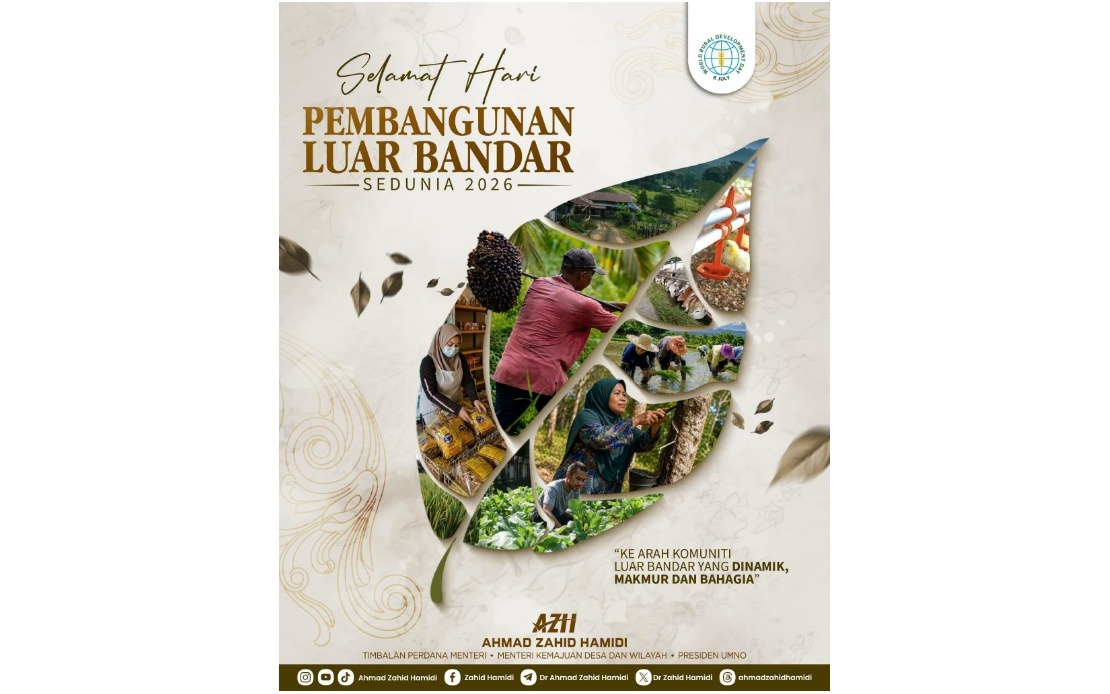
Malaysia marked its inaugural observance of World Rural Development Day on July 6, 2026, with Deputy Prime Minister Datuk Seri Dr Ahmad Zahid Hamidi emphasizing the critical role of the Ministry of Rural and Regional Development in advancing the nation's rural agenda. Speaking on the occasion, Ahmad Zahid stressed that the ministry remains committed to ensuring rural populations gain equitable access to economic opportunities, enhanced infrastructure, and improved living standards that align with Malaysia's broader development trajectory.
The Rural and Regional Development Minister articulated a vision where rural communities would no longer be marginalised in the nation's progress narrative. Instead, he championed a comprehensive approach that positions rural development as integral to Malaysia's economic resilience and social cohesion. This pivot reflects growing recognition within government circles that sustainable national development requires deliberate investment in regions beyond urban centres, where significant populations remain underserved in terms of digital infrastructure, educational facilities, and commercial opportunities.
The establishment of July 6 as an annual commemorative date carries symbolic weight beyond mere administrative scheduling. Ahmad Zahid highlighted that the date aligns with the founding of the Centre on Integrated Rural Development for Asia and the Pacific, an international organisation that has long facilitated knowledge exchange and policy coordination on rural advancement across the Asian and Pacific regions. This historical coincidence positions Malaysia's observance within a broader regional framework, suggesting openness to adopting international best practices in rural development strategies.
Malaysia's inaugural celebration took place at the Tun Abdul Razak Stadium in Jengka, situated near Maran in Pahang state. The venue selection, in a locality with predominantly rural characteristics, underscores the government's intention to ground the commemoration in communities it seeks to uplift. The event's thematic focus—'Toward Vibrant, Prosperous and Happy Rural Communities'—encapsulates aspirational messaging centred on three interconnected pillars: community innovation, rural digitalisation, and rural entrepreneurship development.
The three-pillar framework reflects contemporary understanding that rural advancement requires simultaneous intervention across technological, economic, and social dimensions. Community innovation initiatives target grassroots problem-solving and local entrepreneurial capacity, acknowledging that rural residents possess contextual knowledge and adaptive capabilities that urban-centric development models often overlook. By prioritising community-driven solutions, the ministry recognises that externally imposed programmes frequently falter when disconnected from local realities and preferences.
Rural digitalisation represents perhaps the most time-sensitive pillar, addressing the digital divide that has widened throughout the COVID-19 pandemic and subsequent economic transitions. Robust broadband infrastructure, digital literacy programmes, and technology-enabled services remain unevenly distributed across Malaysia's peninsula and East Malaysian states. Without deliberate intervention, rural areas risk further economic marginalisation as digital commerce, remote work, and technology-dependent services increasingly define economic participation. The ministry's explicit focus on digitalisation suggests recognition that infrastructure gaps constitute barriers to competitiveness and opportunity.
The entrepreneurship development pillar addresses income generation and economic diversification in rural economies traditionally dependent on primary sectors such as agriculture and resource extraction. Strengthening rural entrepreneurship requires multifaceted support encompassing business training, access to financing, market linkages, and supply chain integration. Young rural populations particularly require pathways to remain in or return to their communities while achieving professional advancement—a demographic challenge affecting rural retention across Southeast Asia.
Ahmad Zahid's framing positions World Rural Development Day as an institutional mechanism for elevating rural concerns within national policy discourse. By designating an annual commemorative date, the government signals that rural development constitutes an ongoing priority rather than an episodic initiative. Such designation may also facilitate coordination among multiple ministries and agencies whose mandates intersect with rural welfare—agriculture, infrastructure, education, and technology sectors all possess stakes in rural advancement outcomes.
For Malaysian policymakers and development practitioners, the inaugural celebration represents an opportunity to assess rural development programmes against measurable indicators of community prosperity and infrastructure adequacy. The commemoration's effectiveness ultimately hinges not on ceremonial observance but on sustained budgetary allocation and implementation capacity within the Ministry of Rural and Regional Development. Southeast Asian comparisons suggest that policy commitment frequently outpaces execution capability, particularly in remoter areas where geographic dispersion elevates implementation costs and coordination complexity.
The celebration also carries implications for regional development cooperation within Southeast Asia. As ASEAN members navigate post-pandemic economic recovery, rural resilience and inclusive growth have emerged as shared priorities across member states facing similar challenges of urbanisation, youth outmigration, and agricultural sector vulnerability. Malaysia's institutionalisation of World Rural Development Day potentially strengthens the policy framework for bilateral and multilateral rural development initiatives, particularly given the country's established role as a technology and innovation hub capable of supporting rural digital transformation across the region.
Moving forward, Ahmad Zahid's emphasis on comprehensive rural development suggests the government recognises that selective or fragmented approaches have yielded insufficient results in previous decades. Contemporary rural development thinking emphasises integrated strategies addressing simultaneously the economic, social, environmental, and technological dimensions of community wellbeing. The Ministry of Rural and Regional Development's success in realising this vision will depend substantially on interagency coordination, adequate resource allocation, and responsiveness to evolving rural priorities as demographic and economic conditions shift throughout the coming years.

