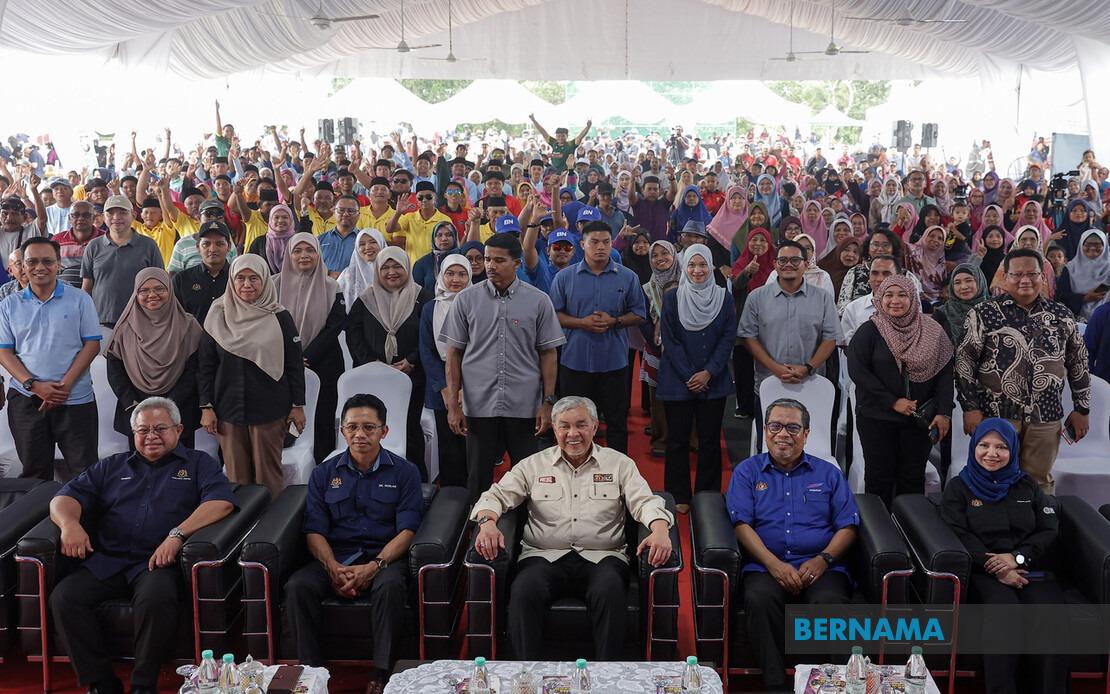
Malaysia's political landscape has grown increasingly complex, prompting Barisan Nasional chairman Datuk Seri Dr Ahmad Zahid Hamidi to advocate for fresh approaches and strategic recalibration among the country's major coalitions. Speaking at the Gema@KKDW 2026 programme near Jempol on July 18, Ahmad Zahid underscored the necessity for political parties to develop innovative strategies and forge new alignments capable of sustaining stability in an environment characterised by rapid shifts in voter preferences and coalition dynamics.
The BN leader highlighted the forthcoming 16th Negeri Sembilan state election as a crucial testing ground for evaluating a tentative understanding between his coalition and Perikatan Nasional (PN). This arrangement, he suggested, would offer valuable insights into whether the cooperative framework could be successfully replicated in other electoral contests, including the upcoming Melaka state election and crucially, the 16th General Election (GE16). By treating Negeri Sembilan as a pilot programme, BN and PN are seeking to establish whether their current modus operandi can deliver the desired electoral outcomes without triggering internal fractures.
Crucially, Ahmad Zahid sought to clarify the nature of the BN-PN arrangement, emphasising that it does not constitute a formal political merger or binding institutional framework. Rather, the understanding represents a pragmatic accommodation aimed at preventing the costly phenomenon of vote-splitting that occurs when multiple coalition partners contest the same electoral divisions. This distinction matters significantly for party members and coalition partners who might otherwise harbour concerns about surrendering autonomy or committing to long-term institutional changes. The BN chairman's emphasis on flexibility reflects the volatile nature of Malaysian politics, where rigid alliances have historically proven difficult to maintain.
The mechanism underlying this understanding operates on a seat-allocation basis, whereby both BN and PN have agreed to avoid fielding candidates in constituencies already earmarked for the other coalition. Such arrangements, while common in mature democracies, remain relatively delicate in Malaysia's context, where intra-coalition disputes over seat distribution have frequently undermined electoral performance. By clearly delineating territorial spheres of influence before campaigns intensify, both coalitions hope to minimise the friction that typically emerges during nomination proceedings.
For the Negeri Sembilan contest, early voting has been scheduled for July 28, with polling day set for August 1. This compressed timeline means that both BN and PN must rapidly operationalise their understanding while managing grassroots expectations and internal party dynamics. The efficiency with which both coalitions execute their cooperation during this period will provide measurable data on feasibility and scalability. Any significant missteps or public disagreements during the Negeri Sembilan campaign could undermine confidence in the arrangement and complicate efforts to extend it nationwide.
Ahmad Zahid's remarks arrive at a moment when Malaysian politics faces structural pressures that traditional coalition frameworks struggle to accommodate. The fragmentation of voter support across multiple political vehicles, combined with the growing volatility of swing constituencies, has rendered conventional winner-take-all approaches increasingly untenable. Coalitions that fail to coordinate efficiently risk handing victories to rival blocs, a dynamic that BN and PN both understand acutely given their shared interest in constraining the electoral space available to other players.
The broader implications for GE16 should not be underestimated. A successful BN-PN coordination in Negeri Sembilan could signal to other state-level and federal-level actors that sophisticated vote management between ostensibly competing coalitions is achievable. However, replicating such arrangements at the national level introduces substantially greater complexity, as the stakes rise, the number of contested seats multiplies, and the internal diversity within each coalition becomes more pronounced. The challenge of negotiating a nationwide seat allocation between BN and PN, while simultaneously managing the expectations of component parties and state-level chapters, represents a logistical and political undertaking of considerable magnitude.
For Malaysian voters and observers, the Negeri Sembilan election represents more than a routine state-level contest. It constitutes a referendum on whether Malaysia's major coalitions can transcend zero-sum political competition and embrace more collaborative frameworks. Should the arrangement succeed, it may herald a new era of coalition politics characterised by negotiated coexistence. Should it falter, it could reinforce the perception that Malaysian political parties remain fundamentally incapable of sustained cooperation, thereby perpetuating the cycle of unpredictable electoral outcomes and governmental instability that has characterised recent years.
From a regional perspective, Malaysia's experimentation with explicit coalition coordination carries relevance for other Southeast Asian democracies grappling with similar challenges of managing multiple political vehicles and fragmented voter support. The Malaysian case demonstrates that even established political institutions may need to fundamentally rethink their operational models to remain viable in rapidly changing electoral environments.
Ahmad Zahid's comments also implicitly acknowledge that the current bipolar structure of Malaysian politics—historically centred on BN versus the opposition—has become insufficiently descriptive of contemporary political reality. The rise of PN as a significant third force, following the 2018 general election and subsequent political realignments, has created a tripartite competitive environment that older strategic frameworks were not designed to navigate. By proposing that BN and PN can cooperate selectively while remaining distinct entities, Ahmad Zahid articulates a vision of managed pluralism that accommodates competing ambitions within a framework of mutual restraint.

