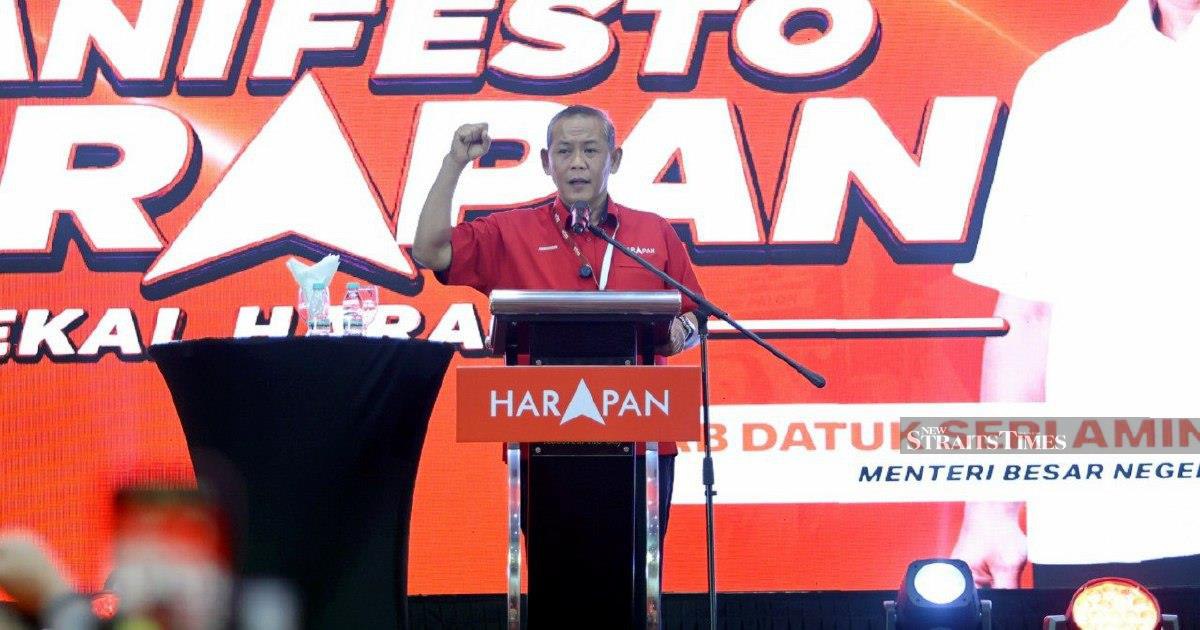
Negri Sembilan Menteri Besar Datuk Seri Aminuddin Harun has launched a pointed criticism of his political rivals, alleging that the Barisan Nasional's campaign platform for the imminent state election relies substantially on ideas that the incumbent Pakatan Harapan government has already developed and implemented. Speaking in Port Dickson, Aminuddin suggested that rather than presenting original policy visions, the opposition coalition has essentially borrowed from the playbook that his administration has been executing.
The timing of this accusation carries significance within Malaysia's evolving political landscape. State elections serve as crucial barometers of public sentiment between general elections, and the battle for Negri Sembilan represents a competitive contest where both coalitions are seeking to demonstrate momentum and public support. The claim that one side is repackaging the other's ideas touches on broader questions about political authenticity and substantive governance versus rhetorical posturing during campaign season.
During state-level campaigns, manifestos typically function as the primary mechanism through which parties communicate their vision to voters. When Aminuddin suggests that BN's manifesto consists largely of duplicated proposals, he is essentially challenging the opposition's credibility to offer genuine alternative direction. This tactic seeks to frame the election as a choice between proven, ground-tested programmes versus recycled promises.
For Malaysian voters, particularly those in Negri Sembilan, understanding whether policy proposals represent genuine innovation or borrowed concepts becomes relevant to their electoral calculations. Voters increasingly scrutinise the track record of implementations claimed by governing coalitions, making Aminuddin's assertion that many BN promises already exist as functioning PH initiatives a potentially powerful campaign argument. It implies continuity and delivery rather than mere campaign rhetoric.
The nature of the overlap that Aminuddin references would logically include social welfare schemes, infrastructure development plans, economic initiatives, or other state-level programmes. State governments in Malaysia operate within significant constraints regarding fiscal autonomy and policy scope, which often means successful initiatives across different administrations address similar fundamental needs—education, healthcare, economic development, and social safety nets. However, the distinction Aminuddin emphasises is between mere overlap in policy areas and wholesale replication of specific, named initiatives that his government has pioneered.
This electoral dispute reflects a broader Malaysian political pattern wherein administrations entering office often continue popular programmes from their predecessors while rebranding them for political credit. However, Aminuddin's pre-emptive characterisation of BN's offerings as "copy-pasted" seeks to seize control of this narrative, positioning PH as the original architect while casting BN as offering derivative proposals lacking the credibility of actual implementation experience.
For Negri Sembilan's electorate, the implications are worth careful consideration. If a significant portion of BN's promised initiatives genuinely mirror existing PH programmes, voters must determine whether they prefer maintaining the current trajectory or whether they believe an alternative administration could execute those same priorities more effectively. The accusation thus pivots the election debate from which promises are made toward which coalition can better fulfil substantively similar objectives.
The political context in Negri Sembilan has undergone considerable shifts in recent years, with various coalitions holding power and the electorate demonstrating willingness to change governments. This fluidity suggests voters are responsive to arguments about governance quality and delivery rather than purely tribal political loyalties. Aminuddin's claim therefore targets a potentially receptive audience if he can substantiate that BN proposals are indeed reproductions of functioning PH initiatives.
During Malaysian state election campaigns, fact-checking the overlap between competing manifestos rarely occurs systematically through media or independent analysis. This creates space for each coalition to frame the comparison according to its preferred narrative. Aminuddin's public statement constitutes an invitation to scrutiny—if his claim withstands examination, it becomes a significant talking point; if contradicted by evidence, it risks damaging PH's credibility.
The broader implication of this accusation extends beyond the immediate Negri Sembilan contest. It reflects increasing sophistication in how Malaysian political campaigns operate, moving beyond simple policy announcements toward meta-level critiques of the authenticity and originality of competing visions. Voters are being asked not simply to evaluate promises on their merits but to consider the intellectual honesty and creativity demonstrated by competing coalitions in their campaign offerings.
As the election campaign intensifies, the substance of Aminuddin's allegations will likely receive further examination. Specific policy comparisons could either validate his assertion that BN has essentially recycled PH programmes or reveal more meaningful distinctions in approach, implementation timelines, or resource allocation. The outcome of this debate will influence how informed voters in Negri Sembilan approach their electoral choice, potentially determining whether the state government remains under PH stewardship or transitions to BN control.

