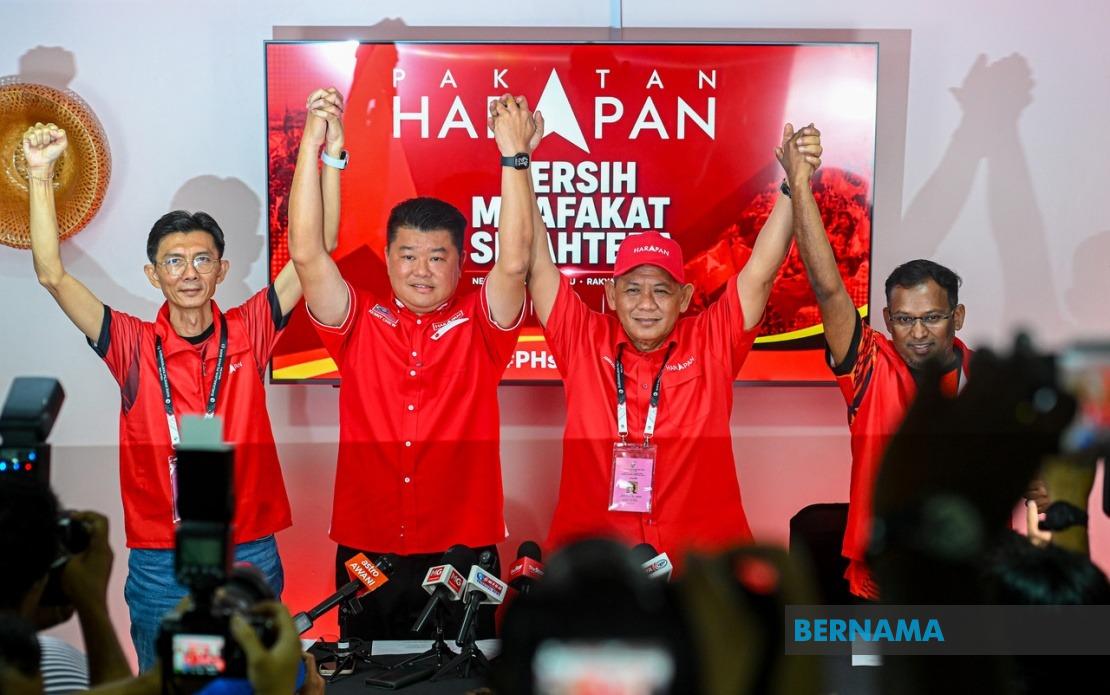
Negeri Sembilan's Pakatan Harapan leadership presented a united front on July 20 as chairman Datuk Seri Aminuddin Harun dismissed mounting suggestions that internal disagreements were undermining the coalition's campaign strategy ahead of the state election. The comments came during a press conference in Port Dickson, where Aminuddin, who doubles as both menteri besar and State PKR chairman, sought to reassure supporters that the party apparatus remained cohesive despite recent chatter on social media platforms questioning the harmony within coalition ranks.
The clarification addressed particular tensions that had surfaced around the re-nomination of Chuah incumbent Datuk Yew Boon Lye, a decision that had generated discussion involving Port Dickson PKR deputy division chief Datuk Kenny Chiew Chi Kin. Rather than allow the matter to fester, Aminuddin framed the situation as a resolved internal matter, emphasizing that Chiew had voluntarily pledged unwavering support for all coalition candidates contesting across the five state constituencies that fall under the Port Dickson parliamentary division: Chuah, Lukut, Sri Tanjung, Bagan Pinang, and Linggi.
In defending Chiew's role and commitment despite not securing nomination as a candidate himself, Aminuddin highlighted the latter's contributions to strengthening party infrastructure within the division over preceding years. The menteri besar's public acknowledgment of Chiew's efforts appeared designed to neutralize any perception that those passed over for candidacy might withdraw support or campaign with reduced vigor. Aminuddin stressed that Chiew, in his capacity as deputy division chief, remained focused on delivering victories for PH across all five seats, framing party unity as the paramount objective transcending individual electoral ambitions.
The broader context suggests that internal competition for candidate selection—a perennial source of friction within Malaysian political coalitions—had generated sufficient noise on social media to warrant direct leadership intervention. Aminuddin's decision to publicly commend Chiew and confirm his ongoing engagement represented an attempt to prevent simmering discontent from crystallizing into active opposition or apathy during the crucial final weeks of campaigning. Such tensions, if left unaddressed, can manifest as reduced volunteer mobilization, fragmented messaging, or informal support for rival candidates within constituencies.
Aminuddin himself is contesting as the PH standard-bearer for Linggi, positioning him directly within the electoral battleground he was addressing. This personal stake underscores the seriousness with which the party hierarchy viewed the need to project confidence and coherence at this stage of the campaign. With early voting scheduled for July 28 and polling day set for August 1, the window for damage control and momentum-building had narrowed considerably, making public displays of harmony especially crucial for maintaining grassroots enthusiasm.
The coalition chairman also characterized the circulating speculation as a deliberate effort by unnamed quarters to portray Pakatan Harapan in an unfavorable light, suggesting that external actors—presumably opponents—were amplifying internal disagreements to undermine PH's electoral prospects. This framing transforms internal party management issues into matters of external interference, potentially unifying supporters around a narrative of defending coalition integrity against hostile outside forces. Such rhetorical positioning is common in Malaysian politics, where attributing negative stories to political enemies can sometimes prove more persuasive than simply denying the allegations outright.
The Chuah seat itself carries historical significance and competitive stakes. Yew's performance in 2023 demonstrated the seat's winnability for PH, as he defeated Perikatan Nasional candidate Tang Jay Son by a margin of 6,298 votes. However, the electoral landscape has shifted with Barisan Nasional now contesting rather than Perikatan Nasional, introducing a different competitive dynamic. Yew will face BN's Pau Jeou Ching, suggesting a realignment of opposition forces that could reshape the electoral calculus for multiple constituencies.
The Port Dickson parliamentary area encompasses five state seats, making it a critical component of PH's strategy for retaining or expanding control in Negeri Sembilan. Any perception of coalition weakness in this concentrated geographic zone could have disproportionate consequences for the broader state election outcome. Aminuddin's comments, therefore, were not merely about managing a single divisional disagreement but about stabilizing confidence across multiple constituencies simultaneously, as volunteers and supporters in all five seats look to leadership for signals about the coalition's strength and viability.
For Malaysian observers tracking intra-coalition dynamics, Aminuddin's intervention illustrates the delicate balancing act required to accommodate diversity of interest within multi-party alliances while projecting electoral confidence. The public acknowledgment of internal resolution—rather than denial or stonewalling—suggests a maturation in how coalition partners manage tensions, though the underlying reality of competition for limited candidacies remains a structural challenge. The ability to navigate such frictions without public rupture will partly determine whether Pakatan Harapan can consolidate its position in Negeri Sembilan or whether fractures manifest as reduced electoral performance when results are tallied on August 1.

