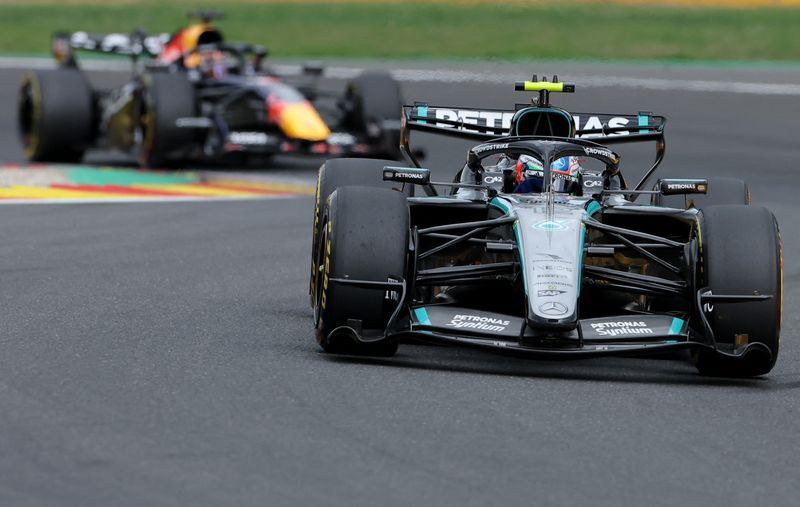
Kimi Antonelli delivered a commanding performance at Spa-Francorchamps on Sunday, steering his Mercedes to victory in the Belgian Grand Prix and dramatically widening his grip on the 2024 Formula One championship. The 19-year-old Italian driver's triumph extended his lead over Ferrari's Lewis Hamilton to 45 points, a cushion that now appears substantial with just over half the season remaining. For Mercedes, the result represents another demonstration of their competitive superiority this campaign, reinforcing their status as the team to beat in both drivers' and constructors' championships.
The race unfolded as a tale of contrasting fortunes within the Mercedes garage. While Antonelli showcased the precision and racecraft expected of a championship leader, his teammate George Russell endured a catastrophic afternoon that has serious implications for his own title aspirations. The British driver, who entered the Belgian weekend as Antonelli's closest challenger in the standings, found himself caught in a first-lap incident with Hamilton that sent him spinning into the gravel trap. Russell's premature exit eliminated any opportunity for points and represents a critical momentum shift in the internal Mercedes battle for supremacy.
The collision that ended Russell's race stemmed from a chaotic opening sequence where the Mercedes driver attempted to recover positions lost during a poor start. In his eagerness to make immediate progress through the field, Russell attempted a manoeuvre on his own teammate Hamilton, a decision that proved fatally optimistic on a circuit as demanding and unforgiving as Spa-Francorchamps. The incident raised questions about team tactics and driver discipline, particularly given the championship stakes involved. With Russell now 50 points adrift of his teammate, the mathematical possibility of a title challenge remains theoretically alive, but the psychological and practical gap has widened considerably.
Antonelli's own race demonstrated the tactical awareness and consistency that have defined his breakout season. Despite losing the lead through the deployment of a virtual safety car period, the Italian systematically worked his way back to the front, displaying the composure and racecraft that suggests his early success is founded on genuine talent rather than fortune alone. His sixth victory in just ten rounds underscores remarkable consistency at a stage in the season where many drivers experience natural fluctuations in form and confidence. The pole position he secured in qualifying represented Mercedes' ninth consecutive front-row start this season, a remarkable operational achievement that reflects the team's comprehensive advantage in car performance and driver skill.
Ferrari's Charles Leclerc salvaged second place, finishing 1.952 seconds behind Antonelli despite leading portions of the race thanks to strategic pit stop execution during the virtual safety car period. Leclerc's ability to extract podium finishes from difficult circumstances has become a Ferrari trademark this season, though the Monegasque driver's championship position remains significantly adrift of the Mercedes frontrunners. His performance demonstrated that Ferrari retains competitive machinery, particularly in qualifying trim, but consistency across race distances and strategic execution continue to separate the Scuderia from championship contenders.
Hamilton's fourth-place finish came with complications that threatened to unravel further. Beyond serving a five-second penalty for the first-lap collision with Russell, the Mercedes veteran remained under investigation for an unsafe release from a pitstop, a technical infringement that could result in further penalty points and position changes. The prospect of dropping to fifth would extend Antonelli's championship advantage even further, though Hamilton's presence in the points demonstrates the value even compromised days can yield at the professional level. The investigating officials' scrutiny highlights the increasingly technical nature of modern Formula One, where marginal advantages in pit stop execution can determine podium positions.
Red Bull's championship challenge received a symbolic boost through Max Verstappen's third-place finish, marking their 300th Formula One podium in the team's history. However, the milestone achievement masks a more sobering reality for the Milton Keynes-based outfit, which has slipped into third in the constructors' championship behind Mercedes and appears unable to mount a serious challenge to Antonelli's emerging dominance. Isack Hadjar's impressive climb from last on the grid to sixth place provided some tactical encouragement, demonstrating that Red Bull machinery retains competitive pace in certain race conditions, but such occasional bright spots cannot disguise the team's overall midfield status this season.
McLaren's championship credentials received a mixed verdict from the Belgian results. Oscar Piastri's fifth-place finish provided incremental points accumulation, yet the Woking team's failure to challenge for podium positions in either driver camp suggests their earlier season promise has not fully materialized. Reigning champion Lando Norris's recovery to seventh place, achieved despite starting 13th following a grid penalty, demonstrated individual competence but equally underscored McLaren's inability to consistently deliver the qualifying performance and race pace that characterize championship winners. The team's constructors' championship position continues to deteriorate relative to Mercedes and Ferrari.
The wider midfield order provided glimpses of developing competition as grid positions consolidate around established hierarchies. Gabriel Bortoleto's eighth-place finish for Audi represented continued points accumulation for the German manufacturer's ambitious entry into Formula One's top tier, while Franco Colapinto's tenth-place result for Alpine-branded Renault offered proof that points-scoring opportunities remain available throughout the field for drivers capable of executing consistent performances. These developments suggest that while Mercedes, Ferrari, and Red Bull dominate the championship mathematics, the intermediate grid positions remain sufficiently dynamic to maintain competitive interest through the season's latter stages.
Antonelli's post-race reflections provided insight into the psychological dimension of championship competition. The Italian acknowledged the fortune that contributed to his victory—particularly the consequences of the Russell-Hamilton incident—while emphasizing that championship success demands capitalizing on opportunities rather than passively accepting favorable circumstances. His observation that momentum could swing rapidly reflected awareness that no championship lead, however substantial, represents an insurmountable advantage over the remaining thirteen rounds. For Mercedes, Antonelli's maturity and consistency suggest the constructors' championship is essentially secure, while the drivers' championship, despite current point spreads, remains sufficiently compressed that strategic errors by the leading driver could quickly reshape the contest.
The Belgian Grand Prix served as a critical juncture in the 2024 championship narrative. Antonelli's performance validated his status as the season's dominant force, while Russell's misfortune simultaneously removed his most credible internal challenge and reinforced the Mercedes hierarchy. As the circus departs Spa-Francorchamps and turns toward the second half of the season, the contours of championship competition have shifted markedly toward Mercedes concentration, with Antonelli's lead now sufficiently commanding that Ferrari and Red Bull face an uphill struggle to challenge for either title.

