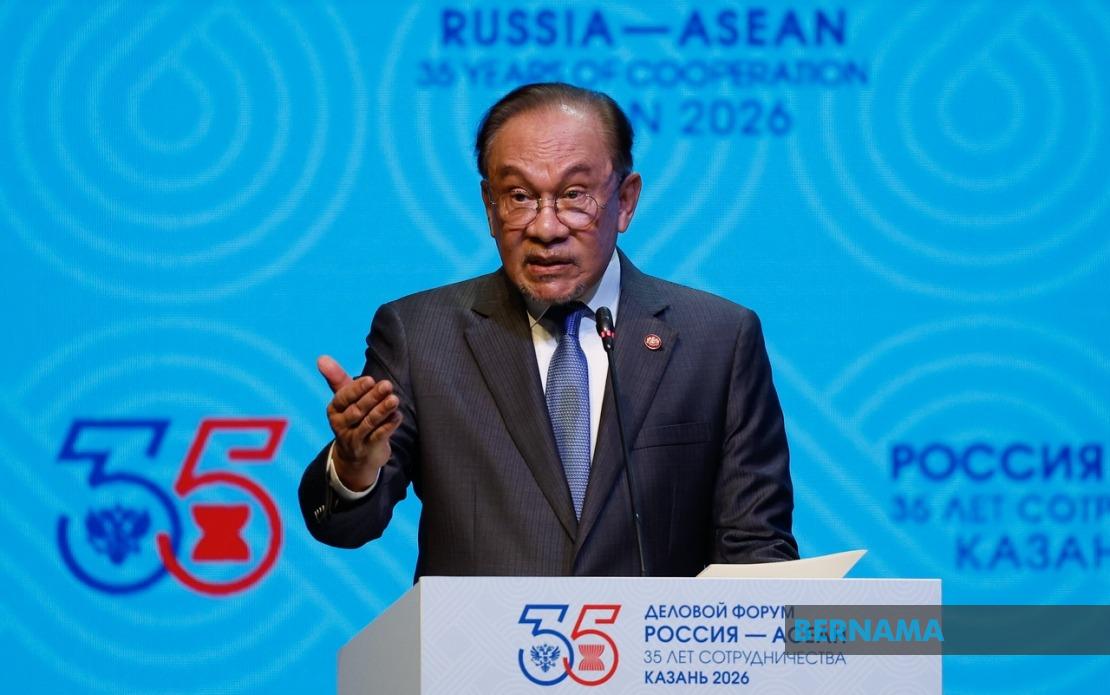
Prime Minister Datuk Seri Anwar Ibrahim has identified substantial untapped potential in ASEAN-Russia relations during discussions with international journalists at the ASEAN-Russia Business Forum in Kazan. Speaking on the sidelines of the summit, Anwar presented a vision of cooperation that extends well beyond the current state of engagement, positioning bilateral ties as strategically important for both regions amid shifting global alignments.
The economic relationship between Southeast Asia and Russia remains considerably underdeveloped compared to ASEAN's partnerships with established powers. While the bloc has cultivated deep trade and investment connections with the United States, China and India, Moscow remains a peripheral economic actor in regional calculations. Anwar's remarks suggest a deliberate effort to rebalance this equation, particularly given Russia's historical significance in the region and its ongoing relevance to questions of energy security and geopolitical balance.
The Prime Minister emphasized that structured platforms such as the ASEAN-Russia Business Forum serve as catalysts for mutual understanding and practical collaboration. He identified multiple sectors where expanded cooperation could yield mutual benefits, including energy security—a perennial concern for resource-dependent Southeast Asian economies—alongside cybersecurity, agricultural development, digital infrastructure, scientific research and higher education. Each sector represents areas where Russia possesses technological expertise or natural resources that could complement ASEAN member states' development priorities.
Anwar highlighted Tatarstan specifically as a case study in regional innovation and technological advancement. The Russian republic has developed particular strengths in technology, scientific research, education and defence sectors. For ASEAN nations seeking to accelerate their own technological capabilities and establish knowledge-sharing arrangements, Tatarstan offers a potential model for cooperation that could operate at both the regional and bilateral levels. This approach potentially opens pathways for Southeast Asian universities and research institutions to engage with Russian counterparts.
The Prime Minister's recent engagement with Russian President Vladimir Putin produced what he characterized as productive discussions centred on economic cooperation and energy security. Energy represents a critical nexus for ASEAN-Russia relations, particularly as regional nations navigate the global energy transition and seek diversified supply sources. Russia's hydrocarbon reserves and technological expertise in energy infrastructure remain strategically valuable, even as both regions confront long-term shifts toward renewable energy systems.
Beyond economic and technical matters, Anwar introduced a cultural dimension to the dialogue that underscores an often-overlooked element of international relations. His engagement with Russian literature and music—reflected in his frequent social media posts of Russian songs including "Matushka", "Zemlya" and "Kalinka Malinka"—demonstrates how personal cultural appreciation can humanize diplomatic relationships. When asked about his musical interests, Anwar revealed that his family shares enthusiasm for Russian compositions, indicating how cultural exports can penetrate Southeast Asian households and generate organic interest in bilateral engagement.
The Prime Minister's expressed admiration for Russian literary giants including Leo Tolstoy, Anton Chekhov and Boris Pasternak reveals sophisticated intellectual engagement with Russian culture. Notably, he pointed out that many of these canonical works have been translated into Malay, creating accessible pathways for Malaysian and broader Southeast Asian audiences to engage with Russian intellectual traditions. This historical connection through literature represents soft power that remains largely underutilized in contemporary ASEAN-Russia diplomacy.
Anwar articulated an important principle regarding cultural exchange as equivalent in significance to economic and technological cooperation. He argued that poetry, literature and cultural expression generate affection and human understanding that purely technical cooperation cannot achieve. In an era of great power competition and ideological contestation, this emphasis on cultural bridges offers a distinctive diplomatic posture that transcends zero-sum calculations. For Malaysia and ASEAN, fostering deeper cultural ties with Russia could create constituencies of mutual understanding that provide resilience to bilateral relationships during periods of political tension.
The Prime Minister opened his forum remarks by reciting verse from Abdullah Tukay, the renowned Tatar poet, signalling respect for local cultural traditions and establishing personal connection with his Kazan audience. This choice of rhetorical strategy demonstrated how cultural literacy serves diplomatic purposes while genuinely engaging with local intellectual heritage. For ASEAN leaders navigating relationships with diverse global partners, such culturally-informed diplomacy offers alternatives to transactional engagement models.
When the conversation pivoted to regional security concerns, particularly tensions between Iran and the United States, Anwar revealed an active diplomatic network spanning multiple Muslim-majority and emerging-market nations. His contacts with Iranian President Masoud Pezeshkian, Pakistani Prime Minister Shehbaz Sharif, Egyptian President Abdel Fattah El-Sisi and Turkish President Recep Tayyip Erdogan indicated Malaysia's positioning as a voice for de-escalation and peaceful resolution. This diplomatic engagement reflects ASEAN's broader strategic interest in preventing major power conflicts that could destabilize global trade and regional security.
Anwar's comments on the Gaza humanitarian crisis underscored his consistent advocacy for Palestinian causes and criticism of what he termed double standards in international human rights application. He characterized the humanitarian situation as a failure of the international community, arguing that democratic values and human rights principles cannot selectively exclude civilian populations experiencing daily violence and suffering. For ASEAN nations with significant Muslim populations, such principled stances resonate domestically while positioning Malaysia as a voice for marginalized populations within global forums.
The Prime Minister's two-day working visit to Kazan for the ASEAN-Russia Commemorative Summit represented part of a broader Malaysian diplomatic calendar addressing regional engagement and great power relations. His multifaceted discussions—ranging from energy security and technological cooperation to literature and humanitarian concerns—reflected the complexity of contemporary statecraft where economic interests, cultural understanding and humanitarian principles operate simultaneously.
Anwar's articulation of ASEAN-Russia potential suggests that Malaysia and its regional partners view Russia not as a declining or isolated actor, but rather as a significant player with whom deeper engagement serves regional interests. This approach balances relations with Western powers while maintaining strategic autonomy in global affairs. The emphasis on untapped cooperation potential indicates that ASEAN-Russia ties remain in early developmental stages, offering opportunities for expanded collaboration as regional circumstances evolve and both sides prioritize diversification of economic and strategic partnerships.