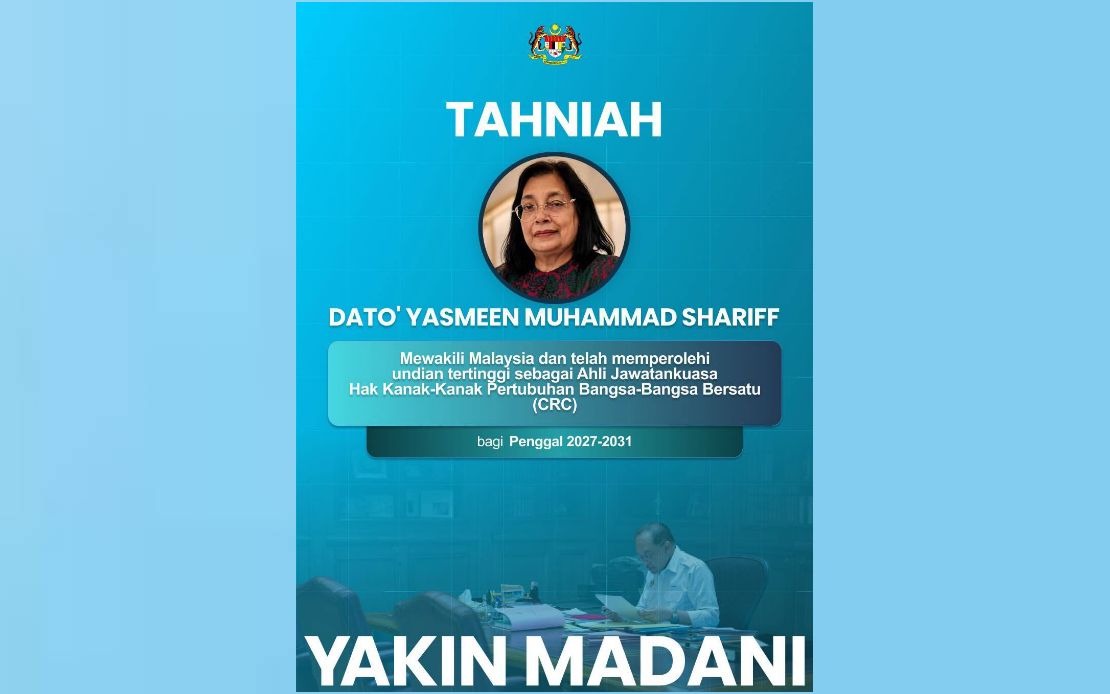
Prime Minister Datuk Seri Anwar Ibrahim has congratulated Datuk Yasmeen Muhamad Shariff on her successful election to the United Nations Committee on the Rights of the Child, a position she will hold from 2027 to 2031. In a statement released on social media, the Prime Minister framed the election as a significant diplomatic achievement that underscores the international community's recognition of Malaysia's contributions to advancing children's welfare and rights on the global stage.
The appointment carries particular symbolic weight for Malaysia's standing in multilateral institutions. Yasmeen secured 136 votes from 189 States Parties during voting held at UN headquarters in New York on Tuesday during the 21st Meeting of States Parties to the Convention on the Rights of the Child. This commanding margin of support—garnering support from approximately 72 per cent of voting nations—indicates broad-based international confidence in her expertise and capacity to serve as an independent expert on the committee tasked with monitoring implementation of the Convention across signatory nations.
Anwar described the achievement as a reflection of Malaysia's evolving role in global affairs and its deepening commitment to child protection frameworks. His congratulations extended not only to Yasmeen but also to the Ministry of Women, Family and Community Development, which coordinated Malaysia's candidacy and advocacy efforts. The Prime Minister suggested this success should galvanise Malaysia to pursue even greater international recognition and responsibility, positioning the nation as a credible voice in global deliberations on children's rights and welfare standards.
For Malaysia, the significance extends beyond ceremonial recognition. Election to UN treaty body committees grants nations and their representatives access to influential policy discussions and allows them to shape international standards and monitoring mechanisms. In the case of the CRC Committee, members review periodic reports from States Parties, issue recommendations, and help establish best practices in child protection—matters that directly affect policy development across dozens of countries, including Malaysia itself.
Yasmeen brings considerable experience to the role, having previously served on the CRC Committee during the 2013-2017 term. Her reelection after a decade indicates sustained confidence in her analytical capabilities and commitment to the committee's work. Committee members serve in their individual capacity as independent experts rather than as government representatives, a distinction that underscores the importance of personal professional standing and technical knowledge in securing and maintaining such positions.
The election also reflects Malaysia's broader diplomatic strategy of pursuing positions within UN bodies that align with national development priorities. Child welfare, education, and family protection are signature policy areas for the Malaysian government, and maintaining representation on relevant UN committees allows the nation to advocate for approaches consistent with its values while also learning from international best practices and peer countries' experiences.
The UN Committee on the Rights of the Child operates as a monitoring mechanism under the Convention on the Rights of the Child, one of the most widely ratified international human rights treaties. The committee comprises ten independent experts elected by States Parties to serve four-year terms. Members review national implementation reports, issue concluding observations with recommendations for improvement, and develop general comments that provide authoritative interpretations of the Convention's provisions for States Parties and other stakeholders.
For Malaysia specifically, having a representative on the committee creates an institutional channel for engagement with global child protection discourse. It also offers opportunities to advocate for regional perspectives on issues such as child labour in supply chains, trafficking prevention, educational access, and digital protection—concerns that are particularly pertinent to Southeast Asian nations navigating rapid economic and technological change.
The timing of this election also matters within Malaysia's domestic context. The Ministry of Women, Family and Community Development has been increasingly visible in advancing child protection legislation and policies, and international recognition of one of its senior officials validates that institutional focus. It provides domestic momentum for initiatives related to child welfare reform and serves as external verification of Malaysia's commitment to protecting vulnerable populations.
Beyond individual achievement, Yasmeen's reelection signals continuity and accumulated influence within UN mechanisms. Her prior experience allows her to navigate committee processes more effectively and build on relationships established during her first term, potentially positioning her to take on leadership roles such as serving on specialized working groups or drafting key documents that shape the committee's outputs and influence on global child protection standards.
The broader diplomatic context also merits consideration. Malaysia's success in securing this position comes amid evolving geopolitical dynamics in which nations compete for influence within multilateral institutions. Election to UN bodies requires sustained diplomatic engagement, consensus-building among regional and cross-regional partners, and substantive advocacy demonstrating why a candidate merits support. That Malaysia succeeded on this occasion reflects effective coordination among relevant ministries and diplomatic missions.
Anwar's public acknowledgment of the achievement serves multiple purposes: it celebrates Malaysia's international role, validates the Ministry of Women, Family and Community Development's institutional standing, and signals the government's commitment to global engagement on rights-based issues. For Malaysian observers, it represents tangible evidence that the nation remains an active participant in shaping global governance frameworks rather than a passive recipient of international standards.

