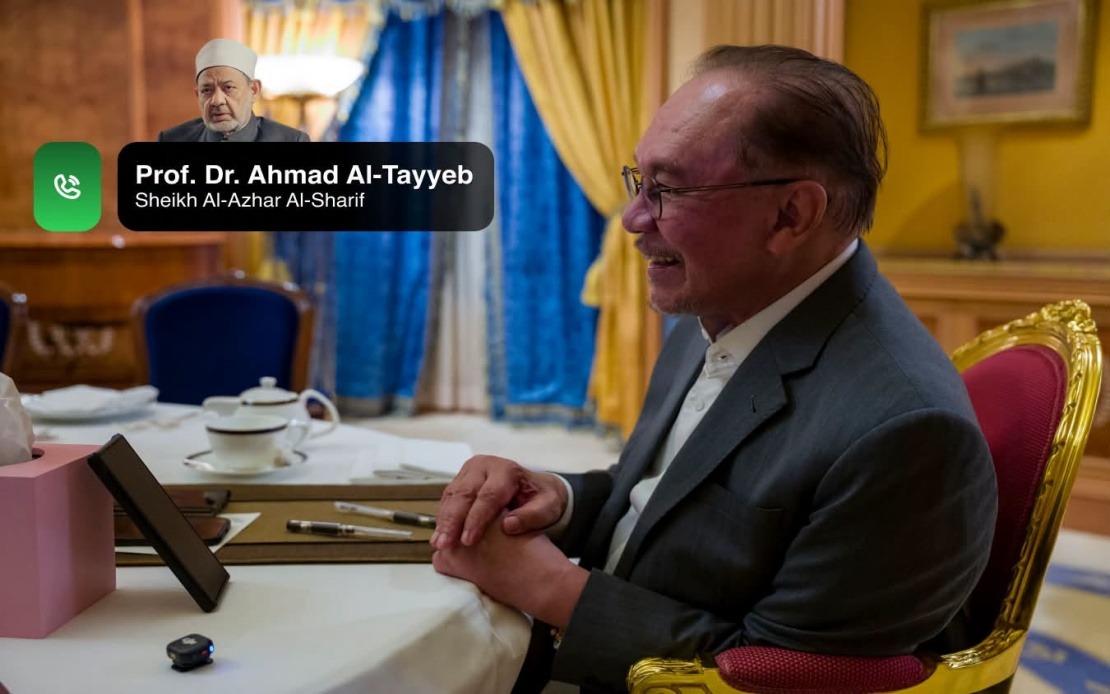
Prime Minister Datuk Seri Anwar Ibrahim has engaged in substantive discussions with one of Islam's most respected institutional leaders, Sheikh al-Azhar al-Sharif Prof Dr Ahmad al-Tayyeb, centring on shared endeavours to deepen religious understanding across Malaysia and the broader Muslim world. The exchange occurred via telephone after the prominent Islamic scholar reached out to check on the Prime Minister's wellbeing and convey prayers following his recent surgical recovery.
In addressing the conversation on social media, Anwar highlighted the positive trajectory of his post-operative period, noting that both the procedure itself and his recuperation have proceeded without complications. He expressed gratitude for al-Tayyeb's thoughtful gesture and used the opportunity to explore matters of mutual concern extending beyond personal health. The discussion pivoted towards the continuation of dakwah—Islamic outreach and educational initiatives—and the expansion of Islamic studies programmes designed to foster deeper comprehension of Islamic principles within communities.
The Prime Minister underscored the significance of the Sheikh's intellectual guidance, characterising it as instrumental in maintaining rigorous Islamic scholarship while simultaneously serving the collective interests of Muslim societies. This framing reflects Anwar's positioning of Malaysia not merely as a nation-state pursuing domestic religious policy, but as an active participant in broader conversations about the future direction of Islamic thought and practice globally. By elevating the perspectives of Al-Azhar, one of Sunni Islam's most influential theological institutions, Anwar signals Malaysia's commitment to engaging with established centres of Islamic learning.
Anwar also recalled Sheikh al-Azhar al-Sharif's previous visit to Malaysia, describing it as having left a lasting and profound impression on the country's Muslim population. This reference serves multiple purposes: it acknowledges a prior diplomatic engagement that generated public interest and religious significance, while simultaneously laying groundwork for future high-level exchanges. The Prime Minister expressed optimism about renewing this engagement, proposing that subsequent meetings could occur either in Cairo, home to Al-Azhar's headquarters, or in Malaysia's capital, thereby cementing bilateral religious and intellectual ties.
Parallel to these discussions with Al-Azhar's leadership, Anwar also communicated with Mohamed Abdelsalam, Secretary-General of the Council of Muslim Elders (Majlis Hukama Muslimin), a pan-Islamic body that coordinates among senior Muslim scholars and leaders. This second conversation demonstrates Anwar's multifaceted approach to engaging with different layers of Islamic institutional authority. The exchange proved reciprocal in nature, with Abdelsalam similarly inquiring after the Prime Minister's health, while Anwar extended his concern to Abdelsalam's spouse, who is currently receiving medical treatment, offering prayers for her swift recovery.
During his conversation with Abdelsalam, Anwar returned to the topic of Sheikh al-Azhar al-Sharif's interest in returning to Malaysia for additional visits and engagements. This reiteration underscores how deeply embedded this prospective visit has become within Malaysia's diplomatic and religious outreach strategy. The discussions also encompassed several emerging initiatives aimed at strengthening Malaysia's institutional relationship with Al-Azhar University, suggesting that the Prime Minister's office is actively developing structured programmes rather than pursuing ad-hoc exchanges. Notably, these initiatives carry an ideological dimension, with emphasis on promoting what Anwar characterised as a straightforward, inclusive, and intellectually rigorous interpretation of Islam—a positioning that carries significance given ongoing debates within Muslim-majority nations about Islamic authenticity and modernisation.
Anwar's public acknowledgment of his wife, Datuk Seri Dr Wan Azizah Wan Ismail, reflects a broader narrative commonly employed by Malaysian political leaders. By highlighting her steadfastness, loyalty, and sacrifice throughout his political journey, the Prime Minister contextualises her role not merely as a spouse but as an active participant in his public mission. This gendered dimension of the narrative, praising her as an exemplary woman, also addresses international audiences increasingly focused on questions of women's roles within Muslim-majority societies.
The substantive content of these conversations—centred on dakwah and Islamic education—touches upon questions that resonate significantly throughout Southeast Asia. Malaysia, as a Muslim-majority nation with constitutional provisions establishing Islam's special position while guaranteeing religious freedom, occupies a distinctive position in articulating models of Islamic governance and learning. The emphasis on expanding religious understanding through dakwah aligns with Malaysian efforts to position the country as a moderate Islamic voice, counterbalancing narratives of extremism or rigid fundamentalism that sometimes dominate international discussions of Islam.
The engagement with Al-Azhar holds particular strategic importance given the institution's unparalleled prestige within Sunni Islamic circles. Al-Azhar's pronouncements on matters of Islamic doctrine, education, and contemporary issues carry weight among Muslim communities globally. By cultivating dialogue with its leadership, Malaysia seeks to amplify its own voice in shaping discourse around Islamic modernisation, interfaith harmony, and the compatibility of Islamic principles with contemporary governance. This positioning also has implications for Malaysia's broader foreign policy, as it reinforces the nation's role as a bridge between various Muslim-majority regions and as a centre for Islamic intellectual thought.
The timing of these exchanges, occurring as Anwar recovers from surgery, lends a personal dimension to what are fundamentally political and diplomatic overtures. The concern demonstrated by both Sheikh al-Tayyeb and Mohamed Abdelsalam, combined with Anwar's reciprocal solicitude for Abdelsalam's family, illustrates how personal relationships and institutional diplomacy intertwine within Islamic leadership circles. These human elements provide texture to what might otherwise appear as purely formal state-to-state or institution-to-institution interactions.
Moving forward, the proposed meetings between Malaysia and Al-Azhar representatives suggest an intensification of engagement rather than a one-off courtesy exchange. The emphasis on strengthening institutional relationships and launching new initiatives indicates that Malaysian policymakers view this connection as integral to advancing their vision of Islam's contemporary relevance and application. Whether these discussions translate into concrete programmes—such as student exchange initiatives, joint research projects, or coordinated educational curricula—remains to be seen, but the Prime Minister's public articulation of these intentions signals their priority within his administration's agenda.
For Malaysia's Muslim population and the broader Southeast Asian region, these developments carry implications extending beyond ceremonial diplomacy. The framing of Islamic understanding as requiring expansion, particularly through structured dakwah and educational efforts, suggests a Malaysian approach that views Islam not as a static set of inherited traditions but as a living intellectual tradition capable of generating relevant guidance for contemporary challenges. This perspective, articulated through engagement with one of Islam's most venerable institutions, positions Malaysia within particular currents of Islamic thought—emphasising scholarship, community benefit, and engagement with modernity rather than isolationism or rejection of external ideas.
Ultimately, these conversations between Malaysian leadership and Al-Azhar's hierarchy reflect broader positioning by the Anwar administration within global Islamic networks and the governance of Muslim-majority states. By cultivating relationships with both institutional Islam and individual elder statesmen, Malaysia signals its commitment to thoughtful, engaged Islamic leadership—a message directed simultaneously at domestic audiences seeking reassurance about the government's Islamic credentials and at international observers evaluating how Muslim-majority nations navigate questions of identity, modernisation, and global engagement in an increasingly complex geopolitical environment.

