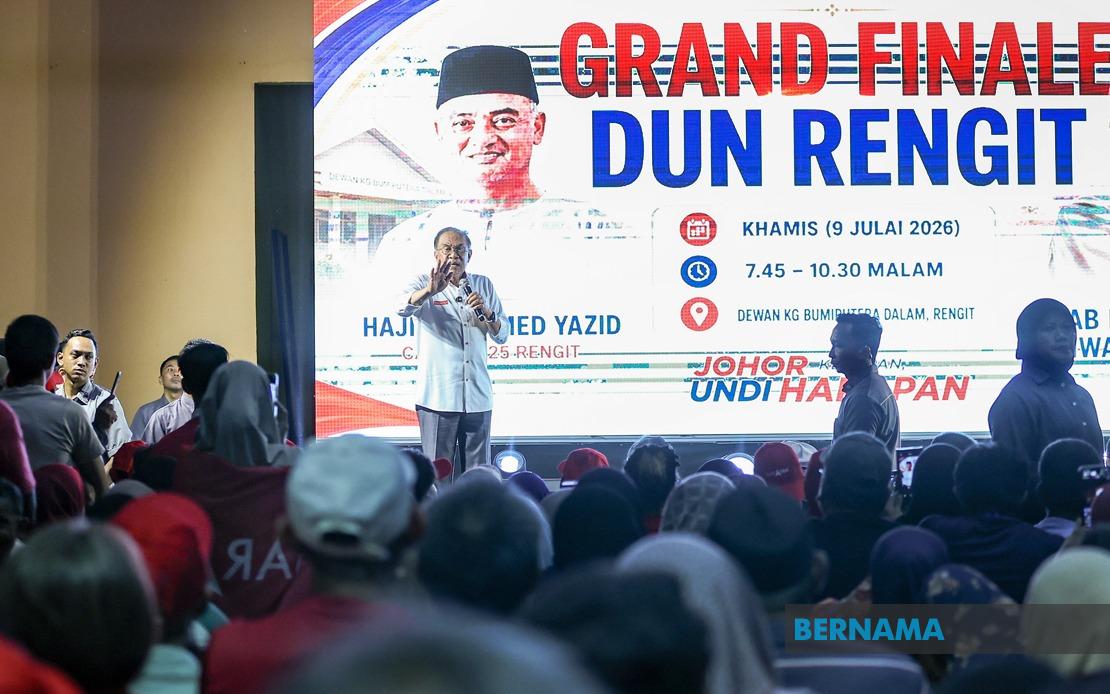
Prime Minister Datuk Seri Anwar Ibrahim has committed to overhauling healthcare infrastructure and resolving persistent water supply disruptions in Rengit, positioning basic amenities as non-negotiable government obligations ahead of Saturday's Johor state election. Addressing a Pakatan Harapan campaign rally in Batu Pahat on July 9, Anwar emphasized that healthcare facilities and clean water constitute fundamental rights that demand immediate attention, particularly in a state claiming developed-nation status. His intervention reflects a broader electoral strategy by the opposition coalition to mobilise voter support by addressing ground-level service delivery failures that have accumulated over years of neglect.
The prime minister's rhetoric sharpened the contrast between deteriorating physical infrastructure and public health expectations, employing the memorable phrase that clinics must treat patients rather than themselves requiring treatment. This framing resonates with residents enduring substandard medical facilities, a persistent complaint across rural Johor constituencies where dilapidated infrastructure has become synonymous with unequal development. The water crisis compounds these concerns, with intermittent supply disruptions affecting agricultural productivity, household consumption, and industrial operations across the Rengit area. By naming these specific grievances at a high-profile campaign event, Anwar positioned the federal government's intervention as both feasible and imminent should PH succeed in recapturing state control.
Anwar's appearance in Rengit formed part of a three-pronged campaign blitz across Johor on the same evening, underscoring the strategic importance PH assigns to the state contest. The coalition is fielding candidates across all 56 seats, a comprehensive challenge to BN's historical dominance in Malaysia's most competitive swing state. The distribution of nominations among coalition partners—20 candidates from PKR, 19 from Amanah, and 17 from DAP—reflects ongoing internal negotiations about seat allocation and reflects each partner's perceived electoral strength in different constituencies. The presence of Sri Gading MP and Johor Amanah chairman Aminolhuda Hassan alongside Rengit PH candidate Yazid Abu Bakar demonstrated the coordinated machinery mobilisation essential for converting ground-level discontent into electoral gains.
Beyond the specific pledges on healthcare and water infrastructure, Anwar articulated a broader governance philosophy centring basic service delivery as government's primary obligation. Housing, education, and healthcare featured in his enumeration of non-negotiable priorities, a populist messaging strategy designed to appeal to voters across income tiers and demographic groups. This framing contrasts sharply with what PH characterises as BN's prioritisation of mega-projects and elite-oriented development, allowing the coalition to claim alignment with ordinary citizens' daily concerns. The emphasis on fundamentals rather than grand infrastructure also sidesteps technical disputes about project feasibility, instead grounding the campaign in universally recognisable service gaps.
Anwar simultaneously issued warnings to government officials and community leaders about maintaining integrity and preventing abuse of power for personal advancement, a coded reference to widespread corruption allegations that have shadowed both state and federal administrations. This dual messaging—positive commitments paired with implicit criticism of incumbent governance—aims to energise voters frustrated by stagnation and perceived malfeasance. The warning carries particular weight given recent federal-level scandals and state-level controversies surrounding resource allocation and contract awards, making governance integrity a potent electoral theme. By addressing both what his administration would deliver and what it would prevent, Anwar attempts to build a comprehensive case for political change.
The prime minister explicitly encouraged voters to elect representatives aligned with the Federal Government, a strategic appeal designed to generate coattails effects from federal-level popularity or at least to neutralise the advantage of incumbent state machinery. This argument carries practical force in Malaysia's federal system, where development allocations, infrastructure grants, and administrative cooperation flow more readily when state and federal governments share party affiliation. Johor, as a traditionally BN-held state with substantial economic output and strategic geographic positioning, represents a high-stakes contest where federal-state alignment could dramatically alter resource distribution and development trajectories. Anwar's emphasis on this factor acknowledges that electoral campaigns increasingly turn on voters' calculations about maximising their constituencies' share of public investment.
The election itself represents a pivotal moment for Malaysian politics, with a total of 172 candidates competing across the 56 state seats. This crowded field reflects not only traditional BN-versus-opposition competition but also the rise of independent candidates and smaller parties seeking representation, complicating prediction models and potentially affecting seat allocation outcomes. Johor's historical role as a kingmaker state—where electoral swings often foreshadow national trends—adds significance to PH's comprehensive challenge to BN incumbency. Should the coalition achieve notable gains, momentum could carry into subsequent state elections and influence perceptions of federal government strength heading toward the next general election, currently due in 2027 but potentially callable earlier.
For Malaysian voters and Southeast Asian observers, Johor's contest embodies broader questions about governance quality, anti-corruption commitment, and service delivery standards. PH's pledge to address longstanding infrastructure deficits appeals implicitly to rural and semi-urban constituencies where development disparities remain acute compared to major urban centres. The water supply crisis particularly resonates given recurring droughts and climate variability affecting the region, making water security both an immediate service concern and a long-term sustainability issue. Healthcare facility improvements similarly address both immediate patient care and Malaysia's ambitions toward universal health coverage and preventive medicine expansion.
The campaign also illuminates tensions within Malaysia's federal structure regarding development responsibility and resource allocation. State elections increasingly turn on service delivery grievances that technically fall within state government purview, yet Anwar's federal-level intervention suggests that voter dissatisfaction cuts across federalism's institutional boundaries. This dynamic reflects Malaysia's competitive federalism, where opposition-controlled states can leverage federal coordination challenges to criticise incumbents, and federal governments must navigate the optics of supporting their parties' state candidates while appearing even-handed in development distribution. The Johor contest thus provides a microcosm of these structural tensions playing out through electoral competition.

