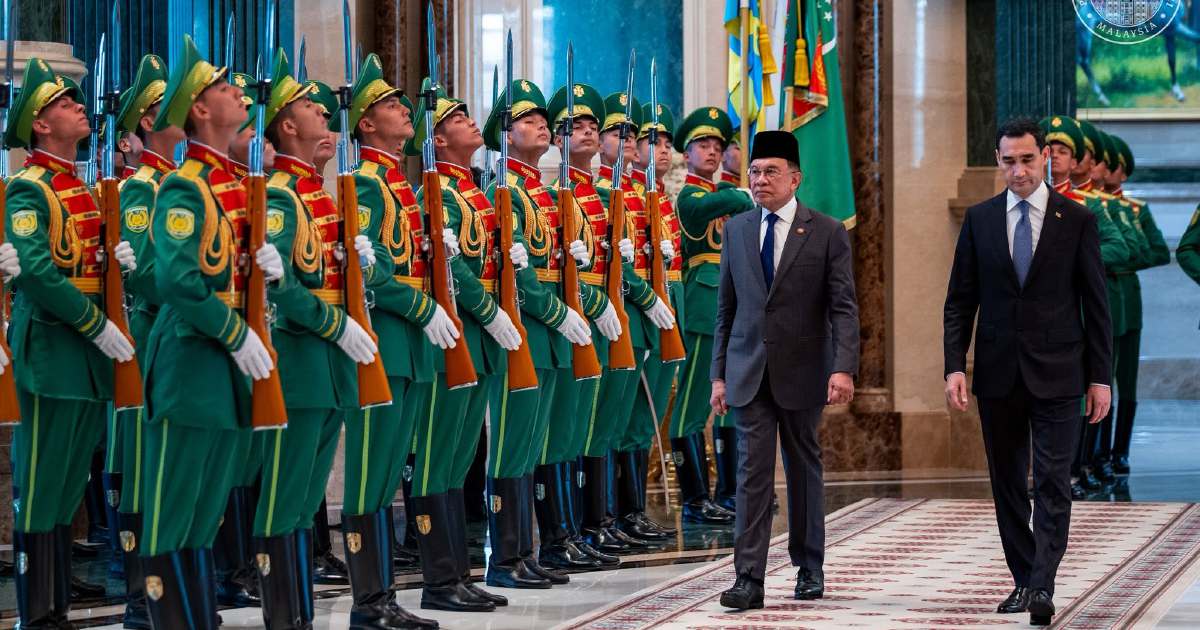
Prime Minister Datuk Seri Anwar Ibrahim stepped into the spotlight of Central Asian diplomacy today when he was formally received at Turkmenistan's Presidential Palace in Ashgabat, cementing what officials hailed as a milestone moment in bilateral relations between the two nations. The ceremonial reception underscored Malaysia's strategic pivot towards engaging with influential regional powers beyond its traditional sphere, signalling a broader reorientation of Kuala Lumpur's foreign policy under Anwar's administration.
This inaugural state visit since Anwar assumed office represents a significant stepping stone in Malaysia's outreach to the energy-rich economies of Central Asia. Turkmenistan, a major global supplier of natural gas and home to substantial hydrocarbon reserves, has long been a crucial player in regional geopolitics and international energy markets. The choice to elevate diplomatic engagement with Ashgabat reflects Malaysia's recognition of the mutual benefits that can flow from deeper partnerships with technologically advanced and resource-endowed nations in this strategically vital corridor.
Central Asia has emerged as an increasingly important theatre for international relations, particularly as global powers compete for influence and access to critical resources. Malaysia's historical focus on Southeast Asian affairs and Islamic diplomacy means that a direct high-level visit to Turkmenistan carries considerable symbolism. It demonstrates Anwar's personal commitment to broadening Malaysia's horizons and establishing direct working relationships with key decision-makers across diverse geopolitical zones. The formal state protocol extended during the reception signals that Turkmenistan views the engagement positively and is willing to invest in substantive ties with Southeast Asia's largest Muslim-majority democracy.
The Presidential Palace ceremony followed traditional diplomatic protocols that emphasise respect and equality between nations. Such formal receptions typically precede substantive bilateral discussions covering trade, investment, technology transfer, and cultural exchange. For Malaysia, which constantly seeks to diversify its economic partnerships and secure stable supplies of critical materials, engagement with Turkmenistan offers tangible opportunities to explore joint ventures in energy, manufacturing, and logistics.
Anwar's diplomatic mission to Central Asia reflects a maturing strategy of economic diversification and political networking. Unlike his predecessors, who occasionally visited the region, Anwar has made it clear that Malaysia intends to maintain sustained engagement rather than episodic contact. This approach aligns with broader regional trends, as countries across Southeast Asia increasingly recognise that their economic futures depend on partnerships extending far beyond their immediate neighbourhood. Central Asia's proximity to China, India, Russia, and Afghanistan makes it a crossroads of competing interests and a region where smaller nations can leverage strategic positioning to their advantage.
The timing of this visit also carries broader implications for Malaysia's role within the Organisation of Islamic Cooperation and the Non-Aligned Movement. Turkmenistan, while a Muslim-majority nation, has traditionally maintained secular governance structures and a pragmatic foreign policy that avoids ideological alignment with any single bloc. Anwar's engagement with such regimes demonstrates his inclusive approach to Islamic diplomacy, prioritising practical cooperation over doctrinal consistency. This pragmatism has been a hallmark of his leadership and contrasts with more ideologically rigid positions that have occasionally characterised Malaysian foreign policy.
Economic considerations undoubtedly feature prominently in the diplomatic calculus behind this visit. Turkmenistan possesses vast natural gas reserves and has been investing heavily in infrastructure development, including pipelines and transportation networks. These sectors present opportunities for Malaysian companies to participate in construction, management, and operational roles. Additionally, Malaysia's expertise in financial services, petrochemicals, and advanced manufacturing could find receptive markets in Turkmenistan's development agenda. The ceremonial welcome represents formal acknowledgement that both nations see value in exploring these commercial possibilities at the highest levels of government.
Cultural and educational exchanges typically accompany such high-level diplomatic visits, even when they are not explicitly mentioned in initial announcements. Malaysian universities and Turkmen institutions may find increased opportunities for student exchanges and research collaborations. Such people-to-people connections strengthen bilateral ties far beyond what formal agreements alone can achieve, creating networks of understanding and goodwill that sustain relationships through inevitable political transitions and economic fluctuations.
Regionally, this visit sends subtle but important signals to Malaysia's partners in Southeast Asia and beyond. It demonstrates that Kuala Lumpur is confident and sufficiently stable to pursue independent foreign policy initiatives extending well beyond traditional alliance networks. It also reinforces Malaysia's commitment to the concept of non-aligned foreign policy, maintaining relationships across diverse political systems and ideologies. For countries in Central Asia watching how major Southeast Asian nations conduct themselves, Malaysia's diplomatic overture suggests a reliable, predictable partner unaligned with aggressive geopolitical contestation.
Looking forward, the success of Anwar's Ashgabat visit will likely be measured not by the ceremonial details of today but by the substance of agreements reached during substantive bilateral meetings. Whether discussions produce tangible results in trade, investment, or technology sharing will determine whether this opening develops into a lasting strategic partnership or remains merely a symbolic gesture. The formal reception at the Presidential Palace has certainly opened the diplomatic door; what happens next will depend on the practicalities of mutual benefit and consistent follow-through from both governments.