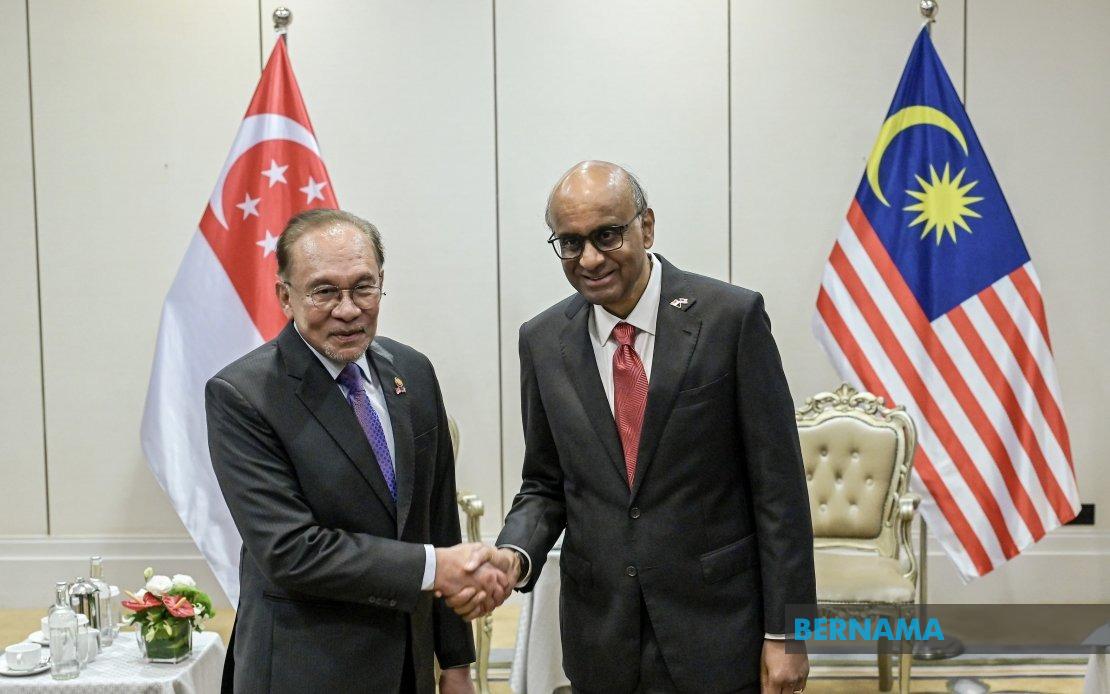
Prime Minister Datuk Seri Anwar Ibrahim received Singapore President Tharman Shanmugaratnam on Monday in a courtesy meeting that underscored the continuing diplomatic warmth between Malaysia and Singapore. The 40-minute engagement at the Prime Minister's office formed part of President Tharman's three-day state visit stretching from July 13 to 15, representing an important gesture of bilateral reciprocity in the two nations' relationship.
The delegation accompanying Anwar during the meeting reflected the economic significance of the Singapore-Malaysia partnership, with representation from several key ministries. Foreign Minister Datuk Seri Mohamad Hasan, Investment, Trade and Industry Minister Datuk Seri Johari Abdul Ghani, and Entrepreneur and Cooperatives Development Minister Steven Sim Chee Keong all participated, alongside senior officials from both governments. The composition of the Malaysian team highlighted how deeply the two countries' interests are intertwined across diplomatic, trade, and investment channels.
Before meeting with Anwar, President Tharman received a full state ceremonial welcome at Istana Negara from Yang di-Pertuan Agong Sultan Ibrahim, observing all formal protocols befitting a visiting head of state. This official reception set the diplomatic tone for the visit, demonstrating Malaysia's commitment to treating Singapore's head of state with the highest courtesy and respect. The ceremonial elements reflected long-established protocols governing relations between the two nations, which despite their proximity and occasional disagreements, have managed to maintain relatively stable diplomatic channels.
The timing of President Tharman's visit carries particular significance as it reciprocates the royal visit that Yang di-Pertuan Agong Sultan Ibrahim made to Singapore in early May 2024. Such exchanges at the highest levels of government serve to reinforce personal relationships between leaders and signal continuity in the bilateral partnership during what has been an evolving period in Southeast Asian geopolitics. The invitation extended by the Malaysian King to the Singapore President demonstrates a willingness on both sides to maintain these high-level engagements despite competing regional interests.
Singapore's economic importance to Malaysia cannot be overstated, particularly given the structure of trade flows in the region. As Malaysia's second-largest trading partner globally, Singapore punches well above its weight in terms of economic influence on the Malaysian economy. Within the ASEAN bloc, Singapore actually ranks as Malaysia's premier trading partner, a position that reflects decades of complementary economic structures and integrated supply chains across sectors ranging from petrochemicals to financial services.
The trade statistics presented during such visits typically serve to reinforce the mutual benefits both nations derive from their commercial relationship. In 2025, bilateral trade between Malaysia and Singapore reached RM402.35 billion in value, equivalent to approximately US$93.97 billion, representing a modest 1.5 per cent increase from the previous year. While this growth rate appears modest, it indicates steady commercial activity despite global economic uncertainties and shifting regional trade dynamics that have affected other bilateral partnerships.
More encouraging signals emerge from the first five months of 2025, during which the two nations' bilateral trade expanded at a significantly faster pace. From January through May, the trade volume climbed to RM189.90 billion, translating to roughly US$47.87 billion and representing a robust 14.5 per cent year-on-year increase. This improvement compared to the corresponding period in 2024, which had recorded RM165.93 billion or US$37.65 billion, suggests that trade momentum has been building as the year progresses. The acceleration in trade growth raises questions about what factors may be driving this stronger performance—whether increased production activity, infrastructure investment, or shifting supply chain dynamics related to regional trade tensions.
For Malaysian policymakers and business leaders, the strength of trade ties with Singapore carries implications that extend beyond simple bilateral commerce. Singapore serves as a crucial entrepôt and financial hub for Southeast Asian trade and investment, meaning that Malaysian companies often route transactions through Singapore to reach broader markets. The relationship also underscores Malaysia's integration into regional value chains, particularly in energy, chemicals, and technology sectors where both nations maintain complementary competitive advantages.
The state visit also provides an opportunity to discuss emerging challenges and opportunities in the bilateral relationship that may not make headlines but occupy considerable attention behind closed doors. These discussions likely touch on border management, maritime cooperation in the Strait of Malacca, coordinated responses to cybersecurity threats, and alignment on regional and global trade issues where both nations have shared interests despite occasional divergences on specific matters.
President Tharman's visit represents the kind of sustained high-level engagement that characterizes mature bilateral relationships in Southeast Asia. While Singapore and Malaysia have experienced their share of tensions—stemming from water agreements, maritime boundaries, and historical grievances—the capacity to maintain courteous state visits demonstrates both nations' commitment to managing differences within a framework of constructive dialogue. This diplomatic balance proves essential given the geographic proximity and economic interdependence that make conflict costly for both sides.
The broader context of this visit includes Malaysia's efforts to strengthen its position within ASEAN and across the Indo-Pacific region. Maintaining strong ties with Singapore, despite occasional tensions, forms part of a wider diplomatic strategy aimed at preserving regional stability and supporting economic prosperity. As global supply chains continue to shift and new economic blocs emerge, the Malaysia-Singapore partnership remains a cornerstone of regional integration and prosperity that benefits not just the two nations but the wider Southeast Asian community.

