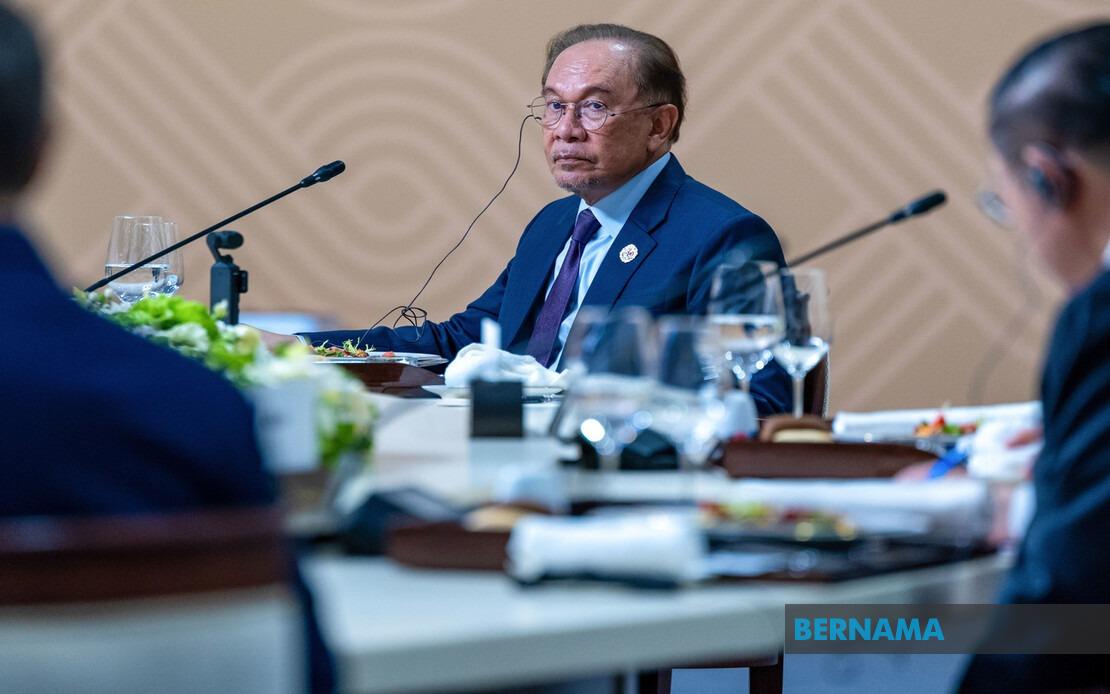
Prime Minister Datuk Seri Anwar Ibrahim has called for ASEAN and the Shanghai Cooperation Organisation to harness their combined strength in tackling transnational crime and advancing energy security through more robust cooperation mechanisms. Speaking during an ASEAN-Russia working lunch in Kazan on June 18, Anwar outlined how the two regional blocs could move beyond rhetoric to deliver concrete results in priority areas where collective action yields tangible benefits for all member states.
The foundation for such collaboration already exists, Anwar noted, pointing to a 2005 memorandum of understanding that provides the framework for joint efforts against terrorism, drug trafficking, money laundering, and coordinated economic and energy initiatives. However, this institutional groundwork has largely remained dormant, with opportunities for practical advancement left unexploited. Anwar emphasised the need to revitalise these commitments by concentrating efforts on specific, measurable outcomes achievable within defined timeframes rather than pursuing broad mandates that diffuse resources and accountability.
The challenge of cross-border criminal activity has intensified dramatically in recent years, particularly as digital technologies enable sophisticated schemes to operate across jurisdictions faster than law enforcement can respond. Online fraud networks, money laundering operations, and human trafficking syndicates routinely exploit gaps between national regulatory systems, creating safe havens for illicit activity. Anwar stressed that intelligence sharing and capacity-building represent the most effective responses to these threats, allowing member states to pool expertise and coordinate enforcement operations across borders in ways individual nations cannot achieve independently.
For Southeast Asian nations including Malaysia, this argument carries particular weight. The region has emerged as both a transit corridor and destination for transnational crime, with gangs exploiting porous borders and inconsistent enforcement standards. Malaysian authorities have repeatedly identified cross-border human trafficking, drug smuggling, and cybercrime as priority challenges requiring regional coordination. By formalising intelligence-sharing protocols with SCO members—particularly Russia, China, and Central Asian states—ASEAN could significantly enhance its investigative capacity and disrupt criminal networks operating across multiple jurisdictions.
Energy cooperation represents the second major pillar of Anwar's proposal, reflecting Malaysia's strategic interest in diversifying supply sources and integrating renewable technologies. The SCO encompasses major global energy producers and technological leaders, including Russia, China, Kazakhstan, and Uzbekistan. This concentration of hydrocarbon reserves and renewable expertise creates opportunities for practical collaboration on energy security, a concern intensifying as regional demand accelerates and climate transitions reshape global energy markets. Anwar highlighted specific cooperation avenues including liquefied natural gas arrangements, grid modernisation, renewable integration, and knowledge exchange on operational safety and system resilience.
Malaysia's energy security interests align closely with broader ASEAN concerns about supply diversification and transition economics. As Southeast Asia pursues carbon reduction goals while managing growing electricity demand, partnerships with SCO members offer access to technology, investment capital, and operational expertise that could accelerate the renewable energy transition. LNG cooperation specifically benefits nations like Malaysia that already possess LNG infrastructure but face competitive pressures in global markets and require cost-effective sourcing to maintain competitiveness.
Beyond the SCO, Anwar extended his argument to the Eurasian Economic Union, proposing that ASEAN leverage existing frameworks to strengthen commercial ties and investor confidence. Current ASEAN-EAEU relations remain underdeveloped relative to potential, with insufficient private sector engagement and limited awareness of investment opportunities on both sides. The Prime Minister advocated for regular business forums, greater participation in major regional trade events, and coordinated support for small and medium enterprises seeking market access across the respective blocs.
This emphasis on private sector mobilisation reflects recognition that formal government agreements achieve little without business incentives for implementation. Malaysian companies, particularly small and medium enterprises, often lack market intelligence and regulatory knowledge necessary to operate successfully in Central Asian and Russian markets. Similarly, EAEU firms remain largely unaware of opportunities within ASEAN, despite complementary economic structures and mutual investment potential. Structured dialogue platforms and technical assistance programs could unlock significant commercial flows currently constrained by information asymmetries and perception gaps.
Anwar identified emerging technology and agriculture as particularly promising collaboration domains. Digital economy integration, artificial intelligence applications, cybersecurity standards, and food security mechanisms represent areas where ASEAN and EAEU interests increasingly converge. For Malaysia specifically, food security cooperation offers strategic benefits given the nation's import dependence for staple grains and the need to secure reliable supply chains less vulnerable to geopolitical disruption. Russian and Central Asian agricultural capacity, combined with ASEAN distribution networks and financial expertise, could develop resilient supply systems benefiting all participants.
The Kazan summit itself carries symbolic significance as Russia's outreach to Southeast Asia intensifies amid broader geopolitical realignment. ASEAN's centrality to regional diplomacy gives the bloc leverage to shape regional architecture, and Anwar's framing of cooperation as mutually beneficial rather than aligned with any single power demonstrates ASEAN's preferred diplomatic positioning. By emphasising practical collaboration on crime, energy, and commerce, Anwar positioned ASEAN as pragmatic and results-focused rather than ideologically driven, an approach that preserves strategic autonomy while enabling constructive engagement.
Implementing Anwar's proposals requires overcoming substantial obstacles including divergent security interests, competing geopolitical alignments among ASEAN members, and SCO member concerns about sharing sensitive security information. Establishing operational protocols for intelligence sharing involves complex negotiations around confidentiality, legal jurisdiction, and enforcement cooperation. Energy cooperation, though seemingly technical, involves sensitive negotiations over pricing, supply guarantees, and infrastructure investment terms that reflect underlying power asymmetries.
Nevertheless, the direction Anwar outlined reflects emerging Southeast Asian consensus that engaging major powers on specific, bounded issues offers superior outcomes to either isolation or alignment with any single actor. For Malaysia particularly, balancing deepening ties with established partners against new opportunities requires precisely the kind of focused, pragmatic cooperation Anwar advocated. Whether ASEAN member states collectively muster the political will to institutionalise these arrangements remains uncertain, but the case for doing so, particularly on transnational crime where regional vulnerabilities have become acute, grows increasingly compelling.