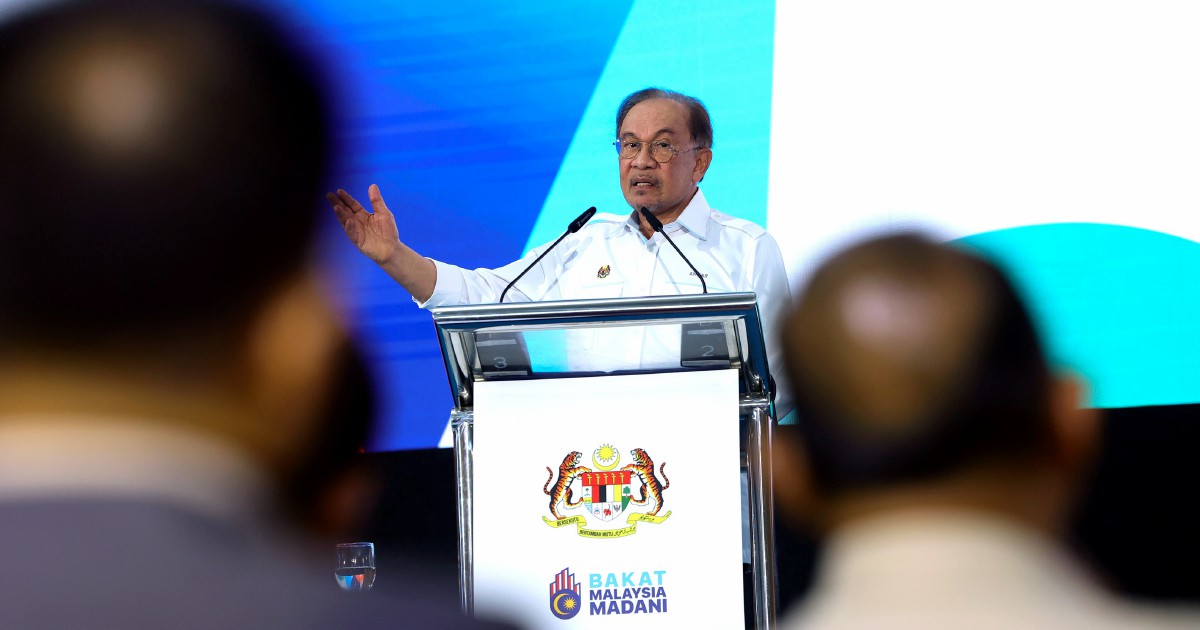
Prime Minister Datuk Seri Anwar Ibrahim has outlined substantial expectations for the Bakat Madani initiative, a recently-introduced government programme designed to address skills development and livelihood opportunities across the country. Speaking in Seremban, Anwar projected that the scheme would extend assistance to 25,000 beneficiaries within the first twelve months, signalling the administration's commitment to rolling out the initiative at scale. The announcement reflects the government's broader strategic focus on human capital development as a cornerstone of Malaysia's economic transformation agenda.
The Bakat Madani programme represents a contemporary approach to workforce development that aligns with the nation's medium-term economic priorities. Rather than adopting conventional skills training models, the initiative appears designed to bridge the gap between job market demands and the capabilities of the working-age population. This positioning is particularly significant given Malaysia's ongoing challenges in youth unemployment and underemployment, issues that have gained prominence in policy discussions as the country navigates post-pandemic economic recovery.
The government's decision to launch this initiative from Putrajaya underscores its designation as a federal priority rather than a fragmented state-level programme. Centralised coordination enables standardised delivery mechanisms, consistent quality assurance, and equitable distribution of resources across all thirteen states and federal territories. For Malaysian readers accustomed to initiatives that suffer from implementation inconsistencies, this structural approach suggests the administration is attempting to learn from previous programme shortcomings.
Within the Southeast Asian context, Malaysia's investment in talent development responds to regional competitive pressures. Neighbouring economies including Vietnam, Thailand, and Indonesia have aggressively expanded vocational training and skills certification schemes, recognising that demographic dividends depend entirely on workforce quality. The Bakat Madani programme signals that Malaysia intends to maintain its competitive edge through intentional capability-building rather than relying on inherited economic advantages.
The specific target of 25,000 beneficiaries warrants scrutiny regarding realistic implementation capacity. For comparative perspective, Malaysia's workforce comprises approximately 9.3 million individuals, suggesting the programme would initially touch roughly 0.27 per cent of the total employment base. While appearing modest, this scale allows the government to establish operational protocols, refine delivery mechanisms, and gather evidence of impact before potential expansion in subsequent years. Stakeholders monitoring the initiative should assess whether this first-year target represents genuine capacity constraints or conservative political positioning.
Sector-specific applications of the Bakat Madani framework hold particular relevance for Malaysian economic restructuring. High-growth industries including digital economy services, advanced manufacturing, biotechnology, and green energy increasingly struggle to recruit suitably qualified personnel from local talent pools. A well-designed initiative could systematically channel prospective workers toward these high-value sectors, addressing both individual career prospects and national productivity metrics. However, programme success ultimately depends on curriculum alignment with actual employer requirements, a challenge that frequently undermines Malaysian training initiatives.
The programme's timing coincides with heightened awareness of job market disruption driven by artificial intelligence and automation. Traditional skills training approaches that emphasise task-specific competencies risk obsolescence within five to ten-year horizons. For Bakat Madani to deliver enduring value to beneficiaries, the curriculum must prioritise adaptability, digital literacy, and conceptual reasoning alongside technical competencies. The 25,000 individuals supported during the inaugural year essentially become pilot participants in an experiment with significant implications for subsequent cohorts.
Regional disparities in economic opportunity present both implementation challenges and strategic opportunities for the programme. Urban centres including Kuala Lumpur, Selangor, and Penang typically concentrate high-skilled employment opportunities, while peripheral regions struggle with limited professional advancement pathways. The Bakat Madani framework could either reinforce existing geographical inequality by concentrating resources in established economic zones, or deliberately prioritise underserved communities to facilitate more balanced regional development. Early programme design decisions will substantially influence which trajectory emerges.
Private sector engagement emerges as a critical success factor largely unaddressed in the initial announcement. Government-delivered training programmes lacking organic connections to employer demand frequently produce qualification holders without corresponding job opportunities. Strategic partnerships enabling employers to shape curricula, provide apprenticeship placements, and offer employment pathways would substantially enhance programme relevance. Conversely, programmes operating at arm's length from commercial reality often deliver credentials that fail to translate into meaningful career advancement for beneficiaries.
The financial sustainability of reaching 25,000 beneficiaries annually raises implicit questions about programme funding mechanisms and cost-per-beneficiary structures. Malaysian taxpayers increasingly demand evidence that publicly-funded initiatives deliver measurable returns on investment rather than creating dependency on recurring subsidies. Transparent communication regarding programme costs, anticipated wage improvements for participants, and projected economic contributions would strengthen public confidence and political support as the initiative scales.
Monitoring and evaluation frameworks appear absent from the initial announcement but will ultimately determine whether Bakat Madani becomes a genuine success story or another well-intentioned programme that underperforms expectations. Establishing baseline metrics, tracking employment outcomes for cohorts across three to five-year periods, and publishing transparent performance reports would enable evidence-based refinement and defend the initiative against inevitable political criticism. Malaysian readers should scrutinise whether such accountability mechanisms exist alongside the optimistic participation targets.
The success of Bakat Madani within this critical first year will establish the template for Malaysia's approach to broader human capital challenges facing the nation. If the 25,000 target is achieved and demonstrable employment gains materialise, the initiative could genuinely influence Malaysia's competitive positioning within Southeast Asia's evolving economic landscape. Conversely, shortfalls would reinforce perceptions of Malaysian government implementation weakness and potentially undermine confidence in future policy initiatives aimed at workforce transformation.

