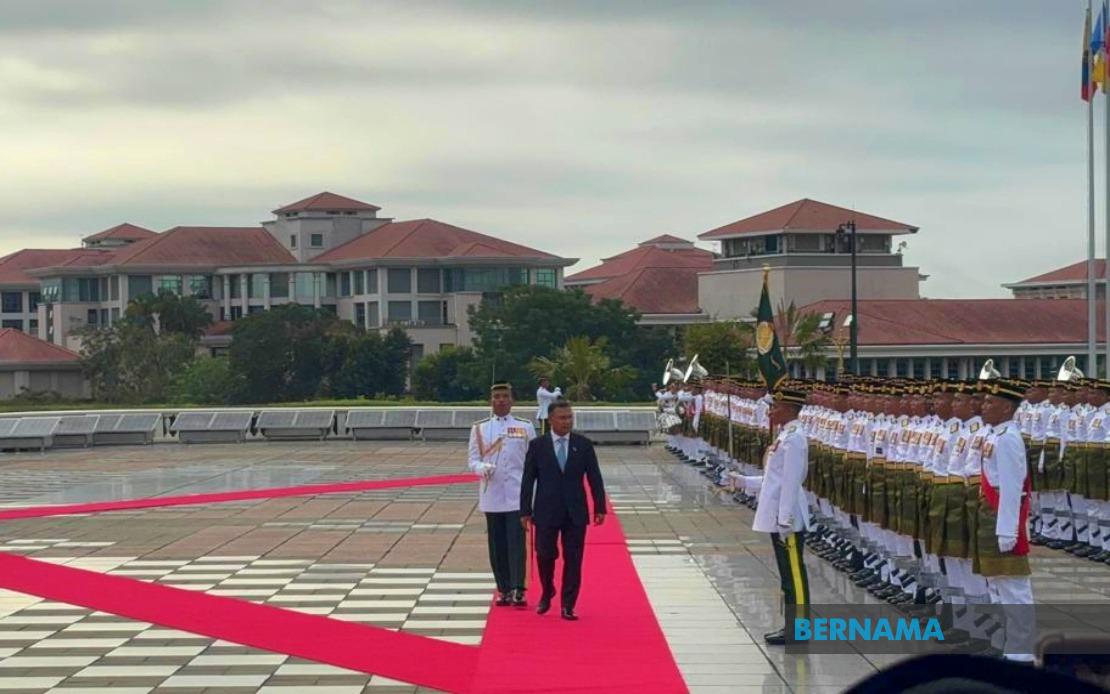
Bangladesh Prime Minister Tarique Rahman stepped onto Malaysian soil with full ceremonial honours on June 22, arriving at the Perdana Putra Complex in Putrajaya for a two-day official visit that underscores the deepening strategic partnership between the two nations. The morning ceremony saw Prime Minister Datuk Seri Anwar Ibrahim extending the formal reception, a gesture that reflects Malaysia's commitment to elevating its relationship with one of South Asia's most significant economies. The careful choreography of state visits—from the playing of national anthems to the formal inspection of a guard of honour—signals the importance both governments attach to their bilateral engagement.
The ceremonial dimensions of Rahman's reception were comprehensive and deliberate. A contingent of 103 personnel from the First Battalion of the Royal Ranger Regiment, under the command of Major Nur Ahmad Zaim Zahari, mounted an impressive guard of honour for the visiting dignitary. The presence of Deputy Prime Minister Datuk Seri Dr Ahmad Zahid Hamidi, Foreign Minister Datuk Seri Mohamad Hasan, Home Minister Datuk Seri Saifuddin Nasution Ismail, and Communications Minister Datuk Fahmi Fadzil alongside other Cabinet members and foreign diplomats underscored the high-level nature of the engagement. This collective showing of institutional support signals that Bangladesh occupies a prominent space in Malaysia's regional diplomatic and economic calculations.
The substantive work of the visit commenced following the ceremonial proceedings, with Rahman and Anwar engaging in a one-on-one discussion before convening a broader bilateral meeting involving senior officials from both nations. These consultations were designed to traverse Malaysia and Bangladesh's multifaceted relationship, examining both the momentum already established and the untapped potential waiting to be harnessed. The agenda encompassed not merely transactional trade matters but encompassed a holistic review of cooperation spanning human resource management, semiconductor manufacturing, renewable energy initiatives, agricultural development, and educational exchange programmes. Such breadth indicates that Malaysian and Bangladeshi policymakers view their nations' interaction as extending far beyond conventional commerce into domains that will shape both societies' development trajectories.
Regional and international affairs naturally featured in the leaders' discussions, reflecting the reality that bilateral relationships operate within broader geopolitical contexts. The two nations share interests in maritime security, counterterrorism efforts, and the preservation of the rules-based international order in the Indo-Pacific. Bangladesh's geostrategic location bordering India and its role as a critical hub in South Asian politics means its perspectives on regional stability resonate with Malaysian strategic thinking. Similarly, Malaysia's position within ASEAN and its bridging role between Southeast Asia and South Asia make its viewpoints valuable to Bangladeshi policymakers navigating regional complexities.
The formal agreements reached during the visit provided concrete manifestations of the relationship's substance. Both leaders witnessed the signing of a Memorandum of Understanding focused on cultural cooperation, an area often overlooked but crucial for fostering people-to-people connections that undergird governmental relationships. Additionally, two Exchanges of Notes were executed—one addressing counter-terrorism research collaboration and another facilitating investment promotion and facilitation mechanisms. These instruments demonstrate that cooperation extends into sensitive security domains whilst simultaneously removing bureaucratic impediments to commercial interaction. The official luncheon hosted by Anwar in Rahman's honour concluded the formal proceedings, providing an informal setting for relationship building.
From an economic perspective, the Malaysia-Bangladesh relationship represents significant value creation for both sides. In 2025, bilateral trade totalled RM12.18 billion (USD2.84 billion), positioning Bangladesh as Malaysia's 28th largest trading partner globally. However, within the South Asian context, Bangladesh ranks as Malaysia's second most important economic partner, trailing only India. This distinction holds considerable weight, as it reflects the scale and sophistication of commercial interaction occurring between Kuala Lumpur and Dhaka. The asymmetry inherent in the trade figures—Malaysian exports valued at RM10.08 billion compared to imports of RM2.10 billion—reveals much about the two economies' comparative advantages and the complementarity driving their exchange.
Malaysia's export portfolio to Bangladesh centres heavily on petroleum products, reflecting both nations' energy security considerations and Malaysia's position as a hydrocarbon producer serving regional demand. The diversification of Malaysian exports beyond energy into other strategic sectors remains an opportunity, particularly as Bangladesh's economy continues expanding. Concurrently, Bangladesh's export strengths in textiles, apparel, and footwear demonstrate the country's competitive positioning within global value chains for labour-intensive manufacturing. As regional supply chains reconfigure in response to geopolitical pressures and trade tensions, the Bangladesh-Malaysia relationship offers both nations flexibility and resilience in sourcing and market access.
The timing of Rahman's visit carries particular significance given broader regional dynamics. Southeast Asia watches closely how South Asian economic powers integrate with the region's frameworks and partnerships. Bangladesh's engagement with ASEAN through dialogue mechanisms and trade frameworks positions it as a crucial bridge between South and Southeast Asia. Malaysia, as both an ASEAN member and an active participant in Indo-Pacific affairs, plays a pivotal role in facilitating this integration. The visit reinforces mechanisms through which these connections deepen, potentially creating spillover effects that benefit the broader region through enhanced stability and prosperity.
Rahman's accompanying delegation, including his spouse Dr Zubaida Rahman and Foreign Minister Dr Khalilur Rahman, represented Bangladesh's institutional commitment to the visit. The composition of delegations often signals which sectors or themes receive particular emphasis, and the inclusion of the Foreign Minister suggested that diplomatic and security matters featured prominently alongside commercial considerations. The presence of senior government officials from multiple Bangladeshi ministries indicated that this visit touched multiple dimensions of state apparatus, from economic development agencies to security establishments.
Looking forward, the mechanisms established during this visit—the new MoUs, the Exchanges of Notes, and the broadened dialogue platforms—create infrastructure for sustained engagement beyond this particular visit. Bilateral relationships require continuous tending; formal visits and agreements provide the framework, but implementation and follow-up determine whether rhetoric translates into tangible benefits for citizens of both nations. The focus on sectors like semiconductors and energy reflects both nations' recognition that future prosperity lies in high-technology manufacturing and sustainable energy transitions. For Malaysian readers, Bangladesh represents not merely a trading partner but an increasingly important neighbour whose trajectory significantly influences regional stability and economic opportunity.
The visit also demonstrated how formal state ceremonies, whilst perhaps appearing purely ceremonial to observers, serve important functions in international relations. They establish hierarchy, signal commitment, and create emotional investments in relationship success amongst officials and populations alike. That Bangladesh's Prime Minister received the full panoply of Malaysian state honours—from guard of honour to Cabinet presence to official luncheon—sends unmistakable signals to both nations' domestic audiences and to the broader international community about how Malaysia values this partnership. In the context of intensifying great power competition and shifting regional alignments, such clarity about bilateral priorities carries strategic weight beyond the symbolic realm.

%22%2F%3E%3C%2Fpattern%3E%3C%2Fdefs%3E%3Crect%20width%3D%22100%25%22%20height%3D%22100%25%22%20fill%3D%22url(%23ph5elj1g)%22%2F%3E%3Crect%20width%3D%22100%25%22%20height%3D%22100%25%22%20fill%3D%22url(%23ph5elj1p)%22%2F%3E%3Ctext%20x%3D%2250%25%22%20y%3D%2250%25%22%20text-anchor%3D%22middle%22%20dominant-baseline%3D%22central%22%20fill%3D%22rgba(255%2C255%2C255%2C0.95)%22%20font-family%3D%22Georgia%2C%20'Times%20New%20Roman'%2C%20serif%22%20font-weight%3D%22700%22%20font-size%3D%22226%22%20letter-spacing%3D%22-0.02em%22%3EPolice%3C%2Ftext%3E%3C%2Fsvg%3E)