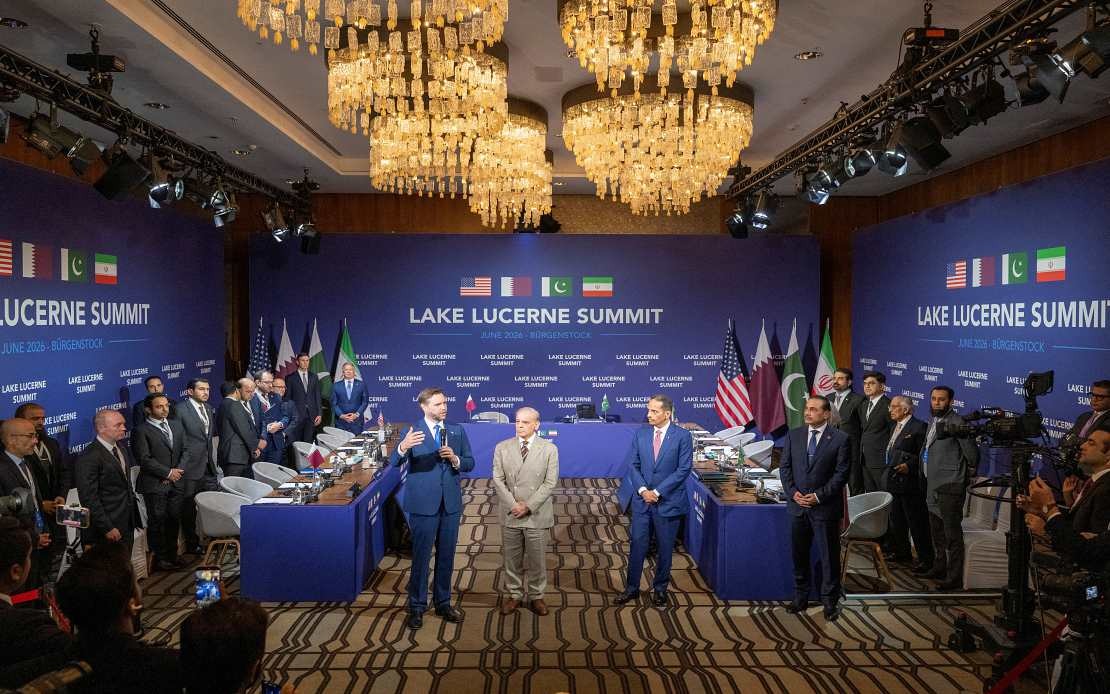
Mediators Qatar and Pakistan declared tangible momentum on Monday following the opening session of high-level negotiations between Washington and Tehran at the Lake Lucerne Summit in Switzerland. The announcement underscores intensifying international diplomatic efforts to resolve the long-standing tensions between the United States and Iran, with both nations appearing willing to engage through structured multilateral channels rather than direct bilateral confrontation. The gathering represents a rare moment of diplomatic opening between adversaries whose relationship has been marked by escalating hostilities and economic sanctions over the past decade.
The joint statement released after the first day of deliberations emphasised the constructive tone pervading discussions, suggesting that both delegations brought serious intent to the negotiating table. Beyond mere rhetoric about positive atmospheres, the mediators highlighted concrete procedural developments that suggest genuine movement toward substantive bargaining. These operational advances indicate that negotiators have moved beyond preliminary posturing and begun establishing the institutional scaffolding necessary for sustained engagement on the most contentious bilateral issues.
Central to the breakthrough was the creation of a technical discussion mechanism designed to facilitate ongoing dialogue between specialised experts from both nations. This apparatus allows negotiators to compartmentalise complex issues and assign them to working groups with domain-specific expertise, a standard practice in international diplomacy that enables progress on narrower points without requiring agreement on broader political questions. By establishing this framework early in proceedings, the parties have demonstrated commitment to methodical problem-solving rather than winner-take-all confrontation.
Equally significant was the establishment of a high-level political oversight committee empowered to direct the mediation process and supervise subordinate working groups. This dual-track structure—combining technical specialists with senior political decision-makers—reflects lessons learned from previous failed negotiations and attempts to ensure that technical progress translates into actual policy shifts. The committee's mandate to receive regular reports from lead negotiators creates accountability mechanisms that prevent discussions from drifting into abstract theoretical exercises disconnected from genuine political commitment.
The negotiators mapped out three distinct working groups focusing on Iran's nuclear programme, sanctions architecture, and dispute resolution frameworks. For Malaysia and Southeast Asia, understanding these parallel tracks proves essential, particularly regarding sanctions relief provisions. Should the United States ease restrictions on Iranian oil exports and international financial transactions, regional economies dependent on stable energy markets and predictable trade flows would benefit significantly. Conversely, any renewed escalation would exacerbate global energy price volatility already impacting developing nations across Asia.
Most ambitiously, negotiators agreed upon a compressed 60-day timeline for achieving a final comprehensive agreement. This aggressive schedule suggests either exceptional optimism about the tractability of remaining issues or political pressure from senior leadership to demonstrate results within a defined window. The deadline's feasibility remains uncertain, particularly given the technical complexity of nuclear verification mechanisms and the political sensitivity surrounding sanctions removal. Nevertheless, setting explicit temporal targets imposes discipline on negotiating teams and prevents indefinite postponement of difficult decisions.
A memorandum of understanding reportedly signed during preparatory sessions provided the foundational document upon which subsequent negotiations build. While the specific provisions remain largely confidential, such documents typically establish baseline principles including mutual recognition of sovereign rights, commitments to non-interference, and general frameworks for implementing whatever final agreement eventually emerges. The fact that both parties already signed preliminary documentation indicates substantial prior negotiation and suggests less distance between opening positions than historical precedent might suggest.
Particularly noteworthy for regional stability was the establishment of a dedicated communication channel between Washington and Tehran regarding maritime safety in the Strait of Hormuz. This critical waterway, through which roughly one-third of seaborne traded oil passes daily, has witnessed escalating tensions and several incidents involving military vessels and commercial tankers over recent years. Creating formalised mechanisms to prevent accidental escalation and ensure safe passage of commercial shipping reflects recognition that even adversaries share interest in avoiding inadvertent conflict that might spiral beyond their control. For Southeast Asian nations heavily dependent on reliable oil supplies transiting this chokepoint, such confidence-building measures carry immense practical significance.
The mediation by Qatar and Pakistan reflects broader Middle Eastern and Islamic world interests in de-escalation between major powers whose conflict generates regional instability. Qatar's experience hosting international negotiations combined with Pakistan's historical diplomatic connections to Iran position both nations as credible intermediaries. Their joint presentation of outcomes suggests aligned strategic interests in preventing further Middle Eastern conflict, particularly given impacts on global energy markets, refugee flows, and counterterrorism efforts that reverberate throughout Asia.
For Malaysia specifically, progress toward US-Iran reconciliation carries implications for crude oil pricing stability, maritime security, and regional balance of power calculations. Any fundamental shift in America's Iran policy reverberates through regional security architectures that Malaysian defence planners must factor into strategic assessments. Additionally, resolution of Iran sanctions could open economic opportunities for Malaysian companies in sectors ranging from energy to manufacturing, should Kuala Lumpur navigate complex compliance requirements governing trade with Iranian entities.
Sceptics rightly note that announcing procedural progress differs fundamentally from achieving substantive breakthrough on core issues. The fundamental disagreements driving decades of US-Iran antagonism—centring on nuclear weapons development, regional proxy conflicts, and American security guarantees to Gulf allies—involve zero-sum considerations that procedural innovation alone cannot resolve. Previous diplomatic initiatives have similarly demonstrated early momentum before collapsing when negotiations encountered genuine differences of interest.
Nevertheless, the Lake Lucerne discussions represent the most substantive engagement between Washington and Tehran in considerable time, signalling at minimum that both nations perceive benefit in exploring negotiated settlement. The 60-day timeline creates measurable pressure points at which success or failure becomes evident. Should negotiators overcome formidable obstacles and reach final agreement within the stated window, the implications for regional stability and global energy markets would prove transformative. Conversely, failure would likely prompt renewed hostility and damage the mediatory credibility of Qatar and Pakistan for future diplomatic efforts.
The coming months will test whether early diplomatic courtesies translate into willingness to make consequential concessions on matters that have proven absolutely non-negotiable in past rounds of engagement. The establishment of technical frameworks and communication channels represents necessary but insufficient conditions for genuine breakthrough. Real progress emerges only when negotiators demonstrate capacity to bridge fundamental divisions through mutual compromise—a challenge that has eluded previous attempts at US-Iran reconciliation despite considerable diplomatic effort.