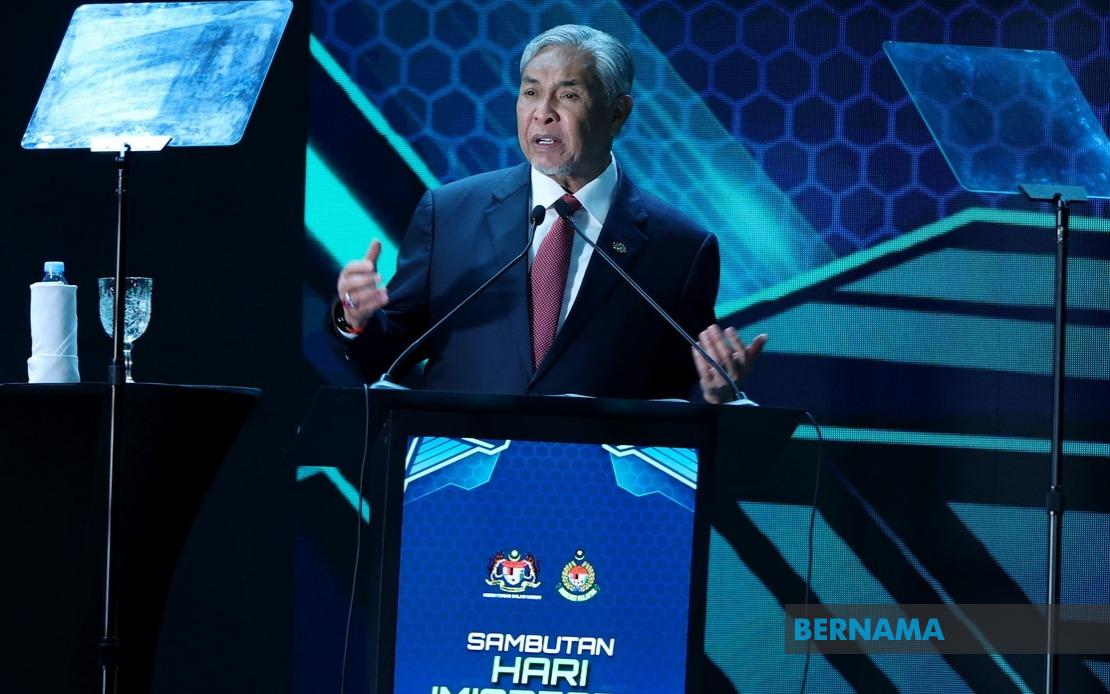
Barisan Nasional has reaffirmed its commitment to remaining part of the Unity Government coalition, with party chairman Datuk Seri Dr Ahmad Zahid Hamidi citing the binding resolution adopted at UMNO's most recent General Assembly. Speaking at the 2026 Immigration Day celebration in Cyberjaya, the UMNO president and Deputy Prime Minister stressed that the assembly decision represents the party's definitive stance on the matter, and he urged all stakeholders to respect the outcome reached at the organisation's highest decision-making body.
The confirmation comes amid ongoing scrutiny of the stability of Malaysia's current governing arrangement. The Unity Government, formed following the 2022 general election, has maintained an uneasy coalition between Barisan Nasional, Pakatan Harapan, and several smaller parties. Ahmad Zahid's explicit reaffirmation suggests that internal discussions or external pressure may have prompted the need to clarify BN's position, underscoring the delicate balance required to keep the alliance functioning.
Ahmad Zahid emphasised that no institution within UMNO or Barisan Nasional supersedes the General Assembly in terms of authority over party direction. By anchoring BN's commitment to the assembly resolution, he sought to preempt any future challenges to the decision from within party ranks. This approach reflects established democratic procedures within the coalition, where major strategic decisions require validation from the broadest representation of party members. The statement effectively closes off debate on the matter within BN structures, at least in the near term.
The party chairman's remarks also touch on the delicate relationship between coalition partners and the prerogatives of the Prime Minister. Ahmad Zahid acknowledged that Datuk Seri Anwar Ibrahim, as Prime Minister, retains absolute authority over Cabinet appointments and dismissals. This clarification appears designed to distinguish between BN's strategic coalition commitment and the executive flexibility required by the head of government to manage ministerial performance and conduct.
Understanding the broader context is essential for Malaysian observers. The Prime Minister had previously warned government ministers, deputy ministers, and agency officials against utilising their positions to criticise or undermine other coalition partners, particularly during state-level election campaigns. Such cross-party attacks risk fracturing the already fragile coalition consensus and create friction between ministries led by different political parties. Anwar signalled that he would not tolerate such conduct, implying that offending parties might be required to vacate their government positions.
This disciplinary position reflects the persistent challenge of managing a multi-party government where coalition partners hold competing political interests and often contest elections against one another. The prohibition on intra-coalition attacks during campaigning represents an attempt to maintain the firewall between coalition cooperation at the federal level and electoral competition at the state level. However, enforcing such boundaries remains perpetually difficult given the political incentives parties face to differentiate themselves from coalition partners when seeking voter support.
For Malaysian voters and analysts, Ahmad Zahid's statement carries multiple implications. First, it signals that Barisan Nasional has internally resolved to remain committed to the current governing arrangement, suggesting the party has calculated that continued coalition participation serves its interests better than alternative arrangements. Second, it demonstrates that the party respects its own institutional decision-making processes, a factor that could influence perceptions of internal governance and party stability among members and supporters.
The timing of the clarification also merits consideration. Coming at a public event and following what appears to be internal party deliberations, the statement suggests that questions about BN's long-term commitment to the Unity Government may have circulated within political circles or party structures. By publicly recommitting to the assembly resolution, Ahmad Zahid aims to eliminate uncertainty and prevent speculation from undermining coalition stability or creating opportunities for opposition parties to poach disaffected coalition politicians.
Regionally, Malaysia's experience with coalition governance offers instructive lessons for other Southeast Asian democracies managing similar arrangements. The mechanisms through which Barisan Nasional and other parties attempt to balance coalition discipline with individual party autonomy reflect common challenges in systems where no single party commands an outright majority. The emphasis on party assembly decisions as binding provides one institutional mechanism for resolving such tensions, though the sustainability of this approach depends on continued benefit calculation among coalition participants.
Looking forward, Ahmad Zahid's reaffirmation provides short-term clarity on BN's position but does not fundamentally address the underlying fragility of coalition governance. The requirement that the Prime Minister invoke disciplinary measures against ministers who attack coalition partners suggests ongoing compliance problems. Whether Anwar Ibrahim's warnings will effectively constrain inter-coalition behaviour during upcoming state elections remains uncertain, and future election campaigns could test the stability of commitments made at party assemblies.
The relationship between assembly resolutions and actual political behaviour also deserves scrutiny. While Ahmad Zahid emphasised that the General Assembly decision represents the party's highest authority, political parties frequently revisit positions when circumstances change or when cost-benefit calculations shift. The durability of BN's current commitment thus depends partly on continued satisfaction with coalition participation and partly on whether opposition parties or alternative arrangements present more attractive options to BN leadership in coming months.

