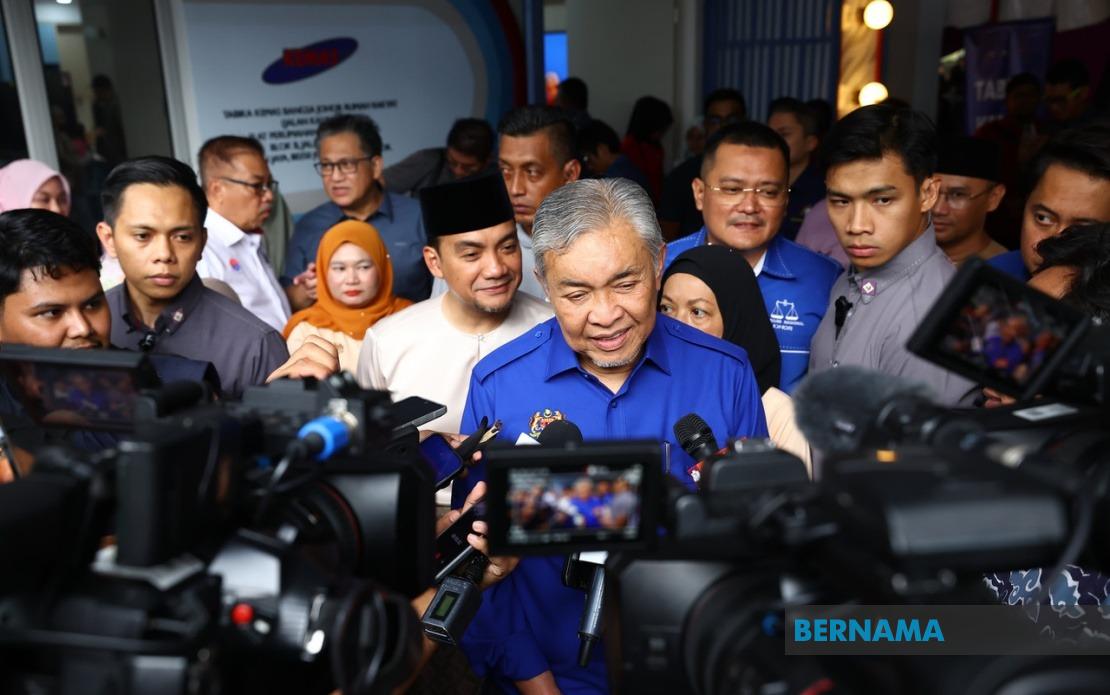
Barisan Nasional has publicly acknowledged Pakatan Harapan's manifesto for the upcoming Johor state election, with BN Chairman Datuk Seri Dr Ahmad Zahid Hamidi extending what amounts to a respectful nod to his political opponents' platform. The Deputy Prime Minister's comments, made during an engagement session with parents at a community programme in Johor Bahru, reflect the mature democratic discourse expected of Malaysia's major political players as they vie for electoral support in the resource-rich southern state.
Ahmad Zahid's statement carries particular significance because it signals BN's confidence in its own standing rather than any weakness. By welcoming proposals from competing parties, the BN chairman positioned his coalition as the custodian of democratic principles while simultaneously defending BN's track record. He emphasised that as a democratic nation, Malaysia's electoral process thrives when multiple parties present competing ideas to voters, a framing that implicitly underscores BN's role as a stabilising force in national politics.
Pakatan Harapan unveiled an ambitious 10-point manifesto designed to appeal to Johor's diverse electorate across multiple life stages and economic circumstances. The platform includes the Johor Health Scheme, financial assistance for first-time homebuyers, a substantial RM500 million allocation for youth development programmes, and measures to strengthen educational institutions. These proposals target specific demographics—young families, students, and working-age adults—reflecting PH's strategy to build a coalition encompassing younger voters and those concerned with economic opportunity and social mobility.
BN's counter-positioning rests heavily on demonstrated performance. Ahmad Zahid highlighted that the state government fulfilled more than 90 per cent of its previous manifesto commitments, a claim intended to distinguish BN's promise-keeping from opposition parties' rhetorical flourishes. This emphasis on implementation reflects a broader strategic calculation that experience and delivery matter more to voters than aspirational propositions, particularly in a state where BN has maintained considerable institutional advantages and deep-rooted political networks.
The BN manifesto itself claims comprehensive coverage across society's entire demographic spectrum. Ahmad Zahid detailed how BN's offerings span from expectant mothers and young children through school-age pupils and university students, extending to single parents and elderly residents. This cradle-to-grave approach aims to neutralise opposition claims that BN neglects any particular social segment or ethnic community. The framing of universal benefits under the concept of "Bangsa Johor"—essentially a state-based identity transcending ethnic lines—represents BN's attempt to position itself as a non-divisive, inclusive force.
The scale of the electoral contest reflects Johor's political importance. With 172 candidates competing across 56 state seats, the election commands attention from national leadership and substantial campaign resources from both major coalitions. The state's size and economic significance mean that governing Johor carries implications extending beyond state-level policy, affecting national political momentum and factional dynamics within both BN and PH. Ahmad Zahid's personal involvement in the campaign underscores how senior federal politicians have invested themselves in the outcome.
Johor's political trajectory over recent years has demonstrated volatility beneath apparent stability. While BN retained the state in 2018 when the coalition suffered nationwide defeat, the margin of victory has narrowed compared to earlier decades, and younger voters show less automatic loyalty to the ruling coalition. This context explains why both BN and PH have invested considerable effort in crafting manifestos targeting specific constituencies and addressing emerging concerns around healthcare, housing affordability, and youth employment—issues transcending traditional communal divides.
Ahmad Zahid's ministerial portfolio as Rural and Regional Development Minister adds another dimension to his campaign involvement. He used his role to reinforce the message that federal resources and attention flow toward Johor under BN stewardship, a practical argument complementing BN's campaign messaging about stability and delivery. This integration of ministerial authority with electoral campaigning represents how Malaysia's political system blurs lines between governance and partisan competition, a characteristic that shapes electoral dynamics in ways distinct from Westminster-style separations.
The polling timeline compresses the campaign into a brief window, with early voting on July 7 and main polling on July 11. This compressed schedule means both coalitions must rapidly convert manifesto announcements into voter engagement and ground organisation. For voters seeking detailed policy comparison, the swift pace presents challenges, yet it also reflects Malaysian electoral practice where late campaign momentum and ground-level organisation often prove decisive alongside national messaging.
PH's manifesto proposals, particularly the health scheme and youth development fund, signal strategic targeting of Johor's evolving demographics. As urbanisation continues and younger Malaysians comprise an increasing share of the electorate, opposition parties have calculated that healthcare quality and economic opportunity resonate more powerfully than traditional appeals to communal identity or patronage networks. BN's countering emphasis on proven delivery and inclusive benefits attempts to retain support among constituencies valuing stability and tangible results over programmatic innovation.
The election holds broader implications for Malaysian politics beyond Johor's borders. A decisive BN victory would reinforce the coalition's recovery from its 2018 defeat and strengthen Ahmad Zahid's standing within party leadership. Conversely, significant PH gains would demonstrate that opposition momentum persists in certain constituencies and that younger voters remain receptive to change-oriented messaging. National political observers monitor Johor as a bellwether for factional strength and voter sentiment ahead of anticipated general elections.
Ahmad Zahid's respectful acknowledgment of PH's manifesto, while highlighting BN's superior track record, encapsulates the coalition's dual campaign strategy: validating democratic competition while asserting incumbency advantages. Whether voters ultimately prioritise demonstrated performance or embrace policy innovation will determine not merely Johor's political composition but also provide crucial insights into Malaysia's broader electoral trajectory and the balance between continuity and change animating contemporary Southeast Asian democracy.

