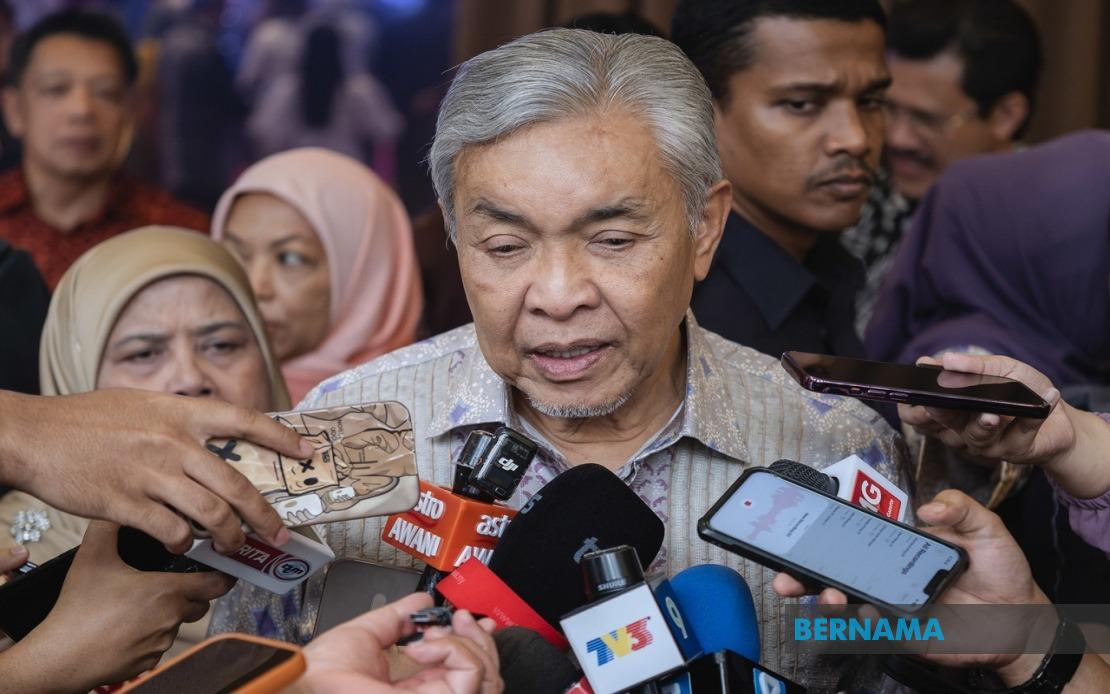
Barisan Nasional leadership has made an explicit commitment to maintain distance from matters pertaining to the Negeri Sembilan royal institution and the state's Council of Justice and Laws (DKU) as the coalition prepares for the upcoming state election scheduled for August 1. Deputy Prime Minister Datuk Seri Dr Ahmad Zahid Hamidi, who also leads UMNO, emphasised this position during discussions with the party's state-level leadership regarding electoral preparations, underscoring the importance of respecting institutional boundaries during politically sensitive periods.
Ahmad Zahid's remarks, delivered following his attendance at a Ministry of Rural and Regional Development ceremony in Kuala Lumpur, signal BN's intention to avoid the kind of political complications that can arise when ruling coalitions become entangled in royal or judicial proceedings. This declaration reflects broader concerns within Malaysia's political establishment about maintaining the separation between electoral competition and the operations of constitutionally protected institutions, a principle that carries particular weight in states where royal families exercise significant constitutional authority.
The coalition's emphasis on non-interference comes at a moment when BN is recalibrating its political strategy for Negeri Sembilan's 16th state election, which will determine the composition of the 36-member state assembly. Unlike the previous electoral cycle, when BN collaborated with components of the opposition Pakatan Harapan alliance, the upcoming contest will pit the coalition against the opposition in a more traditional adversarial format, potentially intensifying competition across all legislative seats.
Ahmad Zahid identified party unity as the paramount concern driving BN's current focus in Negeri Sembilan, emphasizing that cohesion among leaders and members at every organisational tier represents the coalition's most effective asset. This emphasis on internal solidarity reflects recognition that electoral success in a competitive multi-party environment demands disciplined mobilisation of party machinery, particularly in a state where BN has faced challenges in recent years from increasingly organised opposition movements and shifting voter preferences.
The shift away from cooperation with Pakatan Harapan components marks a significant departure from the approach adopted during the 15th state election, when BN and several PH parties worked together under a formal understanding. This realignment underscores the broader fragmentation of Malaysia's political landscape, where formerly entrenched alliance structures have given way to more fluid and contested electoral dynamics. For Negeri Sembilan specifically, the return to straight contest format means that BN cannot rely on the mathematical advantages that cross-coalition cooperation previously provided.
The Deputy Prime Minister's explicit statement regarding the royal institution and the DKU carries weight because both entities exercise real institutional influence within Negeri Sembilan's governance framework. The Council of Justice and Laws, in particular, functions as a quasi-judicial body with authority over certain legal and administrative matters affecting state governance. By pledging non-interference, BN seeks to insulate these institutions from accusations of political capture, a concern that resonates across Malaysian civil society given heightened sensitivity about institutional independence.
For Malaysian voters, particularly those in Negeri Sembilan, this commitment carries practical implications regarding how political contests are conducted. The statement represents an effort to assure the electorate that regardless of electoral outcomes, BN will respect constitutional boundaries and the autonomy of institutions that exist beyond the realm of partisan politics. This messaging becomes especially important in states where royal-institutional relationships retain substantial significance for both governance legitimacy and public confidence.
The broader context of BN's positioning in Negeri Sembilan reflects the coalition's efforts to rebuild political credibility following the 2020 state elections and the subsequent political turbulence that characterised Malaysian politics in recent years. By explicitly distancing itself from potential interference in sensitive institutional matters, BN signals a commitment to institutional respect that could resonate with voters concerned about the politicisation of previously apolitical domains.
The August 1 polling date provides a defined timeline within which these political contests will be settled, focusing attention on campaign activities, policy proposals, and candidate appeal rather than on institutional controversies. BN's decision to establish clear boundaries regarding royal and legal matters represents a strategic choice to keep the electoral narrative focused on areas where the coalition believes it can make persuasive arguments to voters about governance, development, and representation.
For the broader Southeast Asian region, Malaysia's management of these boundaries between electoral politics and protected institutions carries significance as other democracies grapple with similar questions about institutional autonomy and political competition. Negeri Sembilan's election will serve as a test case for whether established parties can navigate competitive electoral environments while respecting institutional limits that transcend partisan interests.

