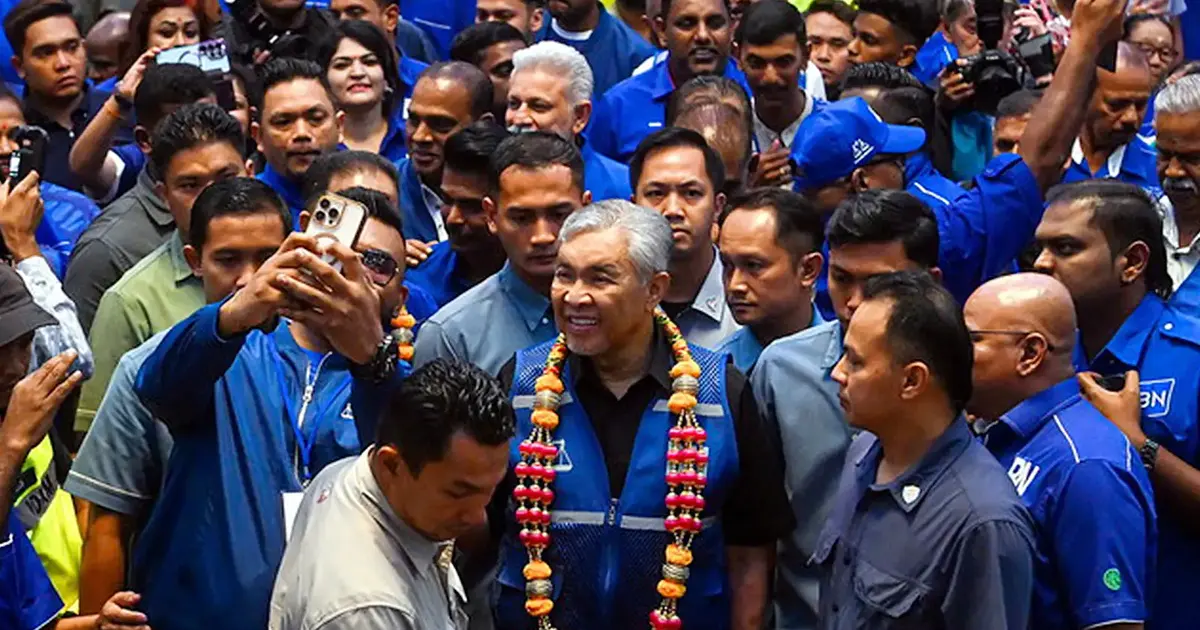
Barisan Nasional chairman Ahmad Zahid Hamidi has signalled his coalition's commitment to Indian community representation by promising two executive council seats if the group secures victory in the Negeri Sembilan state elections. The pledge represents an effort to consolidate minority support as BN seeks to strengthen its electoral position in the state, where demographic and political dynamics have shifted in recent years.
Zahid's confidence stems partly from the Malaysian Indian Congress's strong performance in the recent Johor state elections, where the party achieved a clean sweep of contested seats. This unprecedented result demonstrated that the MIC, long considered a junior partner within BN, remains capable of mobilising Indian voters when given space and strategic positioning. The Johor outcome has galvanised discussions within the coalition about reproducing similar success across other state elections, particularly in Negeri Sembilan where Indian voters comprise a meaningful percentage of the electorate.
The explicit commitment to two exco positions signals that BN recognises the importance of tangible representation for minority communities in coalition governance structures. In Malaysian politics, exco seats carry symbolic and substantive weight, determining access to ministerial portfolios and influence over state-level decision-making in areas affecting constituents. The pledge indicates that BN is not treating minority community support as automatic but rather as something requiring concrete political acknowledgement and institutional inclusion.
This move also reflects broader patterns in Malaysian electoral competition, where ethnically fragmented constituencies create incentives for coalition parties to emphasise their commitments to specific communities. By publicly stating the number of exco positions available to Indian representatives, Zahid aims to provide voters with a measurable guarantee rather than vague assurances of future consideration. Such clarity can prove particularly effective in constituencies with significant Indian populations where community leaders and grassroots organisations monitor such commitments closely.
The timing of these announcements matters considerably for state electoral dynamics. Negeri Sembilan has experienced significant political flux in recent years, with shifting voter preferences and changing perceptions of BN's capacity to deliver developmental benefits. Indian voters, traditionally a BN support base, have in some instances diversified their political allegiances or shown reduced turnout in recent elections. The exco pledge attempts to reverse such trends by demonstrating that a BN victory would translate into meaningful representation within the state administration.
MIC's trajectory within BN has undergone substantial evolution. The party faced significant organisational challenges and declining membership in recent decades, losing ground to DAP in certain Indian-majority constituencies. The Johor election performance therefore represented a potential turning point, suggesting that with proper organisational effort, adequate candidate selection, and coalition support, MIC could recover electoral momentum. If the party performs similarly in Negeri Sembilan, it would indicate a more durable revival rather than a one-off result.
Zahid's statement should be understood within the context of BN's broader strategy to present itself as a governing coalition that respects constituent community interests. Unlike Pakatan Harapan's more recent coalition structures, BN has longer institutional experience managing multi-ethnic power-sharing arrangements, though this history is contested and subject to varying interpretations. The exco commitment represents an attempt to leverage this institutional experience as an electoral asset, positioning BN as the coalition that understands and practices meaningful minority representation at state level.
For Negeri Sembilan specifically, the stakes extend beyond Indian community representation to broader questions about administrative competence and development delivery. The state faces infrastructure challenges, economic diversification pressures, and demographic shifts that require capable governance regardless of which coalition controls the state government. Indian voters in the state, like other constituencies, prioritise education access, economic opportunity, and community safety. The BN pledge of exco positions should be evaluated alongside broader policy commitments and the coalition's track record on delivering services to all communities.
The position of MIC within BN governance structures also carries implications for how effectively Indian community concerns are articulated and addressed at federal level. State-level exco representation creates pathways for escalating local grievances to national decision-making forums, particularly regarding federal allocations, development projects, and policy implementation affecting minority communities. If MIC secures exco positions in Negeri Sembilan following electoral victory, the party would gain additional platforms for advocating Indian community interests across multiple governance levels.
Opposition coalitions have similarly sought to attract Indian voters through representation pledges and targeted policy announcements addressing community priorities. The broader competitive dynamic suggests that explicit commitment to representation is becoming expected rather than exceptional in Malaysian electoral campaigns. Voters increasingly hold parties accountable for translating campaign promises into actual institutional positions and resource allocation, making such pledges both more common and more scrutinised than in previous election cycles.
The Negeri Sembilan elections will test whether BN's strategy of offering concrete representation commitments, combined with MIC's organisational revival, proves sufficient to secure victory and maintain the coalition's traditional support base among Indian voters. Success would vindicate both Zahid's confidence in BN's competitive position and MIC's revival narrative, while failure would prompt significant reassessment of minority community engagement strategies across Malaysian political coalitions.

