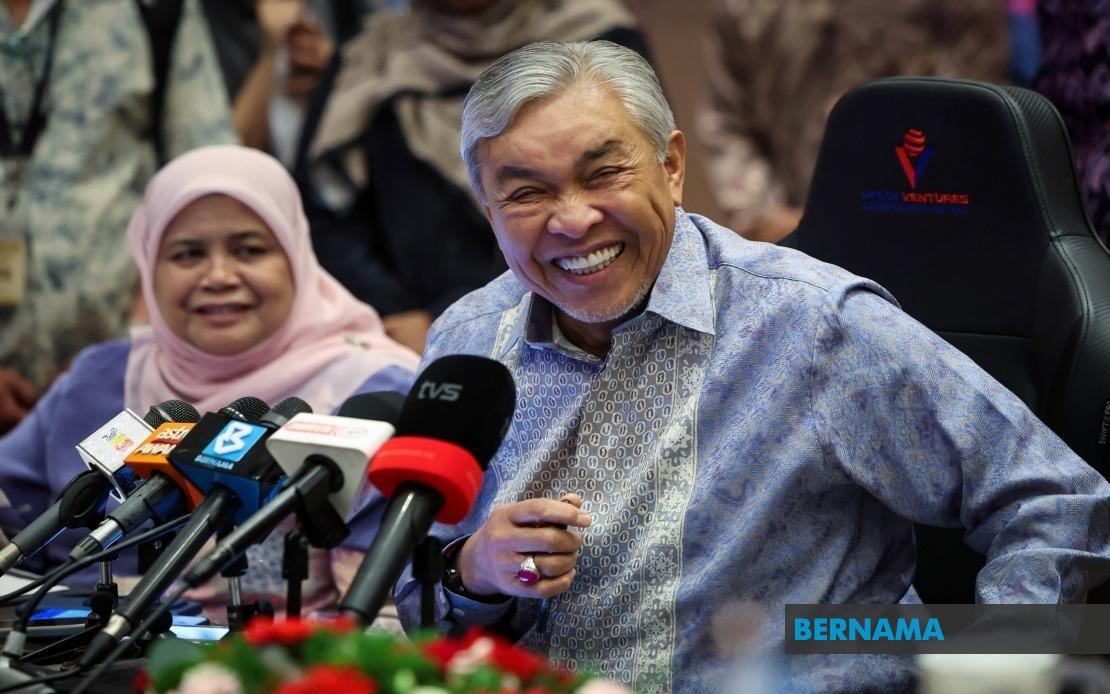
Barisan Nasional has moved to quash speculation about its political future, with Deputy Prime Minister Datuk Seri Dr Ahmad Zahid Hamidi reiterating that the coalition remains fully committed to supporting Prime Minister Datuk Seri Anwar Ibrahim's administration until parliamentary term ends. Speaking in George Town following the 61st Coordination Meeting between the Minister of Rural and Regional Development and State Executive Councillors, Ahmad Zahid categorically rejected suggestions that BN might manoeuvre to destabilise the current government through alleged geopolitical machinations or internal realignment schemes.
The deputy premier's emphatic statement arrives at a moment when Malaysia's political landscape continues to be shaped by the Unity Government framework established after the 2022 general election. Ahmad Zahid framed BN's position not as a political calculation but as a principled commitment aligned with the Yang di-Pertuan Agong's directive to form a broad coalition capable of providing stable governance. This framing carries particular weight in Malaysia's constitutional monarchy, where royal endorsement of political arrangements carries significant moral and institutional weight among key stakeholder constituencies.
Ahmad Zahid's language proved notably unambiguous when addressing persistent rumours about potential political adventurism. He explicitly rejected the possibility of what he termed "Bangkok Move" or "Dubai Move"—colloquial references to extra-territorial political manoeuvring and coalition engineering that Malaysian political observers have periodically speculated about over recent years. By naming and dismissing these scenarios directly, the BN chairman sought to eliminate any remaining ambiguity about the coalition's intentions, whilst simultaneously acknowledging that such speculation had gained sufficient currency to warrant public denial.
The broader context of BN's commitment reflects the delicate balance that has characterised Malaysian governance since the 2023 transition. The Unity Government itself represents an unprecedented configuration bringing together BN, Pakatan Harapan, and smaller coalition partners under a shared commitment to institutional stability. For BN, this arrangement marks a significant evolution from its historical dominance, requiring the coalition to operate within a more constrained political framework. Ahmad Zahid's statements therefore signal that BN leadership has accepted these parameters and views long-term institutional stability as preferable to the risks and uncertainties of political realignment.
During the same engagement, Ahmad Zahid addressed operational challenges emerging within BN's grassroots structures during the ongoing Negeri Sembilan state election campaign. A polling district centre in Klawang had reportedly ceased operations amid disagreements over candidate selection, with some BN members expressing frustration that their state seat had been allocated to another coalition partner. This episode illuminates tensions that periodically surface within multi-party coalitions when resource allocation and candidate nomination procedures generate disappointment among party activists accustomed to greater control over electoral processes.
Ahmad Zahid indicated that Negeri Sembilan UMNO leadership under Datuk Seri Jalaluddin Alias was actively managing the situation, with approximately nine days remaining before polling. His confident assessment that the matter could be resolved reflected both the interim nature of the grievance and the institutional mechanisms available to coalition managers for addressing such concerns. The Klawang state seat itself presents a complex three-way contest involving Pakatan Harapan candidate Bakri Sawir, Perikatan Nasional's Danni Rais, and Bersatu's Muhammad Adib Musa, highlighting the fragmentation of Malaysian politics at state level despite broader federal coalitional arrangements.
Significantly, Ahmad Zahid also addressed recent speculation regarding potential cooperation between BN and Perikatan Nasional under a proposed "Perikatan Barisan Nasional" (PBN) framework. The deputy premier clarified that whilst the concept had been mentioned during campaign speeches by various political figures, no formal discussions had occurred between the two major coalitions on this arrangement. This distinction proves important for managing expectations and maintaining clarity about actual versus speculative political developments. By characterising PBN as merely rhetorical positioning rather than substantive negotiation, Ahmad Zahid implicitly suggested that any such realignment would require extraordinary circumstances and deliberate institutional engagement rather than emerging organically from campaign discourse.
The Negeri Sembilan state election campaign itself has become a vehicle through which federal coalitional relationships are being tested and refined at state level. With BN and Pakatan Harapan supporting opposing sides in multiple contests, the campaign demonstrates how the broader Unity Government framework accommodates competitive electoral dynamics within specific jurisdictions. This compartmentalisation represents a sophisticated evolution in Malaysian coalition politics, permitting tactical disagreement on particular contests whilst maintaining strategic alignment at the federal level.
Ahmad Zahid's characterisation of his relationship with Prime Minister Anwar as remaining cordial despite campaign-level competition reflects the professionalisation of political relationships within the Unity Government. The two leaders exchanged pantun—traditional Malay verse forms—highlighting the cultural dimension of political communication and the importance of maintaining personal rapport amidst institutional collaboration. This symbolic dimension matters considerably in Malaysian political culture, where personal relationships between leaders often carry significance equivalent to formal institutional arrangements.
The deputy prime minister's comments ultimately serve multiple audiences simultaneously. For BN's own membership and supporters, his statements provide reassurance about party leadership's strategic direction and institutional stability. For coalition partners in Pakatan Harapan, they offer concrete affirmation of BN's continued participation in joint governance arrangements. For Perikatan Nasional, they clarify that whilst competition exists, no imminent reconfiguration threatens the current political settlement. For international observers and regional partners, they signal that Malaysia's political system remains capable of sustained institutional stability despite the complexity inherent in multi-party governance.
Moving forward, the sustainability of BN's commitment to the Unity Government will likely depend on several interconnected factors: the coalition's ability to deliver demonstrable policy achievements and economic improvements, the management of resource allocation and candidate selection processes at state level, the evolution of Perikatan Nasional's political trajectory and competitive positioning, and broader shifts in voter sentiment as the 15th Parliament progresses toward its natural conclusion. Ahmad Zahid's statements establish clear parameters for BN's political conduct, though the coalition's actual behaviour during the challenging periods ahead will ultimately determine whether this public commitment translates into enduring institutional alignment.

