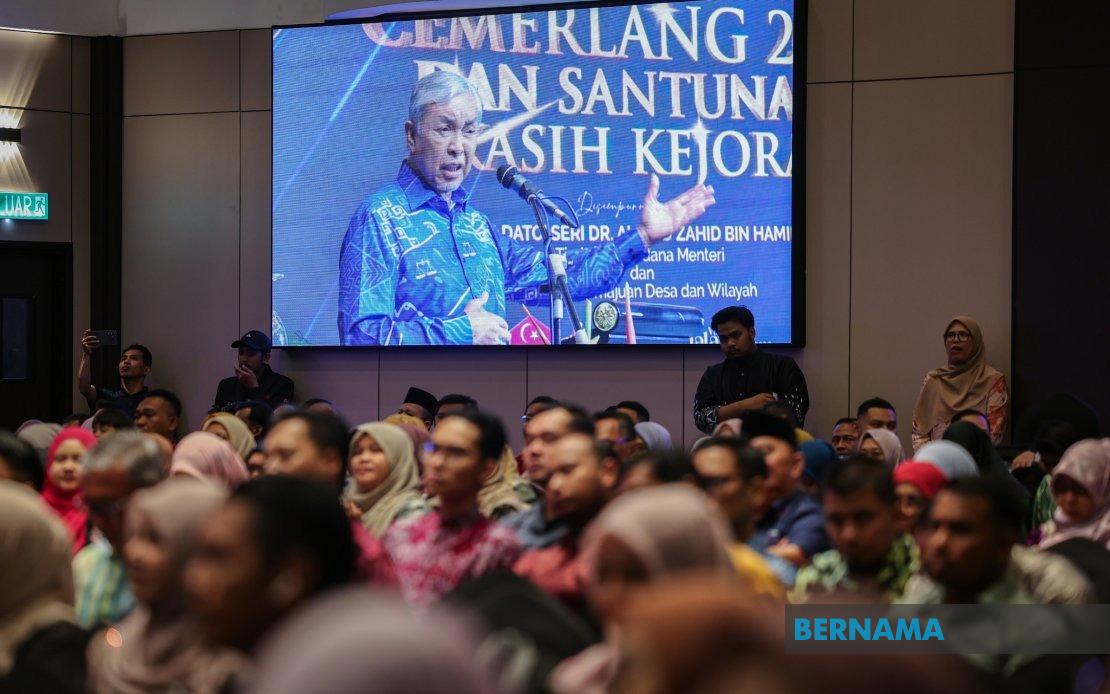
Datuk Seri Dr Ahmad Zahid Hamidi has pushed back against suggestions that Barisan Nasional's campaign for the upcoming Johor state election lacks energy or momentum, framing such assessments as subjective political commentary rather than factual observations. Speaking at an event in Kota Tinggi, the BN chairman and Deputy Prime Minister contended that the coalition's grassroots machinery has been actively mobilising voters and conducting intensive campaign activities across the state, contradicting narratives from opposition quarters that have characterised the effort as uninspiring.
Zahid's remarks come as the July 11 polling date approaches, with early voting scheduled for July 7. The timing of his comments reflects BN's apparent confidence in its position, though the coalition faces competition from a fragmented field that includes Pakatan Harapan, Perikatan Nasional, Bersama, MUDA, and several smaller parties. Both BN and PH are contesting all 56 state seats, while Perikatan Nasional is fielding 33 candidates, creating a complex multi-cornered battle across most constituencies.
Zahid acknowledged that rival coalitions have the right to their own interpretations of the campaign's vigour, adopting a measured tone that avoided direct confrontation with critics. He characterised such differing assessments as matters of perspective rather than substantive disagreement about BN's campaign performance. This diplomatic stance reflects the delicate political dynamics in Malaysian politics, where avoiding inflammatory rhetoric can protect a party's broader strategic interests, particularly when operating within the federal Unity Government framework that pairs BN with Pakatan Harapan.
The question of voter confusion stemming from the cooperation between BN and Pakatan Harapan at the federal level has emerged as a potential complication for BN in Johor. Some observers have questioned whether this partnership might alienate traditional BN supporters who view the two coalitions as natural adversaries. However, Zahid dismissed this concern, noting that Johor occupies a distinctive position in Malaysian politics. The state government, led by Menteri Besar Datuk Onn Hafiz Ghazi, was already established before the Unity Government was formed at the federal level, meaning the supposed contradiction is largely a temporal and administrative matter rather than a genuine policy conflict.
Zahid emphasised that the working relationship between BN and Pakatan Harapan at the federal level is characterised by professionalism and cooperation on matters of national interest. This framing attempts to neutralise the narrative that voters face an uncomfortable contradiction by supporting BN in Johor while that coalition maintains a federal alliance with Pakatan Harapan. For Malaysian readers, particularly those in Johor, this argument suggests that the two coalitions can coexist productively at different governmental levels without compromising either's integrity or effectiveness.
The BN chairman highlighted the economic achievements of the Johor state government under Onn Hafiz's administration as a central plank of the coalition's campaign pitch. The state generated RM2.26 billion in revenue during the previous financial year, a figure Zahid described as the highest among Peninsular Malaysian states. This emphasis on fiscal performance and revenue generation reflects a broader BN strategy of leading with administrative competence and economic delivery rather than relying primarily on partisan attacks or ideological appeals. For potential voters, particularly those concerned with state development priorities, such metrics provide tangible evidence of governance quality.
Zahid indicated that securing a strengthened mandate in the July 11 election would allow the Johor state government to accelerate its development agenda over the next five years. The framing of electoral victory as enabling rather than merely celebratory suggests BN's intention to use a strong result as political capital for pursuing its policy programme without obstruction. This approach resonates with voters who prioritise stability and continuity in government, particularly in a state like Johor with significant economic importance to the broader Malaysian economy.
When asked about recent comments from PAS president Tan Sri Abdul Hadi Awang, who has called on voters to reject Pakatan Harapan outright even in straight contests involving BN, Zahid chose to maintain his professional demeanour. Rather than reciprocating PAS's more combative rhetoric, Zahid reaffirmed BN's commitment to conducting its campaign with professionalism and focusing exclusively on promoting its own candidates. This measured response suggests awareness that excessive negativity could backfire with moderate voters, while also implicitly signalling that BN does not require external validation or strategic guidance from Perikatan Nasional or its constituent parties.
Zahid's comment that any additional support from external sources would be welcomed represents a subtle acknowledgement that political alliances remain fluid in Malaysian politics, even within ostensibly consolidated coalitions. However, his primary emphasis remained on BN's intrinsic strength and the merits of its candidates and platform. The statement also contains an implicit confidence that BN believes it can prevail without depending on tactical support from other parties, a positioning that protects the coalition's independence and authority in the state.
The composition of candidates across the competing coalitions reveals the complexity facing Johor voters. With Perikatan Nasional contesting 33 of 56 seats, Bersama offering 15 candidates, and smaller parties including MUDA, Parti Orang Asli Malaysia, and Parti Sosialis Malaysia fielding candidates alongside six independents, many constituencies will feature multi-way contests. This fragmentation potentially benefits BN and Pakatan Harapan, as votes opposing the establishment coalitions could split across multiple alternatives, though it also creates unpredictability that even experienced observers struggle to forecast.
For Malaysia's broader political environment, the Johor election serves as a significant barometer of public sentiment toward the Unity Government and the state government's performance. A decisive BN victory would reinforce the stability of both the state administration and the federal coalition, while a surprisingly strong performance by Perikatan Nasional or other opposition parties would signal discontent with the current political arrangements. Zahid's confidence in BN's campaign performance and readiness to achieve a strong result thus carries implications extending well beyond Johor's borders, affecting calculations about political momentum nationally.
As polling day approaches, Zahid's reframing of the campaign narrative appears designed to counter any suggestion of complacency or weakness within BN's organisation. By insisting that the coalition's machinery operates at full capacity and that critical assessments represent mere political perspective, he aims to maintain party morale and voter enthusiasm during the crucial final stretch. Whether this narrative aligns with ground-level realities in constituencies across Johor will become evident once voters cast their ballots on July 11, providing definitive evidence of campaign effectiveness that transcends the competing claims of coalition leaders.

