Kluang's emerging economic proposition centres on a deliberate strategy to position the constituency as a settlement hub for workers employed across Johor's more prosperous urban and industrial zones. Barisan Nasional candidate Syed Hussien Syed Abdullah has articulated this framework—dubbed "Work in the City, Live in the Countryside"—as the cornerstone of his policy agenda for the Mahkota state seat, acknowledging the persistent tension between economic opportunity and quality of life that shapes decision-making for younger professionals across Malaysia.
The concept directly addresses a demographic reality facing rural constituencies throughout the country: young talent gravitates toward major cities to pursue better-remunerated positions, progressively hollowing out smaller towns of their most mobile and ambitious residents. Syed Hussien's proposal attempts to circumvent this drain by reimagining commuting infrastructure and economic geography, rather than simply exhorting residents to remain within their hometowns. The initiative relies substantially on the Electric Train Service's expansion and connectivity improvements to render daily travel between Kluang and Johor's employment centres genuinely feasible, transforming what might otherwise demand residential relocation into a manageable daily commute.
This framework aligns strategically with the Johor Economic Transformation Plan announced by Menteri Besar Datuk Onn Hafiz Ghazi, which seeks to distribute prosperity more equitably across all 10 districts rather than concentrating development in the state capital and surrounding areas. For Mahkota voters, the implication is tangible: the constituency would function as a satellite residential community serving workers in higher-wage sectors, whilst preserving the lower cost of housing and living expenses that distinguish rural Malaysia. Such positioning could appeal particularly to young professionals navigating Malaysia's expensive property market, where median house prices in major cities have substantially outpaced wage growth over the past decade.
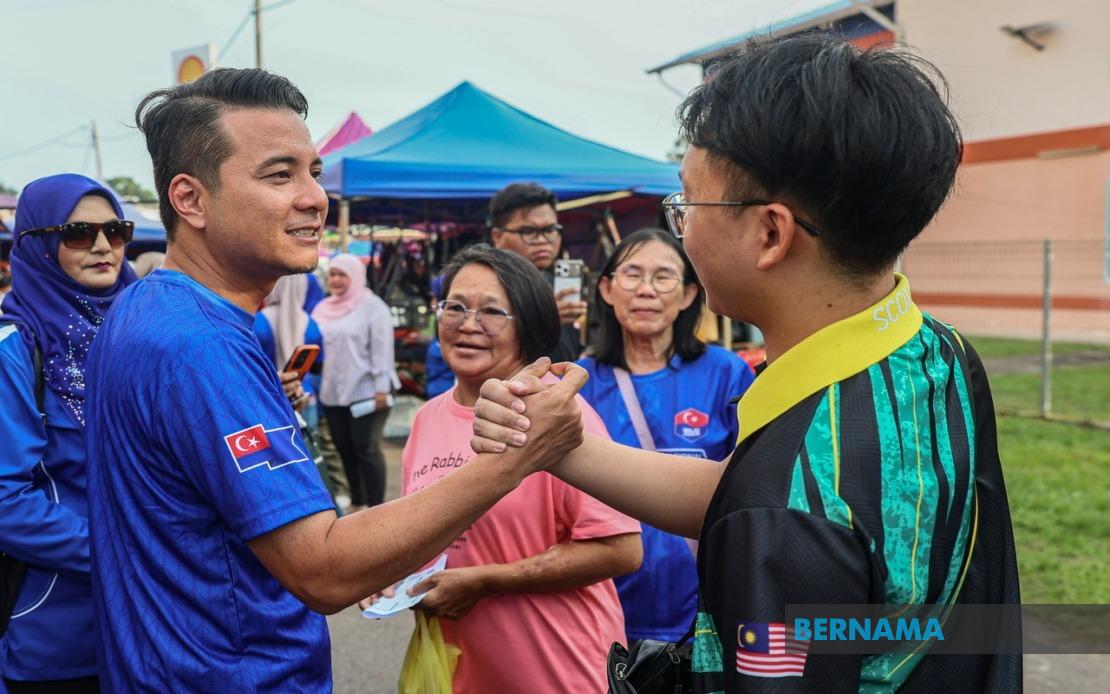
On the campaign trail, Syed Hussien reported substantial progress in grassroots engagement, having reached more than half of Mahkota's localities through ground-level interaction rather than relying on periodic or event-based voter contact. He attributed this momentum to consistent, year-round engagement strategies that combine conventional face-to-face constituency work with digital outreach methods, allowing the coalition machinery to maintain proximity to voters beyond traditional campaign seasons. This approach reflects broader recognition within BN that electoral success increasingly depends on sustained community presence rather than concentrated campaign bursts.
Language capacity emerged as a secondary topic in Syed Hussien's campaign narrative, with his Mandarin fluency presented as instrumental for engaging the Chinese community. However, he emphasised that linguistic ability, while valuable, ultimately remains subordinate to demonstrated sincerity, reciprocal respect, and equitable treatment across all communal groups. This framing suggests awareness that voters increasingly scrutinise substantive policy competence and genuine intercommunal commitment rather than superficial cultural signalling.
The candidate has adopted a notably cautious posture toward youth mobilisation, a demographic cohort whose voting patterns remain notoriously unpredictable and whose support could determine marginal outcomes in contests like Mahkota. Rather than deploying populist incentives or unrealistic pledges, Syed Hussien has articulated a vision centred on cultivating political maturity and responsible civic engagement among younger voters. This reflects implicit acknowledgment that previous cycles of extravagant campaign promises have bred disillusionment and cynicism, particularly among university-educated and digitally-connected segments who can readily identify unfinanceable commitments.
The Mahkota contest unfolds as a three-way race involving Syed Hussien for BN-UMNO, Dr Ahmad Zuhan Md Zain representing Pakatan Harapan, and Abd Hamid Ali contesting under the Bersama banner. The broader Johor election encompasses 172 candidates competing for 56 state seats, with polling scheduled for July 11 and early voting on July 7. Electoral history provides context: in 2022, Datuk Sharifah Azizah Syed Zain (BN-UMNO) retained the seat with a majority of 5,166, whilst a 2024 by-election saw Syed Hussien secure 20,648 votes, suggesting substantial shifts in voting composition or turnout patterns within that interval.
Syed Hussien's victory margin in the recent by-election substantially exceeds the 2022 general election result, potentially indicating either improved BN performance or favourable campaign dynamics surrounding the special poll. The scale of this swing warrants examination when interpreting the forthcoming state election outcome, as by-election electorates frequently differ demographically and motivationally from general election participants. Conversely, the expansion of the candidate pool to three contestants in the state election may fragment voting patterns differently than the by-election configuration.
The "Work in the City, Live in the Countryside" proposition carries broader implications for Malaysian regional development strategy. Should such models gain traction across multiple constituencies, they could reshape patterns of internal migration and urbanisation, potentially moderating pressure on congested city centres whilst revitalising smaller towns through sustained residential populations and consumer demand. This approach contrasts with historical development frameworks that concentrated economic activity in established metropolitan zones, effectively rendering smaller constituencies as either agricultural hinterlands or dormitory suburbs.
For Southeast Asian observers, the Mahkota template offers instructive lessons regarding integrating rural constituencies into expanding economies without necessarily displacing established populations. Malaysia's relatively advanced transport infrastructure, particularly the ETS network, provides technical capacity that many neighbouring countries lack, yet the strategic thinking underlying Syed Hussien's vision—leveraging connectivity to create economic optionality rather than geographic displacement—remains transferable across the region.
The campaign's emphasis on responsible political engagement and measured expectations represents an implicit critique of populist politics that has characterised recent Malaysian electoral cycles. Whether voters in Mahkota and beyond genuinely prefer this restrained messaging to more effusive campaign promises remains an open question that July's polling will help illuminate. The three-cornered contest provides additional complexity, as vote-splitting dynamics may reward different coalition strategies than straightforward two-way contests.

