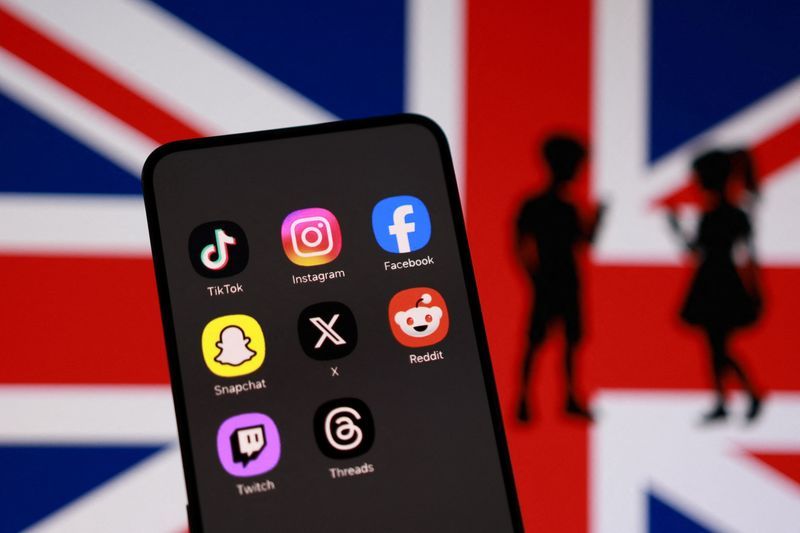
Britain's government is moving to restrict teenage access to social media during night hours, introducing a default curfew that would block users aged 16 and 17 from platforms between midnight and 6 a.m. unless they actively disable the restriction. The measure represents the latest phase of the government's broader digital safeguarding agenda, coming just weeks after it unveiled plans to prohibit social media use entirely for anyone under 16—a move that would make the United Kingdom one of the world's strictest jurisdictions on youth social media access.
Under the proposed framework, technology companies operating platforms such as Instagram, TikTok, and YouTube would face legal obligations to implement the overnight lockout system as a default setting. The architecture would prevent young people from using the apps during sleeping hours, with additional features designed to encourage prolonged scrolling also disabled automatically. Users wishing to access their accounts outside these protected hours would need to navigate settings menus and consciously override the default restrictions, introducing a friction point intended to deter late-night usage among the teenage population.
Technology Minister Liz Kendall framed the initiative as a health protection measure, arguing that enforced overnight restrictions would improve sleep quality for adolescents, enhance academic concentration, and foster stronger family relationships. The government contends that sleep deprivation and excessive social media exposure contribute significantly to mental health challenges among young people—concerns that resonate throughout developed economies grappling with rising rates of teenage anxiety and depression. By establishing technical barriers to night-time access, policymakers hope to redirect teenage behaviour toward healthier patterns of device use and sleep routines.
Online Safety Minister Kanishka Narayan emphasised that technology companies would face no discretion in the matter, describing the approach as a forceful intervention in corporate practices. During a Wednesday radio interview, Narayan stated that platforms failing to implement robust age verification mechanisms alongside the curfew system would face severe regulatory penalties. This language signals an aggressive regulatory posture, suggesting that the government intends to hold technology companies strictly accountable for compliance and may impose substantial fines or operational restrictions for non-compliance.
The regulatory timeline indicates that draft legislation will be presented to Parliament before the year concludes, with full implementation expected by spring 2027. This multi-year rollout period provides technology companies with notice to develop compliant systems, though it also extends the window before actual enforcement begins. The phased approach allows for potential industry consultation and technical refinement, yet establishes clear governmental intent to move forward regardless of corporate objections or assertions regarding feasibility.
However, the proposal has already encountered political criticism, particularly from the opposition Conservative Party. Laura Trott, the Conservatives' education policy chief, characterised the curfew approach as fundamentally incoherent, arguing that permitting young people to override restrictions renders the measure largely symbolic. If teenagers can easily disable the midnight curfew through simple setting adjustments, Trott suggests, the safeguarding benefit becomes questionable, and the initiative amounts to performative policy rather than substantive protection.
This critique points to a broader implementation challenge evident in international precedent. Australia, which became the first nation to ban social media for minors, discovered that technology companies struggled catastrophically with basic age-verification processes, according to advisors who studied the rollout. If platforms cannot reliably confirm user age at the point of access, the entire regulatory framework collapses, rendering age-based restrictions unenforceable regardless of their design. The gap between regulatory ambition and technical capability has emerged as the critical weak point in age-restriction policies globally.
Recent legal settlements underline the serious reputational and financial stakes surrounding teenage social media harm. Both Google and TikTok have reached settlements in separate United States lawsuits brought by minors claiming that platform algorithms and design features damaged their mental health. These legal outcomes reflect judicial recognition that social media companies bear responsibility for youth welfare impacts, creating financial and reputational incentives for platforms to demonstrate commitment to protective measures—though whether voluntary engagement or mandatory regulation proves more effective remains contested.
For Malaysia and Southeast Asian observers, Britain's initiative offers instructive parallels and cautionary lessons. The region has witnessed explosive growth in teenage social media adoption, with platforms deeply embedded in educational, social, and commercial life. However, unlike Britain's developed regulatory infrastructure and technology enforcement capacity, Southeast Asian nations typically face more acute challenges in monitoring compliance, given the scale of internet usage and the prevalence of informal digital markets. The technical feasibility issues that plagued Australia's age-ban implementation could prove even more acute in contexts with limited regulatory resources, suggesting that strict prohibition models may prove less practical than graduated approach permitting access under controlled conditions.
Britain's emphasis on default settings rather than outright prohibition represents a philosophically different approach than Australia's absolute ban, potentially offering a more sustainable model for jurisdictions with implementation constraints. By establishing that the default position favours protection—with users requiring active choice to bypass restrictions—governments can shift responsibility psychology while maintaining access for those who consciously choose differently. This framework may prove replicable across Southeast Asia, where strong youth advocacy and commercial interests would otherwise resist total prohibitions.

