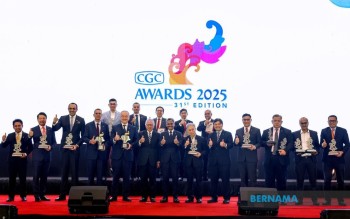
Malaysia's micro, small and medium enterprises received significant recognition at the 31st CGC Awards 2025 ceremony in Kuala Lumpur, where the Credit Guarantee Corporation Malaysia Bhd acknowledged 32 outstanding achievements within the country's entrepreneurial landscape. The awards programme celebrates businesses and ecosystem participants that have navigated economic challenges through demonstrated resilience, adaptability and meaningful participation in Malaysia's enterprise sector. This recognition comes at a critical juncture as policymakers and industry stakeholders intensify efforts to strengthen the foundations of a competitive, inclusive economy.
CGC chairman Datuk Mohammed Hussein delivered a keynote address emphasising that business resilience transcends conventional measures of cash flow and credit access. According to Hussein, the personal qualities of entrepreneurs—their character, discipline and capacity to adapt—prove equally decisive in determining whether enterprises survive downturns and seize emerging opportunities. This perspective reframes business survival not merely as a function of financial engineering but as rooted in leadership qualities and operational culture. Hussein's framing suggests that capacity-building and mentorship may be as critical as traditional lending support in sustaining Malaysia's SME ecosystem.
The chairman articulated a systems-level view of resilience, arguing that sustainable enterprise performance requires coordinated effort across multiple stakeholders. Hussein stressed that government must establish regulatory and operational conditions conducive to entrepreneurship, while research institutions shoulder responsibility for translating scientific advances into commercially viable products and services. Large corporations, he suggested, should leverage their procurement power by genuinely opening supply chain opportunities to SMEs rather than maintaining closed ecosystems. Financial institutions, both conventional and Islamic, must position themselves as growth catalysts through appropriately structured capital products. This ecosystem perspective reflects growing recognition among policymakers that siloed approaches to MSME development yield suboptimal results.
Bumiputera enterprise development constitutes a cornerstone of CGC's strategic mandate. During the preceding financial year, the corporation deployed RM223 million in guarantee facilities supporting 27 Bumiputera-owned companies, demonstrating sustained commitment to indigenous entrepreneurship. This targeted support acknowledges both the economic significance of Bumiputera businesses to the broader Malaysian economy and the particular structural challenges they may encounter in accessing mainstream financing. The guarantee mechanism effectively de-risks lending decisions for financial institutions, thereby widening the pool of Bumiputera entrepreneurs with viable pathways to growth capital.
Environmental, social and governance considerations have gained traction within CGC's portfolio management. The corporation channelled RM1.2 billion in ESG-linked guarantees throughout the assessment period, surpassing its RM1 billion target. This overperformance indicates strong demand among Malaysian enterprises for financing tied to sustainability commitments, whether in environmental remediation, labour standards, or corporate governance reforms. For regional observers, this uptake suggests that Malaysian businesses increasingly recognise competitive and reputational advantages flowing from demonstrated commitment to responsible practice.
The awards ceremony distributed honours across three distinct categories, enabling recognition of diverse stakeholder contributions. Alliance Bank Malaysia Bhd and CIMB Islamic Bank Bhd jointly captured the Best Financial Partner award, signalling strong institutional capacity in MSME lending across both conventional and Islamic banking channels. OCBC Al-Amin Bank Bhd received specific recognition for excellence in supporting Bumiputera SMEs, while Maybank Islamic Bhd garnered special recognition for its Bumiputera-focused initiatives. This distribution of accolades reflects healthy competitive dynamics within Malaysia's banking sector, with multiple institutions competing to demonstrate genuine commitment to MSME development beyond regulatory compliance.
The awards framework itself merits attention for its structural sophistication. By disaggregating financial institution partners into conventional banks, Islamic financial institutions, and development finance vehicles, the framework acknowledges that different institutional types play distinct roles within the broader ecosystem. Bank Simpanan Nasional and SME Development Bank Malaysia Bhd received recognition under the development finance category, affirming their specialised mandate to serve enterprises that may fall outside conventional banking parameters. Peoplender Sdn Bhd's recognition in the non-financial institution category acknowledges the growing importance of alternative capital providers in expanding financing accessibility.
A major policy announcement accompanied the awards ceremony: the launch of a RM10 billion Bank Negara Malaysia-CGC Portfolio Guarantee and Portfolio Guarantee-i scheme. These instruments employ a risk-sharing architecture wherein CGC assumes a defined portion of lending losses, thereby reducing financial institutions' exposure to MSME credit risk. Portfolio-level guarantees operate more efficiently than individual transaction guarantees, reducing administrative friction and enabling faster deployment of capital. The schemes target approximately 12,100 MSMEs across priority economic sectors, suggesting sophisticated targeting based on sectoral analysis of growth potential and employment impact.
The financing facilitated through these guarantee schemes addresses multiple enterprise needs simultaneously. Beyond simple working capital provisioning, the schemes explicitly target business expansion ambitions, productivity enhancements, sustainability transitions, and competitive strengthening. This multi-purpose design reflects understanding that contemporary MSMEs require capital not merely for survival but for meaningful growth and adaptation to evolving market conditions. The emphasis on sustainability transitions is particularly noteworthy, as it positions climate adaptation and environmental compliance as core business imperatives rather than peripheral considerations.
For Malaysian enterprise owners, particularly those in the MSME segment, these parallel initiatives—the awards recognition and the RM10 billion guarantee programme—signal policy coherence around MSME development. The awards ceremony functions partly as morale-building exercise, celebrating peers who have achieved measurable success. Simultaneously, the guarantee scheme announcements translate policy rhetoric into concrete financing mechanisms accessible to thousands of enterprises. This combination of recognition and instrumental support creates reinforcing momentum around MSME competitiveness.
The CGC's stated commitment to its Group 2030 strategic roadmap promises continued evolution of support mechanisms. Financial inclusion remains a stated priority, acknowledging that substantial segments of Malaysia's entrepreneurial population still lack reliable access to growth capital on reasonable terms. Sustainable economic development integration across guarantee programmes reflects growing consensus that businesses ignoring environmental and social dimensions face rising regulatory, reputational and operational risks. The emphasis on collaboration—explicitly naming financial institutions, government agencies, corporates and entrepreneurs as essential partners—suggests recognition that no single institution can catalyse comprehensive MSME transformation.
Regional implications warrant consideration. Malaysia's MSME development model, combining guarantee mechanisms with targeted support for indigenous enterprises and sustainability integration, offers instructive lessons for Southeast Asian neighbours confronting analogous challenges. Countries across the region struggle with MSME financing gaps, Bumiputera-equivalent equity concerns, and pressure to align business activity with environmental objectives. Malaysia's demonstrated willingness to deploy substantial capital—RM10 billion represents meaningful commitment—while simultaneously instituting sophisticated monitoring and recognition systems reflects institutional maturity that other regional economies may aspire to emulate.
Looking forward, the scale of these initiatives suggests that policymakers view MSME development not as marginal concern but as central to inclusive growth objectives. The 31st CGC Awards, combined with the RM10 billion guarantee programme launch, represent substantial institutional commitment to strengthening Malaysia's entrepreneurial foundation. Whether these interventions ultimately translate into measurable improvements in MSME survival rates, employment generation, and sectoral productivity will require sustained monitoring and evaluation, but the direction of policy intent appears unmistakable.

