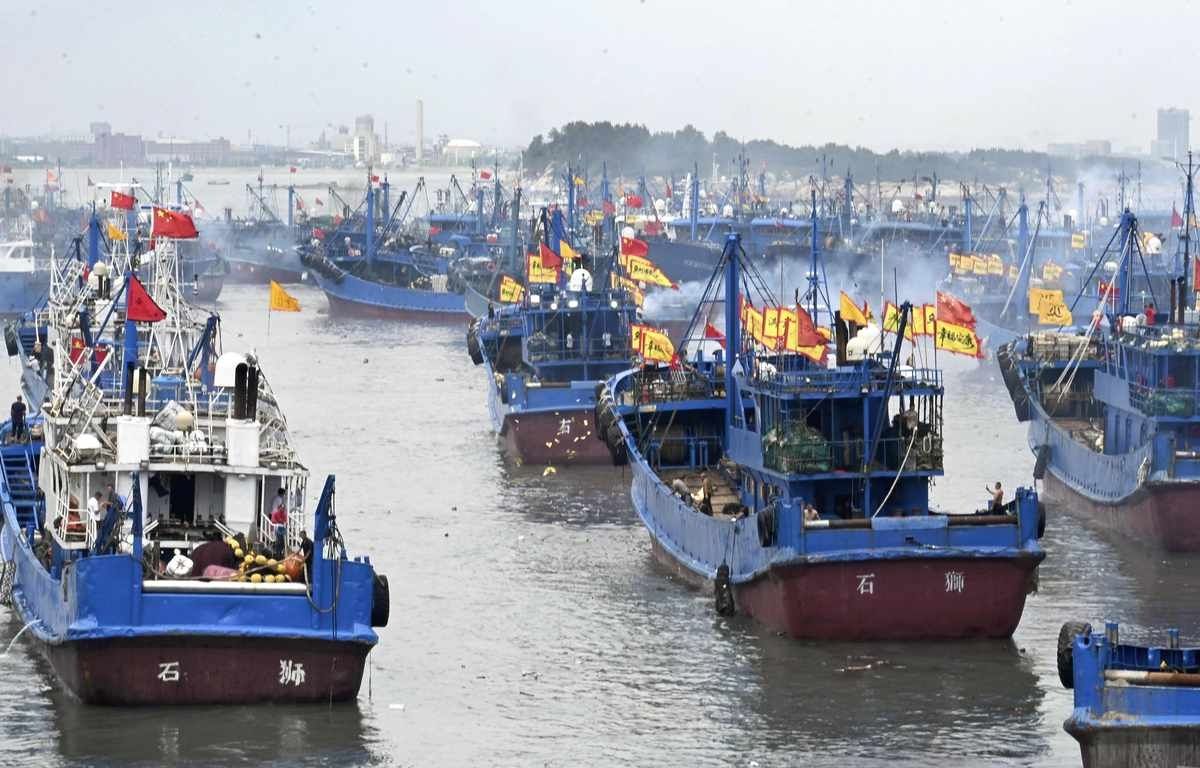
The resumption of Chinese fishing operations in the East China Sea following the expiration of Beijing's seasonal moratorium on Saturday signals a potential shift in an already fraught bilateral relationship with Japan. The immediate departure of hundreds of vessels from ports in Fujian Province, including 654 boats from the city of Shishi alone on Sunday morning, underscores the significant economic stakes involved in these contested waters. The timing coincides with mounting diplomatic tensions between the two nations, prompting Japanese officials to adopt a heightened stance of vigilance over developments in the region.
Historically, the period following the lifting of China's fishing ban has proven to be a flashpoint for confrontation. Observers recall August 2016 when Chinese Coast Guard vessels and between 200 and 400 fishing boats converged on areas surrounding the Senkaku Islands, with documented incursions into Japanese territorial waters. These incidents were widely interpreted as a coordinated effort between official maritime authorities and commercial fishing operations, a possibility that prompted Japan to lodge forceful diplomatic protests. At the time, many analysts believed the aggressive posturing represented China's reaction to Japan's push for acceptance of the Arbitral Tribunal's July 2016 ruling in The Hague, which comprehensively rejected Chinese sovereignty claims across much of the South China Sea.
The Senkaku Islands remain one of the most contentious flashpoints in East Asian geopolitics. Both China and Japan claim sovereignty over the uninhabited archipelago, located approximately 100 kilometres northeast of Taiwan and roughly 170 kilometres southwest of Japan's Okinawa Prefecture. Control over these islands carries profound strategic implications, as they sit atop potentially significant energy reserves and provide command over vital shipping lanes that serve the broader region. For Japan, maintaining administrative control and preventing Chinese encroachment represents a core national interest, while for China, the islands form part of its broader historical and territorial assertions in the maritime domain.
What distinguishes the current situation from previous cycles of tension is a subtle but potentially significant shift in Chinese governmental messaging. Traditionally, Beijing issues fishing restriction notices around May each year, with prior years explicitly warning fishermen to avoid what are termed "sensitive waters" adjacent to South Korea, North Korea, and Japan. However, this year's notice, dated April 30, conspicuously omitted any reference to Japan while maintaining prohibitions on fishing in interim measure areas between China and South Korea. This linguistic change has not escaped the attention of diplomatic observers, who regard it as potentially signalling a recalibration of Chinese policy regarding operations near Japanese-controlled territory.
The motivations underlying this apparent policy adjustment remain complex and layered. In recent years, Chinese local authorities had explicitly instructed fishermen to exercise restraint in sensitive areas, reflecting official concern that uncontrolled fishing operations could trigger accidents or dangerous confrontations with Japanese maritime assets. This cautious approach appeared to yield measurable results, with warnings issued by the Japan Coast Guard to Chinese fishing vessels in the Senkaku territorial waters declining dramatically from 81 in 2021 to merely four in 2025. The dramatic reduction suggested an effective, if informal, understanding regarding operational boundaries. Yet the removal of explicit warnings about Japanese waters in this year's directive may indicate either a loosening of these informal constraints or an effort to provide plausible deniability should incidents occur.
Interviews with fishermen operating from Fujian ports reveal the pragmatic calculus facing those dependent on these waters for their livelihoods. One Shishi-based fisherman in his 50s acknowledged that the areas surrounding the Senkaku Islands represent genuinely productive fishing grounds, making them economically significant destinations. Yet he also recognized the domestic enforcement mechanisms at play, noting that while authorities have not issued explicit prohibitions against operating near the islands, surveillance by Chinese maritime agencies creates practical constraints on behaviour. His comments suggest that the absence of formal restrictions does not necessarily translate into unfettered access, as fishermen must carefully navigate between their economic interests and the risk of detention by their own government's monitoring apparatus.
The timing of these developments occurs against a backdrop of broader deterioration in Japan-China relations extending well beyond maritime disputes. Trade frictions, military posturing in the broader region, and competing visions for regional order have all contributed to a more adversarial bilateral environment. Against this context, any expansion of Chinese maritime activity near the Senkaku Islands carries heightened potential for miscalculation or escalation. Japanese policymakers recognize that fishing incidents, while ostensibly commercial in character, can rapidly acquire political dimensions that extend far beyond the immediate parties involved. The potential for a single accident or confrontation to trigger diplomatic crises adds urgency to Japan's monitoring efforts.
For Malaysia and other Southeast Asian nations, developments in the Senkaku dispute carry implications beyond the immediate bilateral relationship. The pattern of how China and Japan manage contested maritime claims influences regional dynamics more broadly, affecting considerations of international law, freedom of navigation, and the management of overlapping maritime interests. Malaysia itself maintains territorial claims in the South China Sea and faces comparable questions regarding how to balance resource exploitation with geopolitical caution. The approaches adopted by Japan in responding to Chinese fishing operations may offer relevant case studies for how smaller nations navigate assertion of maritime rights against more powerful neighbours.
The coming months will prove revealing regarding Beijing's intentions. If Chinese fishing operations return to significantly elevated levels around the Senkaku Islands, particularly if coordinated with official vessels as in 2016, such a development would signal a deliberate shift toward more assertive maritime behaviour. Conversely, if fishing activity remains relatively constrained despite the removal of explicit warnings, it would suggest that informal agreements continue to structure bilateral conduct despite the apparent policy shift. Japan's Coast Guard will play a critical role in documenting any patterns that emerge, with warning statistics potentially serving as a barometer of Chinese policy direction. For regional observers, the unfolding situation represents an important indicator of whether Japan-China relations are entering a new phase of maritime competition or whether existing tacit understandings will persist despite rhetorical changes.

