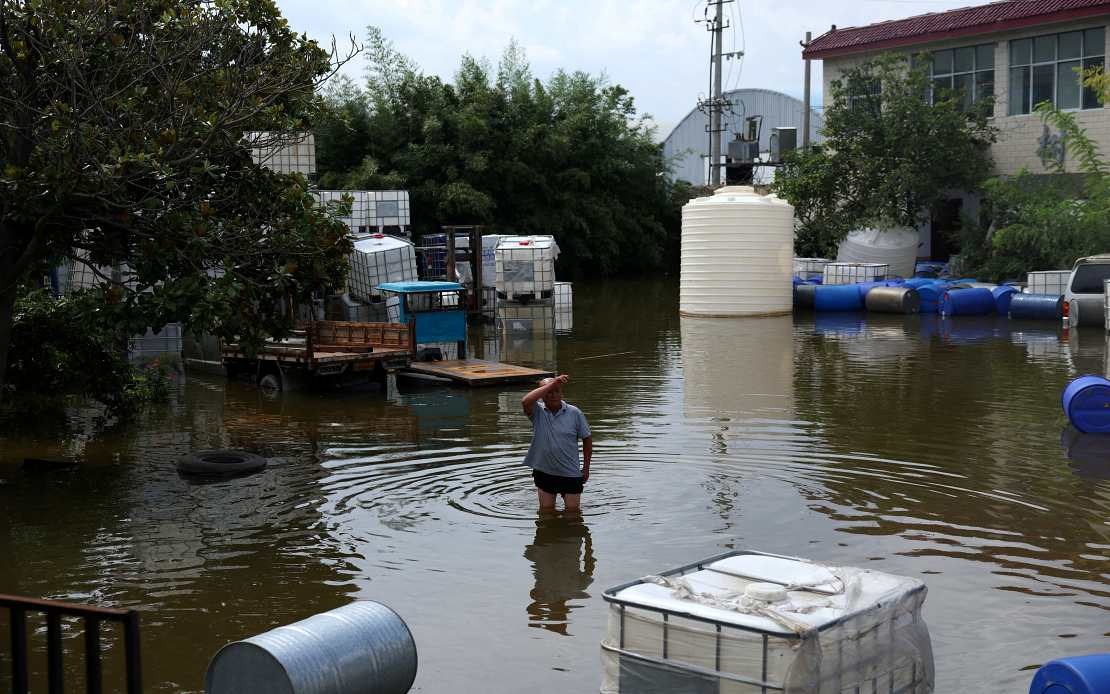
China's Ministry of Emergency Management has mobilized a significant rescue operation in Zhoukou City, located in central Henan Province, after the remnants of Typhoon Dolphin triggered severe flooding and a critical levee failure late Thursday evening. The breach occurred at approximately 11 pm local time following days of torrential rainfall that swelled waterways across the region. The response represents a substantial commitment of resources from Beijing's disaster management infrastructure, signalling the seriousness of the situation facing communities along affected waterways.
The initial deployment includes 200 specialized engineering rescue personnel from China Anneng Group, complemented by 110 units of heavy engineering equipment. These teams crossed into the affected zone on Friday to coordinate with local emergency responders already engaged in immediate rescue and stabilization efforts. The scale of deployment reflects the complexity involved in managing a catastrophic levee breach, which presents multiple hazards including uncontrolled water flow, structural collapse risks, and displacement of large populations. Engineering specialists are critical for assessing remaining infrastructure integrity and preventing secondary failures as water levels continue to fluctuate.
The National Commission for Disaster Prevention, Reduction and Relief formalized the national response by activating a Level-IV emergency protocol for Henan Province on Friday. This tier of activation indicates a major incident requiring coordinated federal intervention across multiple agencies and provincial systems. Typhoon Dolphin, identified as the 13th typhoon of the current season, has demonstrated the vulnerability of river management systems across central China to extreme weather events. The decision to escalate to this level reflects both the immediate humanitarian crisis and the potential for cascading impacts if secondary breaches occur elsewhere in the region.
The humanitarian response extends beyond rescue operations to include the dispatch of 30,000 items of relief supplies intended for displaced and affected residents. The assistance package comprises functional items such as folding beds, summer quilts, and family emergency kits designed to meet basic survival and comfort needs during the critical early phases of displacement. This supply mobilization occurred simultaneously with rescue operations, indicating a coordinated approach between emergency response and humanitarian assistance protocols. The resources were dispatched on Friday through a collaborative effort involving the Commission's central office, the Ministry of Emergency Management, and the National Food and Strategic Reserves Administration, demonstrating inter-agency coordination within China's disaster management system.
The affected region encompasses multiple population centres beyond Zhoukou itself, with distribution zones identified in Xuchang and surrounding areas. This geographic dispersal of impacts underscores how catastrophic levee failures create humanitarian challenges across multiple administrative jurisdictions simultaneously. Coordination challenges multiply when disaster response must account for displaced persons scattered across several cities with varying infrastructure capacities and pre-existing resource availability. For Malaysian observers, this situation provides insights into the scale of resource requirements for managing major water infrastructure failures in densely populated regions—a consideration increasingly relevant given climate change projections for the broader Southeast Asian region.
The incident illustrates the intersection between extreme weather and aging infrastructure vulnerability, particularly relevant across South and Southeast Asia where many river management systems operate under similar pressures. Typhoon Dolphin's path through central China and its subsequent impact on levee integrity demonstrates how monsoon-influenced storm systems can rapidly overwhelm engineered protections designed for historical rainfall patterns. As climate models indicate increased frequency of extreme precipitation events, countries throughout the region face comparable risks to their own flood management infrastructure.
For Malaysia and its neighbouring countries, the Chinese response to this crisis offers instructive examples of rapid resource mobilization and inter-agency coordination during water-related disasters. The simultaneous activation of engineering expertise, supply chain logistics, and humanitarian assistance represents an operational template increasingly relevant to ASEAN nations facing intensifying natural disaster challenges. The effectiveness of such responses ultimately depends on pre-positioned resources, trained personnel availability, and established coordination protocols—factors that regional governments continue developing through various disaster management frameworks.

