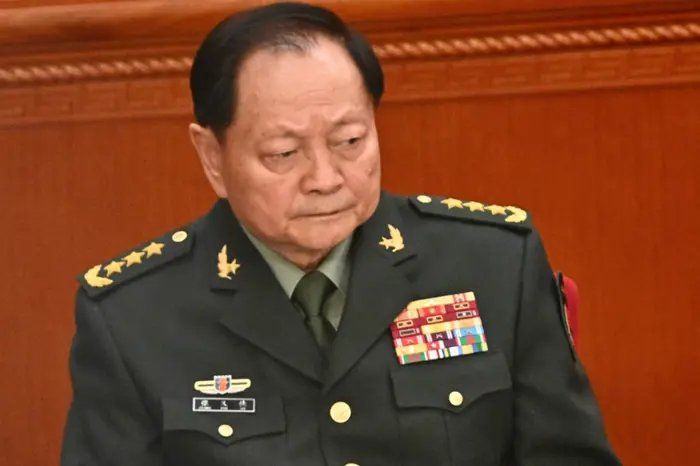
China's government has formally removed General Zhang Youxia from his position as vice chairman of the Central Military Commission, according to an official announcement made through state media on Friday. The decision follows months of investigation into allegations of serious disciplinary and legal violations, a standard phrase used by Beijing when describing corruption cases. The removal marks a significant turning point in the career of one of China's most senior military figures, whose fall from grace has caught observers off guard given his prominent standing within the armed forces and perceived proximity to President Xi Jinping's inner circle.
Zhang's ousting represents another chapter in the broader anti-corruption campaign that has characterised Xi Jinping's leadership since taking power. The purges have touched virtually every level of government and military structure, with dozens of senior officials detained or removed during the past decade. Yet the removal of someone of Zhang's rank and apparent favour with the president underscores how the campaign continues to reshape the power dynamics within China's security apparatus, suggesting that no position, however senior or seemingly secure, remains immune from investigation.
The investigation into Zhang was formally announced in January, when the defence ministry declared that both he and Liu Zhenli, another high-ranking officer, were under investigation for "suspected serious violations of discipline and the law". This phrasing carries significant weight in Chinese government communications, functioning as official code for corruption-related offences. The simultaneous announcement regarding both officials suggested a broader pattern of impropriety within the military establishment, though details about the specific allegations have remained largely opaque.
As the more senior of two vice chairmen serving on the Central Military Commission, Zhang held the distinction of being China's highest-ranking military officer. His position placed him at the apex of a tightly controlled military hierarchy, overseeing vast resources and personnel spanning the People's Liberation Army's various branches. The CMC itself serves as the paramount authority for military affairs in China, answering directly to the president and constituting one of the most powerful bodies in the entire governmental structure. Zhang's elevation to this role had represented the pinnacle of his four-decade military career, making his removal particularly noteworthy within defence circles.
Alongside Zhang, Liu Zhenli has also been dismissed from the military commission. Liu previously served as chief of staff of the CMC's joint staff department, an organisation responsible for overseeing combat planning and military operations strategy. The joint staff department holds considerable influence over China's military readiness and strategic planning, making Liu's position another critically important post. The simultaneous removal of both men suggests coordinated action against what investigators may have characterised as a network of related violations, though the authorities have disclosed little about any connections between the two cases.
The formal removal was announced through Xinhua, the state news agency, during a meeting of the standing committee of China's parliament. The parliamentary standing committee possesses broad constitutional authority over military appointments and removals, providing the legal mechanism through which such administrative decisions are formalised. The decision to process the removal through this body rather than announcing it through the military hierarchy itself may reflect the civilian authority's intention to assert institutional oversight during sensitive personnel matters.
For regional observers monitoring Chinese military developments, Zhang's removal carries implications extending beyond simple personnel turnover. The general had cultivated a reputation as a moderniser within the armed forces, advocating for technological advancement and operational reform during a period when China has substantially increased military spending and capability. His departure may signal shifts in strategic direction or influence within the military leadership, potentially affecting how Beijing approaches defence modernisation initiatives and regional security postures in coming years.
The corruption investigation touching Zhang represents part of a larger pattern within Xi Jinping's governance model, wherein anti-graft campaigns serve simultaneously as mechanisms for consolidating power and reshaping institutional loyalties. High-profile removals of military and civilian officials create space for Xi's preferred candidates to rise through the ranks, gradually reconstituting the leadership structure around trusted subordinates. This approach has proven highly effective in concentrating authority, though it has also created an atmosphere of uncertainty and mutual suspicion among China's elite.
Zhang's case carries particular resonance because of the perception among foreign analysts and Chinese observers alike that he enjoyed Xi's confidence. The general had served alongside Xi in various capacities during his political ascent and was considered part of the president's inner circle of trusted military advisers. The investigation and removal thus suggest that even those believed to enjoy presidential favour remain vulnerable to investigation, a development that may reinforce caution and compliance among other senior military figures contemplating any independent action or initiative.
The removal also reflects evolving dynamics within the Chinese security establishment as it confronts modernisation pressures, budgetary constraints, and competition for influence among various military services and bureaucratic agencies. The investigations into Zhang and Liu may have targeted not merely individual misconduct but also broader patterns of resource misallocation, procurement irregularities, or factional disputes that have plagued military institutions. Such structural issues have reportedly vexed senior leadership for years, prompting the anti-corruption campaign as one mechanism for enforcing fiscal discipline and institutional accountability.

