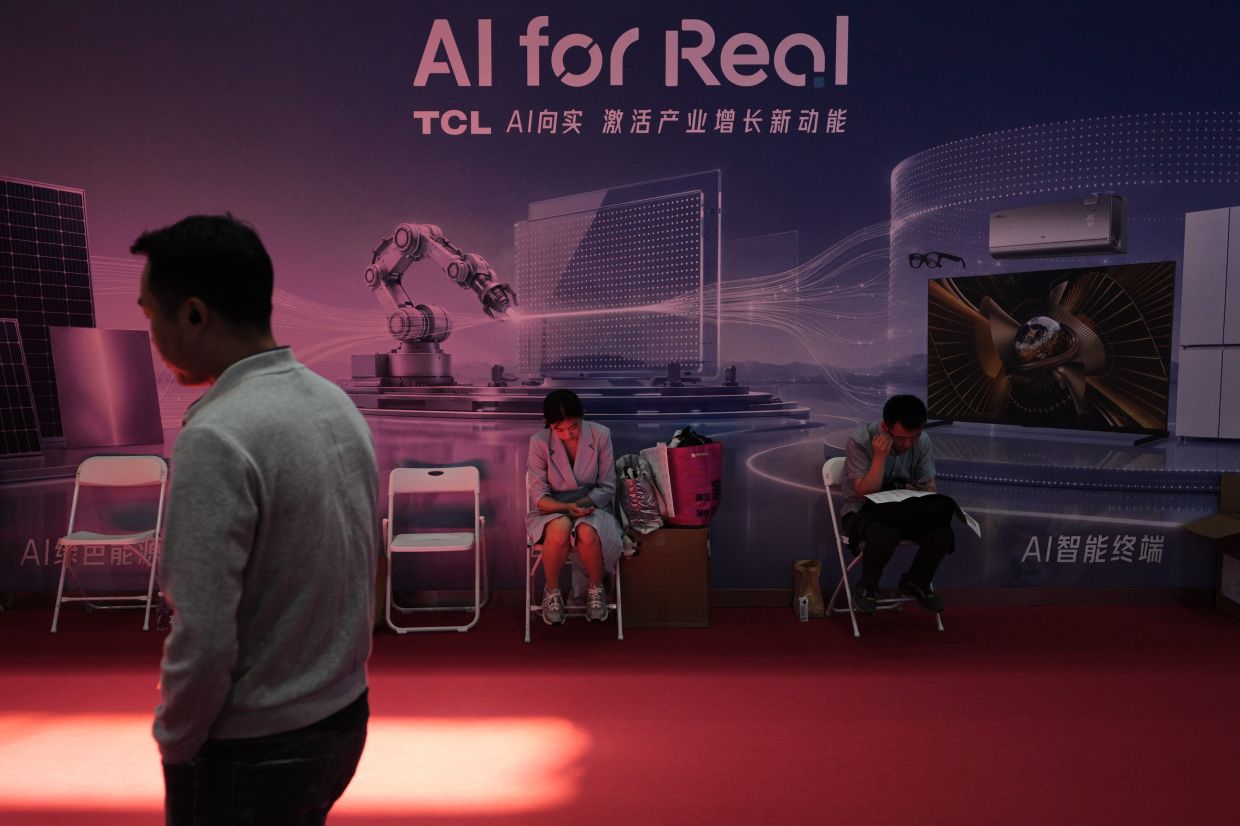
China's workforce is navigating unprecedented technological disruption as artificial intelligence, propelled by supportive government policies, fundamentally reshapes employment across nearly every sector of the world's second-largest economy. The phenomenon is creating a complex landscape where some workers embrace AI tools to stay competitive while others face displacement, raising broader questions about whether sustained economic growth can withstand such rapid workforce transformation. Unlike the widespread anxiety about AI in Western countries, attitudes in China remain relatively measured, yet the tangible impact on livelihoods is undeniable and intensifying.
The government's active role in promoting AI adoption distinguishes China's approach from other major economies. Through initiatives including the "AI Plus" strategy and a five-year plan extending through 2030, Beijing is deliberately accelerating AI integration across industries to strengthen competitive advantage against the United States. This top-down encouragement means deployment happens faster and more comprehensively than in markets driven purely by market forces. Approximately 47.5 per cent of Chinese industrial enterprises reported using AI models and agents last year, a dramatic increase from just 9.6 per cent in 2024, according to market intelligence firm IDC. This acceleration reflects both technological advancement and explicit policy backing that creates powerful incentives for businesses to adopt automation regardless of employment consequences.
Workers in technology and creative fields are experiencing the most immediate disruption. Computer programmers face particular vulnerability, as AI systems have reached sufficient capability that mid-level coding tasks are increasingly replaceable. Script writers, translators, and multimedia creators are similarly affected, with some industries experiencing catastrophic contraction—short-form video production fell roughly 75 per cent in the first quarter of this year compared to the previous year. Humanoid robots now sort parcels in postal centres and are expanding into roles like traffic direction and coffee preparation. Food delivery robots pose existential threats to millions of Chinese workers in that sector. These changes are not hypothetical future scenarios but present realities reshaping employment patterns immediately.
The translation profession exemplifies how AI is fundamentally altering compensation structures and career prospects. Part-time translator Du Qinchun has found himself training AI models that ultimately displace his peers, while compensation across the translation industry has been slashed by more than half compared to previous years. This pattern is driving students away from foreign language university programmes at an accelerating rate. College-age workers making career decisions now avoid fields they recognise as vulnerable to automation, potentially creating skill shortages in these sectors even as AI tools proliferate. The psychological calculus for young people entering the workforce has shifted dramatically within just a few years.
Despite widespread job losses, Chinese workers display surprisingly limited anti-AI sentiment compared to counterparts in Western nations. According to Shujing He, a senior analyst at research firm Plenum, most Chinese workers view AI with either positivity or neutral acceptance. Critically, those displaced from traditional employment often exhibit enthusiasm for experimenting with AI-enabled businesses and independent ventures. This willingness to adapt partly reflects pragmatism—individuals recognise that resistance is futile when competitors embrace AI, making adoption a necessary survival strategy rather than a choice. Programmers like 40-year-old Fei acknowledge that mid-level coding work is essentially replaceable and that refusing to use AI simply puts workers at further disadvantage compared to those who integrate it into their practices.
The economic implications of mass employment disruption extend far beyond individual job losses. China's economic growth has already decelerated, with consumer spending lagging partly because workers are increasingly reluctant to spend when facing precarious employment situations. This creates a vicious cycle where automation reduces labour income, which suppresses consumption, which slows overall economic growth. The housing market's prolonged downturn has further undermined household wealth, amplifying anxieties about job security. Eswar Prasad, professor of trade policy at Cornell University, warns that while AI will likely boost productivity across the board, it threatens severe disruption to employment patterns and could worsen China's existing employment growth problems, with consequences for social stability.
Current unemployment statistics mask the severity of the emerging challenge. While China's overall urban unemployment rate hovers around five per cent, youth unemployment for people aged 16 to 24 (excluding students) is approximately triple that rate, suggesting that young workers entering the labour market face particularly hostile conditions. Major Chinese technology companies have already conducted large-scale layoffs and restructurings, with AI playing a significant role in justifying workforce reductions. These companies, despite their technological sophistication and high productivity levels, are not creating sufficient new employment opportunities to absorb displaced workers. The gap between automation speed and job creation capacity continues widening.
However, demographic realities may eventually reverse employment pressures in China's favour. The nation's population of 1.4 billion is aging and shrinking at an accelerating rate. Projections indicate that by 2050, China will have fewer than two working-age adults to support each retiree, compared with more than 2.5 in the United States. This demographic cliff means that automation could eventually address labour shortages rather than exacerbate unemployment. Xuenan Cao, professor at San Francisco Bay University, suggests that AI-driven automation might partially offset the disruptive effects of a shrinking workforce by extending productive capacity even as the absolute number of workers declines. The immediate disruption may appear counterproductive, but within a longer timeframe, automation could become essential infrastructure for maintaining economic functionality.
Workers who remain employed in fields partially affected by AI are developing pragmatic integration strategies. Scriptwriter Wang Zhicheng used AI tools for brainstorming and fact-checking while recognising that AI-generated content often felt repetitive, formulaic, and inadequately detailed. After his company laid off half its script writing team, he transitioned to independent work creating illustrated children's books. His approach treats AI as a tool analogous to Microsoft Word—useful for specific functions but requiring human judgment for decision-making about which outputs to develop further. This distinction between AI as an enhancement tool versus AI as a replacement system shapes how some workers maintain relevance. Teachers like Yang Zheng report confidence in their positions despite students using AI for homework assistance, recognising that their roles encompassing pedagogy, motivation, and personalised guidance extend beyond what technology can currently replace.
The gender dimension of AI-driven employment disruption adds another layer of complexity to China's economic transition. International Labour Organization research demonstrates that women face higher displacement risks than men because they are disproportionately concentrated in occupations particularly suitable for automation, such as electronics assembly and routine data processing. Simultaneously, women remain significantly underrepresented in science and technology sectors where new employment opportunities are emerging. This creates structural inequality where women bear disproportionate burdens from automation while remaining excluded from growth sectors. China's heavily male-dominated technology industry may perpetuate these patterns unless deliberate policy interventions ensure equitable access to retraining and emerging opportunities.
China's distinctive approach—combining rapid AI adoption with government policy encouragement across all economic sectors—creates a real-world laboratory for understanding how societies navigate technological disruption at scale. Unlike Western economies where market forces drive slower, more fragmented adoption, China's coordinated approach compresses decades of potential adjustment time into years. This simultaneously demonstrates both the productivity potential and the social costs of accelerated automation. Oxford China Policy Lab researcher Zilan Qian notes that China's government commitment to diffusing AI across the economy means technological penetration will occur faster and more comprehensively than in countries relying on market-driven adoption. Understanding how China manages this transition carries implications for other nations facing similar pressures.
The path forward remains uncertain but increasingly urgent. China's leaders must balance productivity gains from AI against employment stability necessary for social cohesion and sustained consumer demand. Current statistics suggest the adjustment is proceeding more rapidly than the economy can absorb displaced workers into new opportunities. Workers themselves are adapting individually—some retraining, others experimenting with entrepreneurship, others accepting reduced circumstances—but without coordinated national strategy for managing transitions, friction and inequality will likely increase. The coming years will reveal whether China's unique combination of government direction, technological sophistication, and worker adaptability can navigate this transformation successfully, or whether the employment disruption ultimately undermines the economic growth that justifies the investment in AI in the first place.

