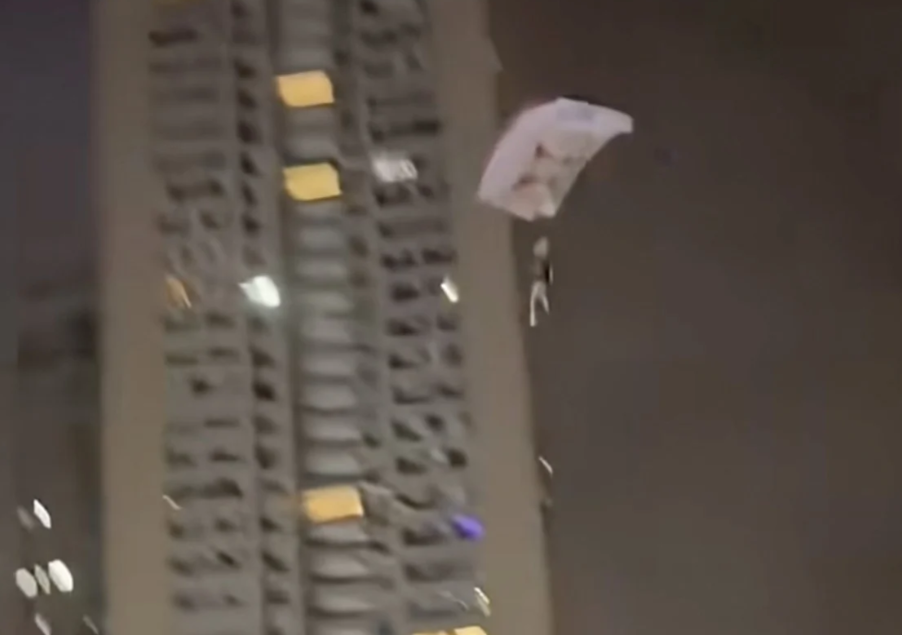
A 23-year-old man in Chengdu, Sichuan province, has landed in serious legal trouble after executing a parachute jump from the roof of a residential tower in a densely populated neighbourhood. The incident on June 30 at 11pm marked another example of content creators pursuing dangerous stunts for online engagement in mainland China, where authorities are increasingly cracking down on such behaviour that jeopardises both individual and public safety.
The man, identified as Ren, filmed his jump and later shared footage on social media platforms where he maintained an account under the pseudonym "Parachute Coach Kakaxi" with approximately 60,000 followers. The video documentation revealed the precarious nature of the jump, showing him descending dangerously close to nearby residential buildings and trees—a scenario that posed clear risks to anyone below or in adjacent structures. Rather than recognising the danger, Ren's primary motivation appeared to be generating traffic and engagement for his online presence, a calculation that ultimately led to police intervention.
Authorities from the Chenghua district police department responded swiftly, detailing how Ren's actions violated multiple public order regulations. The stunt was classified as seriously disturbing public order while simultaneously endangering community safety. As a result, Ren faced administrative detention lasting up to 15 days under Chinese law, and was subsequently prohibited from accessing social media platforms—a significant penalty in a country where online presence constitutes a primary income source for many content creators and influencers.
Investigation revealed further complications with Ren's claims. While he marketed himself as a parachute coach on social media, police verification determined that he lacked proper licensing credentials required to operate professionally in that capacity. This discrepancy between his claimed expertise and actual qualifications adds another layer to the case, suggesting he was not only performing an illegal stunt but also misrepresenting his professional standing to his followers. Records indicated this was not an isolated incident—police uncovered footage from May 2024 showing him conducting a similar parachute jump from another residential building, suggesting a pattern of repeated violations.
The regulatory framework surrounding skydiving in China explicitly permits the activity only with advance official authorisation and exclusively within designated zones designated by authorities. Public venues including downtown building rooftops, residential towers, and bridges are strictly off-limits for parachuting without special permission. Police warnings accompanying the case made abundantly clear that individuals violating these restrictions through aerial stunts in high-density population areas face severe penalties, signalling the government's determination to prevent further copycat incidents.
The incident sparked considerable debate among mainland social media users, many of whom expressed alarm at both the immediate danger and the broader implications. Commenters highlighted the risk of harm to unsuspecting residents below, emphasising that Ren's pursuit of viral content had effectively transformed neighbourhood residents into unwilling participants in his dangerous stunt. Several users argued for harsher penalties, suggesting that without substantial consequences, others might attempt similar acts for online attention. This public response reflects growing frustration with content creators prioritising engagement metrics over community welfare.
Ren's case exemplifies a recurring pattern in contemporary China where influencers and aspiring online personalities pursue increasingly extreme activities to differentiate themselves in saturated digital markets. The prevalence of such behaviour has prompted authorities nationwide to establish clearer boundaries and implement consistent enforcement. Just weeks before Ren's incident, another content creator in Zhejiang province faced police action after uploading a video demonstrating reckless highway driving at 152 kilometres per hour while simultaneously filming on a mobile phone. That driver incurred substantial penalties including nine demerit points from his annual 12-point driving licence allocation and a 250 yuan fine, demonstrating that law enforcement extends beyond building-related violations.
The consequences of this phenomenon extend beyond administrative penalties and legal troubles. The case evokes memories of blogger Wu Yongning, who died in 2017 from physical exhaustion while conducting a live-streamed climb of a 260-metre building in Hunan province without safety equipment. Wu had justified his dangerous pursuits as necessary to earn funds for his mother's medical treatment, yet his death underscored the lethal potential of such activities. His tragedy serves as a cautionary backdrop for current enforcement efforts, illustrating why authorities view stunts like Ren's with such seriousness.
For Malaysian and Southeast Asian readers, Ren's case offers relevant insights into how digital economies can incentivise dangerous behaviour, particularly among younger content creators competing for attention. The regulatory response in China—combining administrative detention, social media bans, and public warnings—represents one approach to managing the externalities of attention-driven content creation. As Southeast Asian countries develop their own digital governance frameworks, the question of how to balance creative expression and platform freedoms against public safety remains complex. Ren's detention signals that Chinese authorities view such incidents not merely as individual recklessness but as systemic challenges requiring firm intervention to protect communities from the collateral damage of viral content pursuits.

